
Superconductivity is a complete loss of electrical resistance. Superconductors are not merely very good metals: it is a fundamentally different electronic state. In normal metals, electrons move individually, and they collide with defects and vibrations in the lattice. In superconductors, electrons are bound together by an attractive force, which allows them to move together in a correlated way and avoid defects. In a very small number of known superconductors, the onset of superconductivity causes spontaneous electrical currents to flow. These…
University of Pittsburgh chemical engineers replicate “swarmalator” behavior in chemical sheets. During the swarming of birds or fish, each entity coordinates its location relative to the others, so that the swarm moves as one larger, coherent unit. Fireflies on the other hand coordinate their temporal behavior: within a group, they eventually all flash on and off at the same time and thus act as synchronized oscillators. Few entities, however, coordinate both their spatial movements and inherent time clocks; the limited…
New experimental findings cast in doubt 90-year-old theoretical model of the transition state in chemical reactions. Research by a team of chemists at the University of Toronto, led by Nobel Prize-winning researcher John Polanyi, is shedding new light on the behaviour of molecules as they collide and exchange atoms during chemical reaction. The discovery casts doubt on a 90-year old theoretical model of the behavior of the “transition state”, intermediate between reagents and products in chemical reactions, opening a new…
Piezoelectric wood Ingo Burgert and his team at Empa and ETH Zurich has proven it time and again: Wood is so much more than “just” a building material. Their research aims at extending the existing characteristics of wood in such a way that it is suitable for completely new ranges of application. For instance, they have already developed high-strength, water-repellent and magnetizable wood. Now, together with the Empa research group of Francis Schwarze and Javier Ribera, the team has developed…
Cryoprotectants are used to protect biological material during frozen storage They have to be removed when defrosting, and how much to use and how exactly they inhibit ice recrystallisation is poorly understood The polymer poly(vinyl)alcohol (PVA) is arguably the most potent ice recrystallisation inhibitor and researchers from the University of Warwick have unravelled how exactly it works. This newly acquired knowledge base provides novel guidelines to design the next generation of cryoprotectants When biological material (cells, blood, tissues) is frozen,…
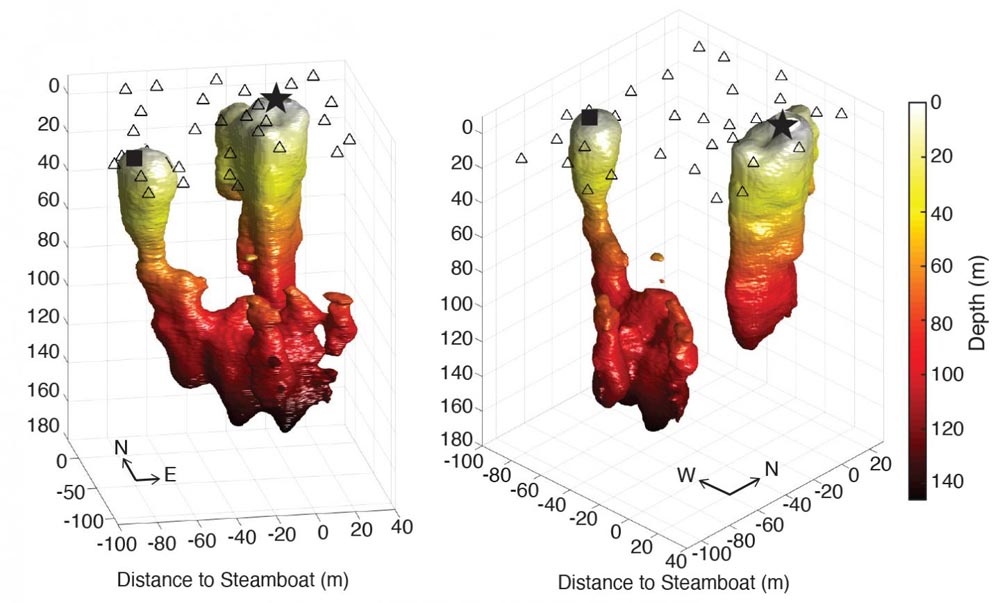
When Steamboat Geyser, the world’s tallest, started erupting again in 2018 in Yellowstone National Park after decades of relative silence, it raised a few tantalizing scientific questions. Why is it so tall? Why is it erupting again now? And what can we learn about it before it goes quiet again? The University of Utah has been studying the geology and seismology of Yellowstone and its unique features for decades, so U scientists were ready to jump at the opportunity to…
Just a few hours instead of weeks KI and HSI enable new inspection system to quickly measure foil quality for organic electronics with high spatial resolution All over the world, researchers are focusing on protecting organic light-emitting diodes, solar cells and circuits against humidity and other harmful environmental impacts by using improved foils. The idea is to make organic electronics components more robust and thus more durable. At the “LOPEC” trade fair in March 2021, the Fraunhofer Institute for Material…
Innovative biotechnological process extracts gallium from industrial wastewater Gallium is a rare metal, but it is widely used in the high-tech industry. This extreme contrast makes recycling indispensable. However, current recycling processes are costly and chemically polluted. Biotechnological approaches, therefore, rely on peptides, as they are able to bind metallic particles, minerals and metal ions in an environmentally friendly manner and to differentiate them in a targeted manner. Scientists at the Helmholtz Institute Freiberg for Resource Technology (HIF) at the…
30 years of ASDEX Upgrade – Operating modes developed for JET, ITER and DEMO / only tungsten machine worldwide On 21 March 1991, the ASDEX Upgrade experimental device at Max Planck Institute for Plasma Physics (IPP) in Garching/Germany generated its first plasma. The task of this most powerful national fusion device of the tokamak type in Europe is to investigate core research questions under power plant-like conditions. For 30 years now, ASDEX Upgrade has been working on plasma scenarios…
Magnetic reconnection refers to the reconfiguration of magnetic field geometry. It plays an elemental role in the rapid release of magnetic energy and its conversion to other forms of energy in magnetized plasma systems throughout the universe. Researchers led by Dr. LI Leping from the National Astronomical Observatories of the Chinese Academy of Sciences (NAOC) analyzed the evolution of magnetic reconnection and its nearby filament. The result suggested that reconnection is significantly accelerated by the propagating disturbance caused by the…
Optical-resolution photoacoustic microscopy innovation enables simultaneous multicontrast imaging with shorter imaging time and improved accuracy. Optical-resolution photoacoustic microscopy (OR-PAM), a new hybrid imaging technique, allows us to listen to the sound of light and see the color of biological tissue itself. It can be used for live, multicontrast functional imaging, but the limited wavelength choice of most commercial lasers and the limitations of the existing scanning methods have meant that OR-PAM can obtain only one or two different types of…
Robotics researchers are developing exoskeletons and prosthetic legs capable of thinking and moving on their own using sophisticated artificial intelligence (AI) technology. The system combines computer vision and deep-learning AI to mimic how able-bodied people walk by seeing their surroundings and adjusting their movements. “We’re giving robotic legs vision so they can control themselves,” said Brokoslaw Laschowski, a PhD candidate in systems design engineering who leads a University of Waterloo research project called ExoNet. Exoskeletons and prosthetic devices operated by…
International team of researchers investigates how evolution forms the structure and function of a newly emerged protein in flies. Proteins are the key component in all modern forms of life. Haemoglobin, for example, transports the oxygen in our blood; photosynthesis proteins in the leaves of plants convert sunlight into energy; and fungal enzymes help us to brew beer and bake bread. Researchers have long been examining the question of how proteins mutate or come into existence in the course of…
Nanomaterials of perovskite dispersed in hexane and irradiated by laser; light emission by these materials is intense thanks to resistance to surface defects. Quantum dots are manmade nanoparticles of semiconducting material comprising only a few thousand atoms. Because of the small number of atoms, a quantum dot’s properties lie between those of single atoms or molecules and bulk material with a huge number of atoms. By changing the nanoparticles’ size and shape, it is possible to fine-tune their electronic and…
Astronomers have painted their best picture yet of an RV Tauri variable, a rare type of stellar binary where two stars – one approaching the end of its life – orbit within a sprawling disk of dust. Their 130-year dataset spans the widest range of light yet collected for one of these systems, from radio to X-rays. “There are only about 300 known RV Tauri variables in the Milky Way galaxy,” said Laura Vega, a recent doctoral recipient at Vanderbilt…
UChicago study finds way that hot, rocky planets in other systems could form and keep atmospheres. An atmosphere is what makes life on Earth’s surface possible, regulating our climate and sheltering us from damaging cosmic rays. But although telescopes have counted a growing number of rocky planets, scientists had thought most of their atmospheres long lost. However, a new study by University of Chicago and Stanford University researchers suggests a mechanism whereby these planets could not only develop atmospheres full…
 Feedback


