
New study finds that the nutritional value of prey within a single species can widely vary, offering key insights for food web dynamics and ecosystem change The hunt is on and a predator finally zeroes in on its prey. The animal consumes the nutritious meal and moves on to forage for its next target. But how much prey does a predator need to consume? Following a period of massive starvation among animals living along the California coast, University of California…

Melting causes accelerated ice loss at tidewater glaciers, releasing pressurized bubbles. As the world’s temperatures rise, tidewater glaciers are receding and melting, releasing air trapped in the ice. Scientists can listen to the release of the air and potentially use the sounds to help them gauge the impact of climate change on the ice floes. During the 181st Meeting of the Acoustical Society of America, which will be held Nov. 29-Dec. 3, Hayden Johnson, from the University of California, San…
An international group of researchers led by the Paul Scherrer Institute and the Heriot-Watt University has carried out in-depth analyses of the climate impact of blue hydrogen. This is produced from natural gas, with the CO2 resulting from the process captured and stored. The study, published in the Royal Society of Chemistry’s journal Sustainable Energy & Fuels, concludes that blue hydrogen can play a positive role in the energy transition – under certain conditions. Hydrogen is an energy carrier of…
Coastal organisms thrive on floating plastic debris in the “great pacific garbage patch”. Coastal plants and animals have found a new way to survive in the open ocean—by colonizing plastic pollution. A new commentary published Dec. 2 in Nature Communications reports coastal species growing on trash hundreds of miles out to sea in the North Pacific Subtropical Gyre, more commonly known as the “Great Pacific Garbage Patch.” “The issues of plastic go beyond just ingestion and entanglement,” said Linsey Haram,…
A new study detects the unique seismological signature of an electron spin crossover in the deep Earth. Most are aware that electrons are negatively charged particles that surround the nucleus of atoms and whose behaviour governs chemical interactions. However, it is less commonly known that electrons come in two distinct kinds: spin-up and spin-down. And the tendency for pairing between up and down spin electrons, forming “dance partners” with one another, is one of the most important behaviours affecting the…
The Arctic Ocean has been getting warmer since the beginning of the 20th century – decades earlier than records suggest – due to warmer water flowing into the delicate polar ecosystem from the Atlantic Ocean. An international group of researchers reconstructed the recent history of ocean warming at the gateway to the Arctic Ocean in a region called the Fram Strait, between Greenland and Svalbard. Using the chemical signatures found in marine microorganisms, the researchers found that the Arctic Ocean…
A new Study provides critical insights into ice mass loss in Antarctica. After the natural warming that followed the last Ice Age, there were repeated periods when masses of icebergs broke off from Antarctica into the Southern Ocean. A new data-model study led by the University of Bonn (Germany) now shows that it took only a decade to initiate this tipping point in the climate system, and that ice mass loss then continued for many centuries. Accompanying modeling studies suggest…
New mineral from Earth’s lower mantle surfaced as diamond inclusion; study led by UNLV geochemist Oliver Tschauner. UNLV geochemists have discovered a new mineral on the surface of the Earth. There’s just one catch: it shouldn’t be here. The mineral — entrapped in a diamond — traveled up to the surface from at least 410 miles deep within the Earth’s lower mantle, the area between the planet’s core and crust. It’s the first time that lower mantle minerals have ever…
New observations of the atomic structure of iron reveal it undergoes “twinning” under extreme stress and pressure. Far below you lies a sphere of solid iron and nickel about as wide as the broadest part of Texas: the Earth’s inner core. The metal at the inner core is under pressure about 360 million times higher than we experience in our everyday lives and temperatures approximately as hot as the Sun’s surface. Earth’s planetary core is thankfully intact. But in space,…
Researchers take a granular look at global inputs and impacts of human wastewater in coastal ecosystems. The tendency for most of us when it comes to human wastewater is out of sight, out of mind. Rarely do we consider what happens after we flush that toilet or turn off that tap. However, researchers at UC Santa Barbara have turned their attention and considerable computational power to the subject and its impacts on global coastal ecosystems. The results aren’t pretty, but…
The project “Drilling Overdeepened Alpine Valleys (DOVE)”, part of the “International Continental Scientific Drilling Program” (ICDP), aims to reconstruct the spatial and temporal climate development during the ice ages up to 2.6 million years ago and show their influence on the landscape development in the entire Alpine region. To this end, the Leibniz Institute for Applied Geophysics (LIAG), in cooperation with the Albert Ludwig University of Freiburg and the Geological Survey in Freiburg (LGRB), carried out three research boreholes in…
PNAS publication: In a laboratory experiment, MARUM researchers simulate alternative hydrocarbon formation through reduction of acetic acid. The isotopic compositions of hydrocarbon compounds are like a fingerprint. They can clearly indicate the way in which hydrocarbons like methane, ethane, propane, butane and pentane are formed. When hydrocarbons are combusted, water and carbon dioxide are produced and energy is released. Hydrocarbons, including crude oil and natural gas, are formed over geological time periods under high temperatures and pressures, and researchers can…
After 200 years of absence due to historic human pressures that once threatened their existence, New Zealand sea lions are returning to New Zealand’s mainland in an emerging story of conservation success and complex opportunities. Dr. Jan O. Engler, a post-doctorate at Chair for Computational Landscape Ecology at Technische Universität Dresden, joined an international team of ecologists and conservationists to map suitable habitats for these endangered New Zealand sea lions and help managers welcome them home. Led by Michigan State…
Researchers find that most coralline algae are negatively affected by ocean acidification, but some species may be more resilient than others. Scientists have long suspected that coralline algae are particularly sensitive to changes in ocean chemistry. Now, researchers have found that most species of coralline algae studied are negatively affected by ocean acidification. In a new study published in Global Change Biology, an international team, including researchers from the University of Tsukuba, revealed that lower seawater pH is associated with…
Study sheds light on the evolution of underground microbes. A new study sheds light on the evolutionary history of what might be the most elusive form of life on Earth: the deep biosphere – a hidden realm of microbes inhabiting the upper few kilometers of Earth’s crust. Deep, dark fractures reaching far down into the oldest rocks on Earth may seem about as hospitable to life as outer space, but some estimates suggest that microbes dwelling deep in the Earth’s…
Coral reef ecosystems are severely threatened by climate change. The urgent need to address the issue is driving a new era of innovation in reef science, shown by a global multidisciplinary exploration of different approaches to enhance coral resilience. An international team including KAUST professors Manuel Aranda and Raquel Peixoto, with adjunct professor Chris Voolstra, have proposed an adaptive framework to increase the resilience of corals in the face of climate change. The team proposes integrating current approaches that center…
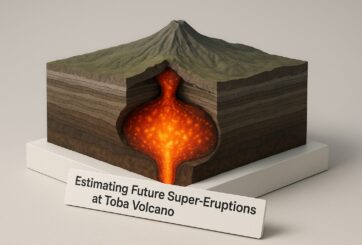
Geologists from the UNIGE and Peking University have developed a technique that makes it possible to estimate the maximum size of a future super-eruption of Toba volcano in Sumatra. It is estimated that about 5-10 volcanoes worldwide are capable of producing a super-eruption that could catastrophically affect global climate. One of these volcanoes hides below the waters of Lake Toba in Sumatra and has caused two super-eruptions in the last one million year. But when will the next one be?…
 Feedback


