
New study finds that the nutritional value of prey within a single species can widely vary, offering key insights for food web dynamics and ecosystem change The hunt is on and a predator finally zeroes in on its prey. The animal consumes the nutritious meal and moves on to forage for its next target. But how much prey does a predator need to consume? Following a period of massive starvation among animals living along the California coast, University of California…

Fish used visual differences between divers to recognize the person who rewarded them For years, scientific divers at a research station in the Mediterranean Sea had a problem: at some point in every field season, local fish would follow them and steal food intended as experimental rewards. Intriguingly these wild fish appeared to recognize the specific diver who had previously carried food, choosing to follow only them while ignoring other divers. To find out if that was true, a team…
Feeding success and demography of a marine mammal provide a multi-decadal ecological baseline to assess impacts of a new fishery and environmental change Over the past 60 years, marine biologists at UC Santa Cruz have monitored the behavior of northern elephant seals that journey to nearby Año Nuevo Natural Reserve. With the seals gathering on the beach by the thousands to breed and molt, generations of researchers have been able to amass more than 350,000 observations on over 50,000 seals….
From beaver dams to termite mounds, research uncovers the extraordinary role of animals in shaping our planet Animals are not just inhabitants of the natural world—they are its architects. A new study led by Professor Gemma Harvey from Queen Mary University of London has revealed how hundreds of species shape the landscapes we depend on, from vast termite mounds visible from space to hippos carving drainage systems and beavers creating entire wetlands. Published in Proceedings of the National Academy of…
Phytoplankton use sunlight to make energy and nearly half the oxygen we breathe, a new tool improves our ability to measure how individual phytoplankton cells are using energy Phytoplankton, tiny plant-like organisms in the ocean, are incredibly important for life on Earth. They’re a major food source for many sea creatures and produce almost half the oxygen we breathe. They also help control the climate by soaking up a lot of carbon dioxide, a gas that contributes to global warming….
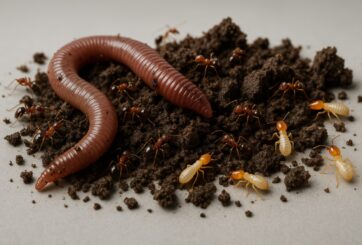
A new Nature publication shows how soil invertebrates influence the world beneath our feet and thus also ecosystem services worldwide. Based on a press release from Sun Yat-senUniversity Since the Industrial Revolution, global changes have led to a decline in biodiversity. To address these changes, it is crucial to understand what constitutes healthy ecosystems – and how to protect and build them. A new meta-analysis by an international research team, including Prof. Nico Eisenhauer from the German Centre for Integrative…
Polythioenones: a step toward a circular economy for synthetic polymers The possibilities for material design and production of plastic components are being expanded through 3D printing technology. However, there is a shortage of recyclable polymers that meet the performance requirements. In the journal Angewandte Chemie, a research team has introduced a new class of polymers called polythioenones, which are mechanically and chemically recyclable and suitable for 3D printing. They also demonstrate better mechanical properties than conventional polyolefins—thanks to a special,…
Despite 2023 and 2024 ranking as the warmest years on record, extreme cold events still gripped parts of China, Europe, and North America. A new study published in npj Climate and Atmospheric Science investigates the paradox of these record-breaking cold spells and assesses future risks in a changing climate. Led by Professor Qian Cheng from the Institute of Atmospheric Physics at the Chinese Academy of Sciences, in collaboration with Dr. Aiguo Dai from the University at Albany, State University of New York,…
A new study has uncovered a novel P-type PPR protein, BoYgl-2, which plays a crucial role in chloroplast RNA editing and chlorophyll biosynthesis in cabbage. This discovery sheds new light on the molecular mechanisms governing leaf color formation and chloroplast development, filling a significant knowledge gap in plant physiology. By identifying a spontaneous yellow-green leaf mutant and deciphering the function of BoYgl-2, the research paves the way for innovative crop breeding strategies that could enhance plant productivity and agricultural sustainability….
The National Champion Tree Program to take nominations for next register through August The National Champion Tree Program (NCTP) will take nominations for new Champion Trees on its website starting February 28. The list of eligible tree species for the 2025-2026 register includes more than 1,200 species of trees native and naturalized to the U.S., a steep increase from the 900 species eligible for the 2024 register. It is available online in the Register of Champion Trees. Nominations for potential Champions will stay…
A new strain of kelp can help support sustainable farming Like most aquatic vegetation, kelp is being negatively impacted by climate change. Warming ocean temperatures have led to shorter growing and harvesting seasons, including for sugar kelp, one of the most commonly farmed kelp species. The loss of kelp populations can significantly impact ecosystems, and potentially the growing demand for sustainably farming food, feed, fertilizer, medicine, and cosmetics. To give kelp a chance against climate change, scientists from the Woods…
DURHAM, N.C. — The world’s largest known lithium deposit exists within a vast salt pan called the Salar de Uyuni, which stretches for thousands of square miles atop a high, dry Andean plateau in Bolivia. For most of the year, salt crystals encrust the terrain, white as confectioner’s sugar. During the wet season, pooling rainwater mirrors surrounding mountains and sky. “The Salar is a magical place for travelers from all over the world who come to see the colors, the…
A system-wide evaluation of California’s marine reserve network finds conservation benefits across multiple ecosystems (Santa Barbara, Calif.) — It’s 1999, the 21st century is on the horizon, and California has big plans for marine conservation. New legislation has presented a mandate to establish an ambitious network of marine protected areas (MPAs) unlike anywhere else in the world. The goal is to craft strategic protections to safeguard the state’s marine life for preservation and economic benefits alike. Now 25 years later,…
Researchers have developed a sustainable catalyst that increases its activity during use while converting carbon dioxide (CO2) into valuable products. This discovery offers a blueprint for designing next-generation electrocatalysts. A collaborative team from the University of Nottingham’s School of Chemistry and the University of Birmingham have developed a catalyst made of tin microparticles supported by a nanotextured carbon structure. The interactions between the tin particles and graphitised carbon nanofibers play a critical role in transferring electrons from the carbon electrode…
Research shows health and economic costs of air pollution in Japan Air pollution is a growing health issue worldwide, and its impacts are often underestimated in aging societies like Japan. A new study led by researchers from the University of Tokyo highlights how fine particulate pollution, or PM2.5, not only worsens health outcomes, but also creates significant socioeconomic challenges in regions with aging populations and limited medical resources. The researchers hope these findings motivate policymakers to tackle the interrelated issues…
Niigata, Japan – The amount of carbon dioxide (CO2) released by microbial decomposition of soil organic carbon on a global scale is approximately five times greater than the amount of anthropogenic CO2 emissions. Thus, it is essential to clarify the impact of climate change on soil CO2 release dynamics. A collaborative research group consisting of Dr. Hirohiko Nagano and Ms. Yuri Suzuki of Niigata University with researchers of Kyushu University and the Japan Atomic Energy Agency conducted incubation experiments on…
A new study of the Great Barrier Reef has revealed that the network of no-take marine reserves supplies nearly half of the region’s coral trout fishery catch. The research, led by Professor Michael Bode from the QUT School of Mathematical Sciences and published in Science Advances, revealed that despite covering only 30 per cent of the reef’s habitat, these protected areas account for 47 per cent of the coral trout catch in fishing areas and contribute 55 per cent of…
 Feedback


