
Coastal forests in Japan had predominantly been afforested with black pine (Pinus thunbergii), a shade-tolerant tree species that can withstand dry land ecosystems and harsh coastal environments. This afforestation initiative, dating back to the Edo period (1603~1867), aimed to mitigate the deleterious effects of robust winds and sand blowing. Subsequent to the Great East Japan Earthquake in 2011, interest shifted to the potential protective effects of coastal forests in reducing the destructive power of tsunamis. The Great East Japan Earthquake…
…to reveal the expanding footprint of human activity at sea. Study reveals 75 percent of the world’s industrial fishing vessels are hidden from public view. A new study published today in the journal Nature offers an unprecedented view of previously unmapped industrial use of the ocean and how it is changing. The groundbreaking study, led by Global Fishing Watch, uses machine learning and satellite imagery to create the first global map of large vessel traffic and offshore infrastructure, finding a…
Using mechanical rather than statistical analysis, the team offers a new framework for understanding the climate system. An international team of scientists has found the first direct evidence linking seemingly random weather systems in the ocean with climate on a global scale. Led by Hussein Aluie, an associate professor in the University of Rochester’s Department of Mechanical Engineering and staff scientist at the University’s Laboratory for Laser Energetics, the team reported their findings in Science Advances. The ocean has weather…
The word “drought” typically conjures images of parched soil, dust-swept prairies, depleted reservoirs, and dry creek beds, all the result of weeks or seasons of persistently dry atmospheric conditions. In the sun-soaked islands in the Caribbean, however, drought conditions can occur much more rapidly, with warning signs appearing too late for mediation strategies to limit agriculture losses or prevent stresses on infrastructure systems that provide clean water to communities. Such occurrences – known as flash droughts – are the focus…
Researchers at the ITA, the University of Bonn and Heimbach GmbH have developed a new method for removing oil spills from water surfaces in an energy-saving, cost-effective way and without the use of toxic substances. The method is made possible by a technical textile that is integrated into a floating container. A single small device can remove up to 4 liters of diesel within an hour. This corresponds to about 100 m2 of oil film on a water surface. Despite…
Prof. Dr. Caroline Gutjahr, Director at the Max Planck Institute of Molecular Plant Physiology in Potsdam, has been awarded one of the highly prestigious Consolidator Grants from the European Research Council (ERC). In her project “SymbioticExchange”, she will investigate how the close coexistence of plants and friendly fungi in the soil works and how the exchange of nutrients between the symbiotic partners is regulated. Her findings could contribute to a new form of agriculture that considers fungi and plants in…
The ‘burrowing effect’ of foraminifera on marine environments. Impact of single-cell organisms on sediment oxygen levels and bacterial diversity measured for the first time. Dr. Dewi Langlet, a scientist at the Evolution, Cell Biology and Symbiosis Unit at the Okinawa Institute of Science and Technology (OIST), studies foraminifera, single-cell organisms with shells made of calcium carbonate. He and his collaborators have shown for the first time that the burrowing of single-celled organisms in marine ecosystems affects oxygen distribution and bacterial diversity in…
Unveiling CO2 absorption dynamics. Magnesium oxide is a promising material for capturing carbon dioxide directly from the atmosphere and injecting it deep underground to limit the effects of climate change. But making the method economical will require discovering the speed at which carbon dioxide is absorbed and how environmental conditions affect the chemical reactions involved. Scientists at the Department of Energy’s Oak Ridge National Laboratory analyzed a set of magnesium oxide crystal samples exposed to the atmosphere for decades, and another for…
TU Freiberg clarifies basis for innovative PFAS filter made of clay. PFAS filters available for industrial waste are usually made of activated carbon (PFAS = perfluorinated and polyfluorinated alkyl compounds). As this is comparatively expensive, researchers are looking for alternative filter materials for the so-called “eternal toxins”, whose hazardous residues only degrade very slowly in the environment. A team from the TU Bergakademie Freiberg is now proposing a clay made of bentonite modified with organic substances as a possible PFAS…
Himalayan glaciers react, blow cold winds down their slopes. Himalayan Glaciers fight back to preserve themselves, but for how long? An international team of researchers, co-led by Professor Francesca Pellicciotti of the Institute of Science and Technology Austria (ISTA), explains a stunning phenomenon: rising global temperatures have led Himalayan glaciers to increasingly cool the air in contact with the ice surface. The ensuing cold winds might help cool the glaciers and preserve the surrounding ecosystems. The results, found across the…
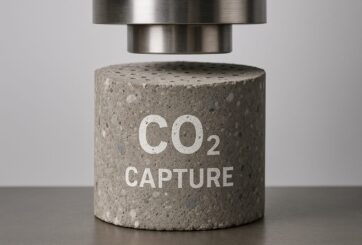
Confirming CO2 origins could be useful for emissions trading. Carbon capture is essential to reduce the impact of human carbon dioxide emissions on our climate. Researchers at the University of Tokyo and Nagoya University in Japan have developed a method to confirm whether carbon in concrete originates from the raw materials, or from carbon in the air which has been trapped when it reacts with the concrete to form the mineral calcium carbonate. By measuring the ratio of certain carbon…
GEOMAR study investigates effects of sediment plumes. The deep sea is home to one of the largest animal communities on earth which is increasingly exposed to environmental pressures. However, our knowledge of its inhabitants and their response to human-induced stressors is still limited. A new study led by scientists from GEOMAR Helmholtz Centre for Ocean Research Kiel now provides first insights into the stress response of a pelagic deep-sea jellyfish to ocean warming and sediment plumes caused by deep-sea mining….
Revolutionizing fishery management and conservation… Deep learning model developed by researchers outperform human fishermen in correctly identifying the gender of horsehair crabs. When winter comes to Japan, fishermen in the northern regions set out to capture one of the most anticipated seasonal delicacies: the horsehair crab. Known locally as “kegani” and bearing the scientific name Erimacrus isenbeckii, this species of crustacean is highly sought after throughout the country. To protect the horsehair crab population from overfishing, the Japanese and prefectural…
North Atlantic circulation reduced little Ice Age cooling. Evidence of climate change in the North Atlantic during the last 1,000 years can be seen in the deep ocean, according to a newly published paper led by researchers from the Woods Hole Oceanographic Institution (WHOI) and University College London. The paper, “Surface climate signals transmitted rapidly to deep North Atlantic throughout last millennium,” published in Science, presents records from North Atlantic sediments that agree with observations of recent surface and deep…
Tomography with neutrons and X-rays shows where particles are deposited. It is a real problem: Microplastic particles are everywhere. Now a team from the University of Potsdam and HZB has developed a method that allows it for the first time to precisely localise microplastic particles in the soil. The 3D tomographies show where the particles are deposited and how structures in the soil are changed. The method was validated on prepared samples. The team used a special instrument at the…
…is already affecting the calcification of marine plankton. The acidification of the oceans caused by human activity is already altering the production of marine plankton shells in the Mediterranean Sea. This is the worrying conclusion of a study led by the Institute of Environmental Science and Technology of the Universitat Autònoma de Barcelona (ICTA-UAB), which alerts of the impact the decrease in pH of the surface ocean has on the production of calcium carbonate by marine plankton, with negative consequences…
 Feedback


