



Feeding 9 Billion: Innovations in Agricultural Modeling
A new study from Iceland’s Surtsey island shows that birds carried most of the plants that colonised the island, challenging long-held beliefs that seed or fruit shape determines how plants spread — offering fresh insight into life’s adaptation to c
When the volcanic island of Surtsey rose from the North Atlantic Ocean in 1963, it offered scientists a once-in-a-lifetime opportunity to observe how life takes hold on a brand-new and barren land. For decades, ecologists believed that plants’ ability to reach remote and isolated places depended mainly on special adaptations for long-distance dispersal — for example, fleshy fruits thought to attract birds, which would eat the fruit and later disperse the seeds — giving those species a decisive advantage in colonising new areas.
A new study published in Ecology Letters challenges this long-standing view. Researchers from Iceland, Hungary, and Spain found that most of the 78 vascular plant species that have colonised Surtsey since 1965 lack any of the traits traditionally associated with long-distance dispersal. Instead, gulls, geese, and shorebirds have played the leading role in bringing seeds to the island — carrying them in their guts or droppings. In doing so, birds have transported a wide range of plant species, laying the foundations for Surtsey’s developing ecosystem.
“Birds turned out to be the true pioneers of Surtsey — carrying seeds of plants that, according to conventional theories, shouldn’t be able to get there,” says Dr. Pawel Wasowicz of the Natural Science Institute of Iceland, one of the study’s authors. “These results overturn traditional assumptions about plant colonisation and show that to understand how life spreads and responds to environmental change, we must look at the interactions between plants and animals. Life does not move in isolation — it follows life.”
Dr. Andy Green from the Estación Biológica de Doñana (CSIC, Spain), who co-led the research, adds:
“Our findings have far-reaching implications for ecology and conservation. Animals — especially birds — are key drivers of plant dispersal and colonisation. As migration routes shift under a warming climate, birds will play a vital role in helping plants move and adapt to new environments.”
The study underscores the exceptional importance of Surtsey as a natural laboratory, where scientists can observe the fundamental processes of life — how ecosystems emerge, evolve, and respond to environmental change. It calls for new ecological models that account for real biological interactions rather than relying solely on seed traits or taxonomic classifications.
“Long-term research like that carried out on Surtsey is invaluable for biology,” says Dr. Wasowicz. “It allows us to witness ecological processes that would otherwise remain invisible — how life colonises, evolves, and adapts. Such work is essential for understanding the future of ecosystems in a rapidly changing world.”
Original PublicationMedia Contact
Heiðrún Eiríksdóttir
Náttúrufræðistofnun
Heidrun.Eiriksdottir@natt.is
Office: 430 9056
Expert Contacts
Dr. Pawel Wasowicz
Natural Science Institute of Iceland
Pawel.Wasowicz@natt.is
Dr. Andy J. Green
Estación Biológica de Doñana
ajgreen@ebd.csic.es
No, the study found that traditional dispersal syndromes do not reliably predict plant colonization. Instead, avian dispersal, especially through endozoochory, plays a major role in how plants reach and establish on Surtsey.
Birds, particularly gulls, are significant vectors for plant dispersal on Surtsey. They help transport seeds through their gut, which is a key mechanism for many plant species, even those that do not have a traditional zoochory syndrome.
The findings challenge existing models that rely on morphological traits to predict plant dispersal. The study suggests that empirical evidence of dispersal processes should be prioritized over subjective classifications based on plant morphology.




Earthquakes in the American state of Utah, the Soultz-sous-Forêts region of France or in the Dutch province of Groningen should not be able to occur even if the subsurface has been exploited for decades. This is because the shallow subsurface behaves in such a way that faults there become stronger as soon as they start moving. At least that is what geology textbooks teach us. And so, in theory, it should not be possible for earthquakes to occur. So why…
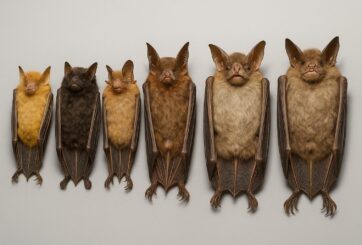
Just in time for Halloween, researchers from the Royal Ontario Museum (ROM), the Field Museum in Chicago, and Lawrence University in Wisconsin have announced the discovery of six new species of bats. These newly identified species, all found in the Philippines, belong to the group known as tube-nosed bats—a fascinating and diverse branch of the mammal family tree. Expanding the Tree of Life Formally recognized as new species through morphological and genetic analysis, this discovery expands the already impressive global…
In a recent study published today in the European Geosciences Union (EGU) journal Biogeosciences, scientists have confirmed that mercury pollution from artisanal and small-scale gold mining (ASGM) is contaminating food crops not through the soil, as previously believed, but directly from the air. Driven by the surging price of gold, which has increased by more than tenfold since 2000, the rapid expansion of unregulated mining in these regions raises urgent questions about food security, human health, and environmental justice The…
An AWI study gives a potential explanation as to why the ocean around Antarctica is defying climate model projections and continuing to absorb CO2, despite the effects of climate change Climate models suggest that climate change could reduce the Southern Ocean’s ability to absorb carbon dioxide (CO2). However, observational data actually shows that this ability has seen no significant decline in recent decades. In a recent study, researchers from the Alfred Wegener Institute have discovered what may be causing this….
 Feedback
