
Earthquakes of similar magnitude can cause tsunamis of greatly varying sizes. This commonly observed, but not well-understood phenomenon has hindered reliable warnings of local tsunamis. Research led by University of Hawai‘i (UH) at Mānoa scientists provides new insight that connects the characteristics of earthquakes—magnitude, depth where two tectonic plates slip past each other and the rigidity of the plates involved—with the potential size of a resulting tsunami. Previous researchers identified a special class of events known as tsunami earthquakes, which produce disproportionately…
NASA will launch four Earth science missions in 2022 to provide scientists with more information about fundamental climate systems and processes including extreme storms, surface water and oceans, and atmospheric dust. Scientists will discuss the upcoming missions at the American Geophysical Union’s (AGU) 2021 Fall Meeting, hosted in New Orleans between Dec. 13 and 17. NASA has a unique view of our planet from space. NASA’s fleet of Earth-observing satellites provide high quality data on Earth’s interconnected environment, from air quality…
A phenomenon where microbe-generated gas bubbles create granular fluctuations at the wet sandy floors of rivers, oceans, and lakes has revealed more about the distribution of materials at the bottom of waterbodies. Tohoku University Researchers dubbed this the “microbial Brazil nut effect.” Details of their research were published in the journal Soft Matter on October 6, 2021. The Brazil Nut Effect (BNE) happens when a granular mixture subjected to shaking results in bigger particles ending up on top. The name…
Submarine groundwater discharge is a process by which water exits coastal aquifers and enters the ocean. This can be terrestrial freshwater or salty seawater that intruded into the porous aquifer at the ocean’s edge. A new study, published in Nature Scientific Reports by University of Hawai‘i at Mānoa researchers, showed that while precipitation and sea level drive coastal groundwater levels, it is sea level, especially tides, that play gatekeeper on the amount of groundwater discharging to Hawai‘i’s coastal zone. Groundwater…
New computer model simulations identify widespread changes in climate variability under sustained anthropogenic forcing. There is growing public awareness that climate change will impact society not only through changes in mean temperatures and precipitation over the 21st century, but also in the occurrence of more pronounced extreme events, and more generally in natural variability in the Earth system. Such changes could also have large impacts on vulnerable ecosystems in both terrestrial and marine habitats. A scientific exploration of projected future…
The coastal zone is home to over a billion people. Rising sea levels are already impacting coastal residents and aggravating existing coastal hazards, such as flooding during high tides and storm surges. However, new research by assistant professor Tina Dura and professor Robert Weiss in the College of Science‘s Department of Geosciences indicates that future sea-level rise will also have impacts on the heights of future tsunamis. “In 50 to 70 years, sea level is going to be significantly higher around the world,”…
A new study detects the unique seismological signature of an electron spin crossover in the deep Earth. Most are aware that electrons are negatively charged particles that surround the nucleus of atoms and whose behaviour governs chemical interactions. However, it is less commonly known that electrons come in two distinct kinds: spin-up and spin-down. And the tendency for pairing between up and down spin electrons, forming “dance partners” with one another, is one of the most important behaviours affecting the…
A new Study provides critical insights into ice mass loss in Antarctica. After the natural warming that followed the last Ice Age, there were repeated periods when masses of icebergs broke off from Antarctica into the Southern Ocean. A new data-model study led by the University of Bonn (Germany) now shows that it took only a decade to initiate this tipping point in the climate system, and that ice mass loss then continued for many centuries. Accompanying modeling studies suggest…
New mineral from Earth’s lower mantle surfaced as diamond inclusion; study led by UNLV geochemist Oliver Tschauner. UNLV geochemists have discovered a new mineral on the surface of the Earth. There’s just one catch: it shouldn’t be here. The mineral — entrapped in a diamond — traveled up to the surface from at least 410 miles deep within the Earth’s lower mantle, the area between the planet’s core and crust. It’s the first time that lower mantle minerals have ever…
New observations of the atomic structure of iron reveal it undergoes “twinning” under extreme stress and pressure. Far below you lies a sphere of solid iron and nickel about as wide as the broadest part of Texas: the Earth’s inner core. The metal at the inner core is under pressure about 360 million times higher than we experience in our everyday lives and temperatures approximately as hot as the Sun’s surface. Earth’s planetary core is thankfully intact. But in space,…
The project “Drilling Overdeepened Alpine Valleys (DOVE)”, part of the “International Continental Scientific Drilling Program” (ICDP), aims to reconstruct the spatial and temporal climate development during the ice ages up to 2.6 million years ago and show their influence on the landscape development in the entire Alpine region. To this end, the Leibniz Institute for Applied Geophysics (LIAG), in cooperation with the Albert Ludwig University of Freiburg and the Geological Survey in Freiburg (LGRB), carried out three research boreholes in…
PNAS publication: In a laboratory experiment, MARUM researchers simulate alternative hydrocarbon formation through reduction of acetic acid. The isotopic compositions of hydrocarbon compounds are like a fingerprint. They can clearly indicate the way in which hydrocarbons like methane, ethane, propane, butane and pentane are formed. When hydrocarbons are combusted, water and carbon dioxide are produced and energy is released. Hydrocarbons, including crude oil and natural gas, are formed over geological time periods under high temperatures and pressures, and researchers can…
Study sheds light on the evolution of underground microbes. A new study sheds light on the evolutionary history of what might be the most elusive form of life on Earth: the deep biosphere – a hidden realm of microbes inhabiting the upper few kilometers of Earth’s crust. Deep, dark fractures reaching far down into the oldest rocks on Earth may seem about as hospitable to life as outer space, but some estimates suggest that microbes dwelling deep in the Earth’s…
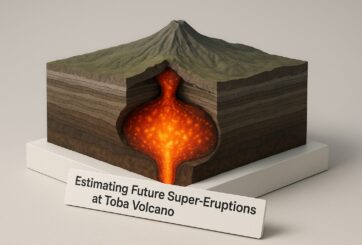
Geologists from the UNIGE and Peking University have developed a technique that makes it possible to estimate the maximum size of a future super-eruption of Toba volcano in Sumatra. It is estimated that about 5-10 volcanoes worldwide are capable of producing a super-eruption that could catastrophically affect global climate. One of these volcanoes hides below the waters of Lake Toba in Sumatra and has caused two super-eruptions in the last one million year. But when will the next one be?…
Ozone depletion has had a direct effect on the geochemical cycle of iodine trapped in Antarctic ice. The ozone hole doesn’t just affect the health of human, terrestrial and marine ecosystems. It also affects environmental chemical processes at the South Pole. This has been demonstrated by an international research team coordinated by the Institute of Polar Sciences of the National Research Council (CNR-Isp) and Ca’ Foscari University of Venice. They studied for the first time, the effects of ozone depletion…
Purely biological: Researchers identify a new kind of pure carbon production by microorganisms. Life on the Earth is based on carbon. Through the course of evolution, living organisms have learned to form and process large numbers of different carbon compounds. Carbon is the cornerstone of most biologically produced organic compounds such as proteins, carbohydrates, fats and DNA. All of these compounds contain, in addition to carbon, many other elements, including hydrogen, nitrogen and oxygen. Elemental carbon is formed from organic…
 Feedback


