
The ice-encrusted oceans of some of the moons orbiting Saturn and Jupiter are leading candidates in the search for extraterrestrial life. A new lab-based study led by the University of Washington in Seattle and the Freie Universität Berlin shows that individual ice grains ejected from these planetary bodies may contain enough material for instruments headed there in the fall to detect signs of life, if such life exists. “For the first time we have shown that even a tiny fraction…
Ground-based measuring devices and aircraft radar operated in the far northeast of Greenland show how much ice the 79° N-Glacier is losing. According to measurements conducted by the Alfred Wegener Institute, the thickness of the glacier has decreased by more than 160 metres since 1998. Warm ocean water flowing under the glacier tongue is melting the ice from below. High air temperatures cause lakes to form on the surface, whose water flows through huge channels in the ice into the…
Researchers at the University of Bayreuth have made a significant scientific breakthrough by discovering new yttrium-hydrogen compounds having serious implications for the research on high-pressure superconductivity. High-pressure superconductivity refers to the property of materials to become superconducting, which means conducting electrical current without resistance, when exposed to certain pressure conditions. The comprehensive high-pressure study of the Bayreuth Researchers shedding light on the complex nature of yttrium hydrides under extreme conditions was published in “Science Advances” journal. Several rare-earth superhydrides are…
SLF climatologist Christoph Marty joins us for an interview to explain why it can snow even in mild winters as well as the difference between the winters of 2022/23 and 2023/24, and to take a look into the future. Dr. Christoph Marty is a snow climatologist at the WSL Institute for Snow and Avalanche Research SLF in Davos, Switzerland. Luzia Schär, Davos – CC-BY Mr Marty, in late November and early December there was snow chaos in large parts…
SLF physicist Lars Mewes is investigating snow crystals’ direction of growth and analysing snow profiles on the Jungfraufirn Glacier. His work is part of a collaboration with other institutions, which the SLF was invited to join because of its expertise on snow. Thin air, peak temperatures of around -10 °C – SLF snow physicist Lars Mewes has swapped his cosy office in Davos for a workplace of extremes this week. Since Monday, he has been at the high-altitude research station…
Having returned from Antarctica, SLF technician Matthias Jaggi talks about new insights into snowpack structure, future work to refine climate models using the samples collected, a personal career highlight – and traffic. Mr Jaggi, what were the main insights you gained during your weeks in Antarctica? It reminded me just how inhomogeneous the snowpack is. The wind has an immense influence on its structure, piling up dunes and creating sloping layers. These aren’t just arranged horizontally, layer upon layer. I’m…
…and submarine cables in the Baltic Sea for Baltic Power Offshore Wind Farm. The Fraunhofer Institute for Wind Energy Systems IWES has conducted a boulder detection campaign in the Baltic Sea on behalf of Baltic Power for the foundations of the planned wind turbines. It also applied the surveying technology along the planned subsea cable routes for the very first time. The innovative Manta Ray G1 measuring system allows not only the detection of boulders located up to 100 meters…
…helps reveal the physics of ice sheet collapse. There’s enough water frozen in Greenland and Antarctic glaciers that if they melted, global seas would rise by many feet. What will happen to these glaciers over the coming decades is the biggest unknown in the future of rising seas, partly because glacier fracture physics is not yet fully understood. A critical question is how warmer oceans might cause glaciers to break apart more quickly. University of Washington researchers have demonstrated the…
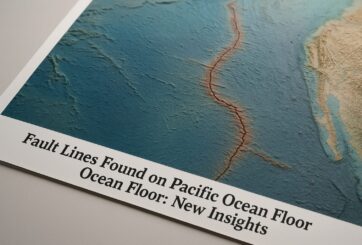
Findings show Pacific Plate is being torn apart at undersea plateaus spanning the ocean by the weight of the oceanic plate subducting at the Western Pacific Ring of Fire. New research led by a team of University of Toronto (U of T) geoscientists is refining the century-old model of plate tectonics that holds the plates covering the ocean floors are rigid as they move across Earth’s mantle. Instead, the researchers found the Pacific Plate is scored by large undersea faults…
University of Tübingen researchers attribute items from French site of Le Moustier to Neanderthals – evidence of higher mental abilities and cultural development. More than 40,000 years ago, early people in what is now France used a multi-component adhesive to make handles for stone tools. They produced a sophisticated mixture of ochre and bitumen, two raw materials that had to be procured from the wider region. This is the earliest discovery of a multi-component adhesive in Europe to date. Under…
Research team analyses organic material from the early Earth tracing its origin and composition. To learn about the first organisms on our planet, researchers have to analyse the rocks of the early Earth. These can only be found in a few places on the surface of the Earth. The Pilbara Craton in Western Australia is one of these rare sites: there are rocks there that are around 3.5 billion years old containing traces of the microorganisms that lived at that…
Climate changes usually happens over long periods of time, but during the last glacial period, extreme fluctuations in temperature occurred within just a few years. Researchers at the University of Basel have now been able to prove the phenomenon also occurred during the penultimate glacial period. In recent geological history, the so-called Quaternary period, there have been repeated ice ages and warm periods. Researchers are able to determine past climate variability from the composition of climate records. In the case…
In autumn 2021, geologists discovered an unusual row of stones, almost 1 km long, at the bottom of Mecklenburg Bight. The site is located around 10 kilometres off Rerik in 21 metres water depth. The approximately 1,500 stones are aligned so regularly that a natural origin seems unlikely. A team of researchers from different disciplines now concluded, that Stone Age hunter-gatherers likely built this structure around 11,000 years ago to hunt reindeer. The finding represents the first discovery of a…
Hardly any gemstone is more difficult to find than diamonds. Geologists from ETH Zurich and the University of Melbourne have now established a link between their occurrence and the mineral olivine. This could make the search for diamonds easier in the future. In brief The abundance of magnesium and iron in the mineral olivine provides information on whether or not diamonds could be present in a kimberlite rock sample. The more magnesium is found in the olivine, the more likely…
Geologists from the University of Cologne are investigating the influence of past climate and environmental changes on the East Antarctic Ice Sheet in regions that are ice-free today. In three expeditions with the research vessel ‘Polarstern’, a consortium of German geoscientists is exploring changes in the East Antarctic Ice Sheet in the geological past. The second of these expeditions was completed on 1 February 2024, and the third is still underway in Antarctica until early April 2024. The researchers are…
TUD geoscientists research in the frozen South. On February 6, 2024, when the German polar research vessel “Polarstern” sets sail from Hobart, Australia, on research cruise PS141, five researchers from TU Dresden will also be on board: Dr. Mirko Scheinert, Lutz Eberlein, and Erik Loebel from the Chair of Geodetic Earth System Research, Xabier Blanch Gorriz from the Junior Professorship in Geosensor Systems, and student Marie Weber (who is in the 5th semester of her studies in Geodesy and Geoinformation)….
 Feedback


