



Feeding 9 Billion: Innovations in Agricultural Modeling
New evidence that events in outer space affect the weather and climate of Earth has been revealed in a study by meteorologists at the University of Reading published in the Proceedings of the Royal Society on Wednesday 18 January.
In their paper ‘Empirical evidence for a non-linear effect of galactic cosmic rays on clouds’, Drs Giles Harrison and David Stephenson suggest that cosmic rays have a significant effect on the Earth’s lower atmosphere – particularly on levels of cloudiness.
The Reading meteorologists discovered that the chance of an overcast day decreases by 20% on days with low cosmic ray fluxes. The effect is strongest when low cosmic ray fluxes occur – this is often associated with solar flares, but may also result from changes outside the solar system.
“Back in 1959, Edward Ney suggested that variations in cosmic rays, which are charged particles mostly originating outside the solar system, could affect our weather,” said Dr Harrison. “This research now provides strong evidence supporting Ney’s suggestion, which effectively links atmospheric and space science.”
“As well as the influence of weather, our evidence shows a small yet statistically significant effect of cosmic rays on daily cloudiness. This suggests that cosmic rays are an additional external source of climate variability that should be considered when modelling past and future climate.”
To detect changes in the atmosphere from cosmic rays, Harrison and Stephenson used solar radiation measurements made by meteorological stations. They conducted a careful analysis of the UK archives of daily solar radiation observations from 1951-2004 and compared them with neutron counter cosmic ray measurements taken at Climax, Colorado, between 1951 and 2000.




Earthquakes in the American state of Utah, the Soultz-sous-Forêts region of France or in the Dutch province of Groningen should not be able to occur even if the subsurface has been exploited for decades. This is because the shallow subsurface behaves in such a way that faults there become stronger as soon as they start moving. At least that is what geology textbooks teach us. And so, in theory, it should not be possible for earthquakes to occur. So why…
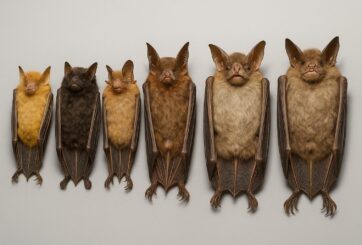
Just in time for Halloween, researchers from the Royal Ontario Museum (ROM), the Field Museum in Chicago, and Lawrence University in Wisconsin have announced the discovery of six new species of bats. These newly identified species, all found in the Philippines, belong to the group known as tube-nosed bats—a fascinating and diverse branch of the mammal family tree. Expanding the Tree of Life Formally recognized as new species through morphological and genetic analysis, this discovery expands the already impressive global…
In a recent study published today in the European Geosciences Union (EGU) journal Biogeosciences, scientists have confirmed that mercury pollution from artisanal and small-scale gold mining (ASGM) is contaminating food crops not through the soil, as previously believed, but directly from the air. Driven by the surging price of gold, which has increased by more than tenfold since 2000, the rapid expansion of unregulated mining in these regions raises urgent questions about food security, human health, and environmental justice The…
A new study from Iceland’s Surtsey island shows that birds carried most of the plants that colonised the island, challenging long-held beliefs that seed or fruit shape determines how plants spread — offering fresh insight into life’s adaptation to c When the volcanic island of Surtsey rose from the North Atlantic Ocean in 1963, it offered scientists a once-in-a-lifetime opportunity to observe how life takes hold on a brand-new and barren land. For decades, ecologists believed that plants’ ability to…
 Feedback
