



Feeding 9 Billion: Innovations in Agricultural Modeling
It was not that cold in subarctic areas of Russia during the epoch of the latest glaciation. This has been proved by the remains of animals found there – not only remains of such frost-resisting animals as mammoths and reindeers, but also those of horses.
During the latest ice age, i.e. 25-15,000 years ago, it was not that cold in the subarctic part of the trans-Ural region as it had been considered earlier. The territory was not covered by glacial wilderness, but by dry and low-snowy steppe. In these conditions, large herbivorous animals, such as mammoths, woolly rhinoceroses (Coelodonta), reindeers, musk-oxen and even ordinary horses felt pretty well. Glaciation took place much earlier in these area – more than 40,000 years ago.
Such conclusion has been made by the researchers of St.-Petersburg State University, after they investigated remains of plants and bones of large animals found on the banks of the Ob River in the area of polar circle. Bones and teeth of the mammoth, musk-ox and horse, pieses of wood, twigs of bushes, peat and silt were exposed to radiocarbon analysis. Almost all bones turned out to be younger than 40,000 years, while glacial sediment is evidently more ancient.
These results disagree with the official point of view on the relatively recent (20-18,000 years ago) glaciation in this region, but they coincide with the researchers of other scientists who assert that 20,000 years ago the trans-Ural region was not covered by glacier.




Earthquakes in the American state of Utah, the Soultz-sous-Forêts region of France or in the Dutch province of Groningen should not be able to occur even if the subsurface has been exploited for decades. This is because the shallow subsurface behaves in such a way that faults there become stronger as soon as they start moving. At least that is what geology textbooks teach us. And so, in theory, it should not be possible for earthquakes to occur. So why…
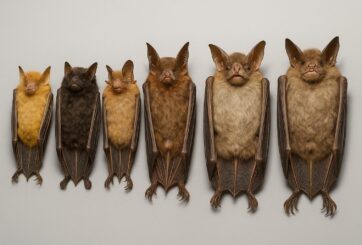
Just in time for Halloween, researchers from the Royal Ontario Museum (ROM), the Field Museum in Chicago, and Lawrence University in Wisconsin have announced the discovery of six new species of bats. These newly identified species, all found in the Philippines, belong to the group known as tube-nosed bats—a fascinating and diverse branch of the mammal family tree. Expanding the Tree of Life Formally recognized as new species through morphological and genetic analysis, this discovery expands the already impressive global…
In a recent study published today in the European Geosciences Union (EGU) journal Biogeosciences, scientists have confirmed that mercury pollution from artisanal and small-scale gold mining (ASGM) is contaminating food crops not through the soil, as previously believed, but directly from the air. Driven by the surging price of gold, which has increased by more than tenfold since 2000, the rapid expansion of unregulated mining in these regions raises urgent questions about food security, human health, and environmental justice The…
A new study from Iceland’s Surtsey island shows that birds carried most of the plants that colonised the island, challenging long-held beliefs that seed or fruit shape determines how plants spread — offering fresh insight into life’s adaptation to c When the volcanic island of Surtsey rose from the North Atlantic Ocean in 1963, it offered scientists a once-in-a-lifetime opportunity to observe how life takes hold on a brand-new and barren land. For decades, ecologists believed that plants’ ability to…
 Feedback
