



Feeding 9 Billion: Innovations in Agricultural Modeling
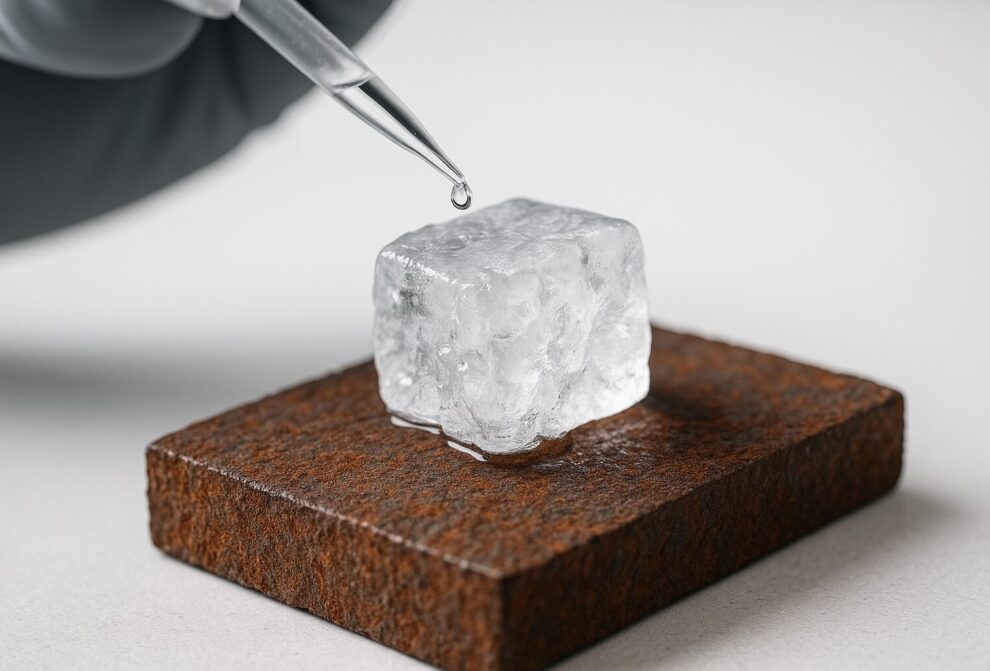
AI Generated Image
Researchers from Umeå University have discovered that ice can dissolve iron minerals more effectively than liquid water—a finding that challenges long-standing assumptions about frozen environments.
The study, published in PNAS, shows that ice at –10°C releases more iron from minerals than water at 4°C. This breakthrough may explain why many Arctic rivers are turning rusty orange as thawing permafrost releases iron into waterways.
“It may sound counterintuitive, but ice is not a passive frozen block,” says Jean-François Boily, Professor at Umeå University and co-author of the study. “Freezing creates microscopic pockets of liquid water between ice crystals. These act like chemical reactors, where compounds become concentrated and extremely acidic. This means they can react with iron minerals even at temperatures as low as minus 30 degrees Celsius.”
To investigate the process, scientists studied goethite—an abundant iron oxide mineral—combined with a naturally occurring organic acid, using advanced microscopy techniques.
They found that repeated freeze-thaw cycles enhance iron dissolution. When ice melts, organic compounds that were previously locked inside are released, fueling further chemical reactions. Salinity also matters: fresh and brackish water speed up the process, while seawater tends to suppress it.
The results primarily apply to acidic environments, including:
Researchers aim to determine whether this phenomenon occurs in all types of iron-bearing ice, with ongoing experiments in the Boily laboratory seeking to answer that question.
“As the climate warms, freeze-thaw cycles become more frequent,” says Angelo Pio Sebaaly, doctoral student and first author of the study. “Each cycle releases iron from soils and permafrost into the water. This can affect water quality and aquatic ecosystems across vast areas.”
The team emphasizes that ice should no longer be viewed as a passive storage medium, but as an active driver of chemical processes. With more frequent freezing and thawing in polar and mountain regions, the ecological consequences could be profound.
Warming climates and more frequent freeze-thaw cycles could significantly affect water quality and ecosystems.
Original Publication
Authors: Angelo P. Sebaaly, Frank van Rijn, Khalil Hanna and Jean-François Boily.
Journal: Proceedings of the National Academy of Sciences
DOI: 10.1073/pnas.2507588122
Method of Research: Experimental study
Subject of Research: Not applicable
Article Title: Ice as a kinetic and mechanistic driver of oxalate-promoted iron oxyhydroxide dissolution
Article Publication Date: 26-Aug-2025
Original Source: https://www.pnas.org/doi/10.1073/pnas.2507588122




Earthquakes in the American state of Utah, the Soultz-sous-Forêts region of France or in the Dutch province of Groningen should not be able to occur even if the subsurface has been exploited for decades. This is because the shallow subsurface behaves in such a way that faults there become stronger as soon as they start moving. At least that is what geology textbooks teach us. And so, in theory, it should not be possible for earthquakes to occur. So why…

Just in time for Halloween, researchers from the Royal Ontario Museum (ROM), the Field Museum in Chicago, and Lawrence University in Wisconsin have announced the discovery of six new species of bats. These newly identified species, all found in the Philippines, belong to the group known as tube-nosed bats—a fascinating and diverse branch of the mammal family tree. Expanding the Tree of Life Formally recognized as new species through morphological and genetic analysis, this discovery expands the already impressive global…
In a recent study published today in the European Geosciences Union (EGU) journal Biogeosciences, scientists have confirmed that mercury pollution from artisanal and small-scale gold mining (ASGM) is contaminating food crops not through the soil, as previously believed, but directly from the air. Driven by the surging price of gold, which has increased by more than tenfold since 2000, the rapid expansion of unregulated mining in these regions raises urgent questions about food security, human health, and environmental justice The…
A new study from Iceland’s Surtsey island shows that birds carried most of the plants that colonised the island, challenging long-held beliefs that seed or fruit shape determines how plants spread — offering fresh insight into life’s adaptation to c When the volcanic island of Surtsey rose from the North Atlantic Ocean in 1963, it offered scientists a once-in-a-lifetime opportunity to observe how life takes hold on a brand-new and barren land. For decades, ecologists believed that plants’ ability to…
 Feedback
