



Feeding 9 Billion: Innovations in Agricultural Modeling
Researchers have created an Artificial Intelligence (AI) system that allows a quadrupedal robot to adjust its gait to various unknown terrains, akin to a genuine animal, marking what is considered a world first.
The innovative technology enables the robot to automatically modify its movement, rather than requiring instructions on when and how to adjust its stride, as is the case with current-generation robots. This advancement is regarded as a significant progression towards the potential deployment of legged robots in perilous environments where human safety may be compromised, such as nuclear decommissioning or search and rescue operations, where the failure to adapt to unforeseen circumstances could result in fatalities.
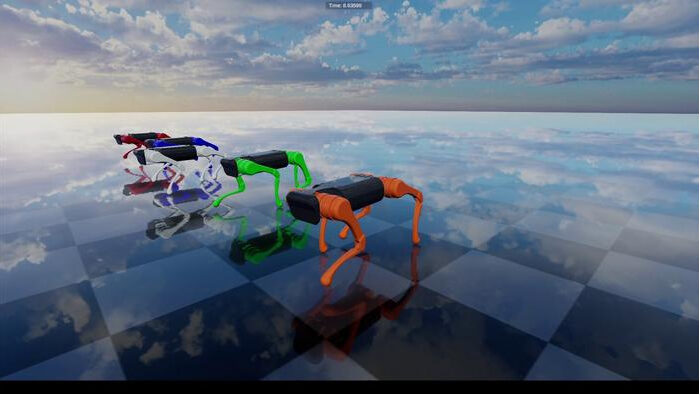
The project, undertaken by the University of Leeds and University College London (UCL), drew inspiration from the animal realm to instruct the robot in navigating unfamiliar terrain. This encompasses quadrupeds such as canines, felines, and equines, who are proficient at adapting to various terrains. These creatures alter their locomotion to conserve energy, sustain equilibrium, or react swiftly to dangers.
The researchers have developed a framework that instructs robots on how to transition between trotting, running, bounding, and other gaits, emulating mammalian behaviour in nature.
By incorporating the tactics employed by animals to traverse an uncertain environment, the robot swiftly adapts its gaits in response to varying terrain. Due to the data processing capabilities of AI, the robot, referred to as “Clarence,” acquired the requisite techniques in about nine hours, significantly quicker than the days or weeks typically required by most juvenile animals to traverse various surfaces with confidence.
In a paper published on July 11 in Nature Machine Intelligence, lead author Joseph Humphreys, a postgraduate researcher in the School of Mechanical Engineering at Leeds, elucidates how the framework allows the robot to adjust its stride in response to its environment, navigating diverse terrains such as uneven timber, loose wood chips, and overgrown vegetation, without necessitating modifications to the system itself.
He stated, “Our findings could have a significant impact on the future of legged robot motion control by reducing many of the previous limitations around adaptability.””
He stated: “This deep reinforcement learning framework teaches gait strategies and behaviour inspired by real animals – or ‘bio-inspired’ – such as saving energy, adjusting movements as needed, and gait memory, to achieve highly adaptable and optimal movement, even in environments never previously encountered.
“All of the training happens in simulation. You train the policy on a computer, then take it and put it on the robot and it is just as proficient as in the training. It’s similar to the Matrix, when Neo’s skill in martial arts is downloaded into his brain, but he doesn’t undergo any physical training in the real world.
“We then tested the robot in the real-world, on surfaces it had never experienced before, and it successfully navigated them all. It was really rewarding to watch it adapt to all the challenges we set and seeing how the animal behaviour we had studied had become almost second nature for it.”
Deep reinforcement learning agents typically excel at mastering a particular task but encounter difficulties in adapting to environmental changes. Animal brains possess inherent structures and information that facilitate learning. Certain agents may replicate this form of learning; but, their artificial systems typically lack the sophistication and intricacy of more advanced models. The researchers assert that they surmounted this problem by incorporating natural animal locomotion tactics into their system.
They claim to possess the inaugural framework that concurrently integrates all three essential elements of animal locomotion into a reinforcement learning system—specifically: gait transition strategies, gait procedural memory, and adaptive motion adjustment—facilitating genuine versatility for real-world application directly from simulation, without necessitating additional modifications on the physical robot.
The robot not only acquires the ability to move but also learns to choose which gait to employ, when to transition, and how to adapt it in real-time, even on unfamiliar terrain.
Professor Zhou, the principal author of the study from UCL Computer Science, stated: “This research was driven by a fundamental question: what if legged robots could move instinctively the way animals do? Instead of training robots for specific tasks, we wanted to give them the strategic intelligence animals use to adapt their gaits — using principles like balance, coordination, and energy efficiency.
“By embedding those principles into an AI system, we’ve enabled robots to choose how to move based on real-time conditions, not pre-programmed rules. That means they can navigate unfamiliar environments safely and effectively, even those that they haven’t encountered before.
“Our long-term vision is to develop embodied AI systems — including humanoid robots — that move, adapt, and interact with the same fluidity and resilience as animals and humans.”
Engineers are progressively emulating nature, referred to as biomimicry, to address intricate mobility difficulties. The crew asserts that their accomplishment signifies a significant advancement in enhancing the adaptability and proficiency of legged robots to navigate real-world challenges, particularly in hazardous locations or areas with restricted access. A robot proficient at traversing unfamiliar, intricate terrain presents new opportunities for applications in disaster response, planetary exploration, agriculture, and infrastructure inspection.
It proposes a viable approach for incorporating biological intelligence into robotic systems and facilitating more ethical examinations of biomechanics hypotheses; rather than subjecting animals to invasive sensors or jeopardising their safety to analyse their stability recovery response, robots can be utilised instead.
By drawing inspiration from the elements that facilitate efficient animal locomotion, the researchers devised a framework adept at navigating intricate and hazardous terrain, even in the absence of exteroceptive sensors—such as vision, olfaction, and auditory perception—that assist humans in their mobility.
Employing deep reinforcement learning—an enhanced form of trial and error—the robot concurrently trained across numerous environments, initially addressing the challenge of locomotion with various gaits, subsequently selecting the optimal gait for the terrain, thereby developing the capacity for highly adaptable movement.
To evaluate this gained flexibility in practical environments, the robot was released onto various surfaces such as woodchip, rocks, overgrown roots, and loose timber, while also subjecting its legs to repeated impacts from a sweeping brush to assess its recovery from trips. The researchers utilised a predefined pathway or a joystick, much to those employed in video games, to manoeuvre the robot.
Surprisingly, the robot was not subjected to any challenging terrain during training, underscoring the system’s adaptability and indicating that these skills have become instinctual for the robot.
The research, partially financed by the Royal Society and the Advanced Research and Invention Agency (ARIA), concentrated on facilitating resilient daily mobility. In future endeavours, the team aspires to incorporate other dynamic skills, like long-distance jumping, climbing, and traversing steep or vertical terrains.
While the methodology has thus far been evaluated solely on a single dog-sized quadruped robot, the foundational principles has wide-ranging applicability. Identical bio-inspired measures can be used to a diverse array of quadrupedal robots, irrespective of their dimensions or mass, provided they exhibit analogous morphology.
Original Publication
Authors: Joseph Humphreys and Chengxu Zhou.
Journal: Nature Machine Intelligence
DOI: 10.1038/s42256-025-01065-z
Method of Research: Computational simulation/modeling
Subject of Research: Not applicable
Article Title: Learning to Adapt through Bio-Inspired Gait Strategies for Versatile Quadruped Locomotion
Article Publication Date: 11-Jul-2025
Original Source: https://www.nature.com/articles/s42256-025-01065-z




In industrial stamping processes, several hundred sheet metal parts are typically produced per minute. Together with the stamped parts manufacturer Quittenbaum GmbH, researchers at Fraunhofer IPM have now for the first time developed and installed an optical inspection system that checks the dimensional accuracy of every single component in high-speed stamping processes – with an accuracy in the range of 100 micrometers. The geometric deviations are depicted in 16 different views on the user interface. © Fraunhofer IPM Connectors, sleeves…
A team of researchers has beaten its own record for the fastest swimming soft robot, drawing inspiration from manta rays to improve their ability to control the robot’s movement in the water. “Two years ago, we demonstrated an aquatic soft robot that was able to reach average speeds of 3.74 body lengths per second,” says Jie Yin, corresponding author of a paper on the work and an associate professor of mechanical and aerospace engineering at North Carolina State University. “We…
Detonation is a supersonic combustion wave, characterized by a shock wave driven by the energy release from closely coupled chemical reactions. It is a typical form of pressure gain combustion, converting chemical energy into thrust efficiently. The concept of harnessing detonation to improve thermodynamic cycle efficiency and enhance the performance of aerospace propulsion systems has been a subject of interest for many years. Since the 1950s, various types of detonation engines have been proposed, including pulse detonation engines, oblique detonation…
A thing of the past! Bipolar plates for fuel cells are mass produced every second. The forming tools used to manufacture them are milled from high-quality metal alloys that provide them with high wear resistance. In the National Action Plan for Fuel Cell Production (H2GO), the Fraunhofer Institute for Laser Technology ILT in Aachen is breaking new ground: Instead of milling the tools from an expensive solid block, the institute is using extreme high-speed laser material deposition (EHLA) to apply…
 Feedback
