



Feeding 9 Billion: Innovations in Agricultural Modeling
University of Leicester scientists have made a unique discovery at an Atlantic island popular with British holidaymakers.
They have uncovered giant sand dunes on Tenerife that tell a tale of terrifying destruction in ancient times, when fiery clouds swept right across the island, leaving very little in their wake.
Volcanic islands – volcanoes whose summits poke out of the oceans – make popular holiday destinations, like Madeira, Hawaii and the Azores. Some, like Hawaii, erupt lava flows, but others explode catastrophically with devastating effect.
Tenerife, one of the Canary Islands, has behaved in both ways in the past million years. Two volcanologists from the University of Leicester investigating ash layers on the island for forensic clues to deduce what happened there long before human colonisation, have unearthed a tale of particularly destructive behaviour.
They discovered giant sand-dunes of volcanic ash, formed when a hurricane-like pyroclastic current, a fiery flow of incandescent hot ash and noxious gases, swept across most of the island, an area about the size of Cornwall.
The two Leicester volcanologists Dr Mike Branney and Dr Richard Brown have deduced that the devastating pyroclastic current that created the dunes must have been sustained for several hours, while part of the island collapsed and its ancient forests were swept away.
In an article this month in GEOLOGY, an international magazine published by the Geological Society of America, they show how despite the extended duration of this catastrophic event, surprisingly little trace remains. This is because the vast tonnage of ash and rocks erupted from the volcano simply bypassed the island entirely and flowed into the ocean.
Geologists, who use ash layers to decipher past behaviour of violent volcanoes, are concerned that past occurrences of such devastating currents are easy to under-estimate, or even overlook, because so little trace of them is left behind. The remarkable dunes, perched on the side of the volcano near the tiny fishing resort of Poris, are the first of their type to be discovered.
“It seems amazing that these devastating currents flowed for such a long time, yet leave such little record of their passage” says Mike Branney who has been working on Tenerife for seven years; “finding the dunes was the key, and we shall be looking out for similar examples elsewhere, so that we can recognise where else this particular type of hazardous volcanic behaviour has occurred.”




Earthquakes in the American state of Utah, the Soultz-sous-Forêts region of France or in the Dutch province of Groningen should not be able to occur even if the subsurface has been exploited for decades. This is because the shallow subsurface behaves in such a way that faults there become stronger as soon as they start moving. At least that is what geology textbooks teach us. And so, in theory, it should not be possible for earthquakes to occur. So why…
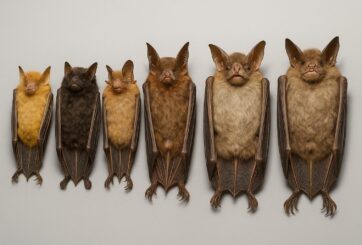
Just in time for Halloween, researchers from the Royal Ontario Museum (ROM), the Field Museum in Chicago, and Lawrence University in Wisconsin have announced the discovery of six new species of bats. These newly identified species, all found in the Philippines, belong to the group known as tube-nosed bats—a fascinating and diverse branch of the mammal family tree. Expanding the Tree of Life Formally recognized as new species through morphological and genetic analysis, this discovery expands the already impressive global…
In a recent study published today in the European Geosciences Union (EGU) journal Biogeosciences, scientists have confirmed that mercury pollution from artisanal and small-scale gold mining (ASGM) is contaminating food crops not through the soil, as previously believed, but directly from the air. Driven by the surging price of gold, which has increased by more than tenfold since 2000, the rapid expansion of unregulated mining in these regions raises urgent questions about food security, human health, and environmental justice The…
A new study from Iceland’s Surtsey island shows that birds carried most of the plants that colonised the island, challenging long-held beliefs that seed or fruit shape determines how plants spread — offering fresh insight into life’s adaptation to c When the volcanic island of Surtsey rose from the North Atlantic Ocean in 1963, it offered scientists a once-in-a-lifetime opportunity to observe how life takes hold on a brand-new and barren land. For decades, ecologists believed that plants’ ability to…
 Feedback
