



Feeding 9 Billion: Innovations in Agricultural Modeling
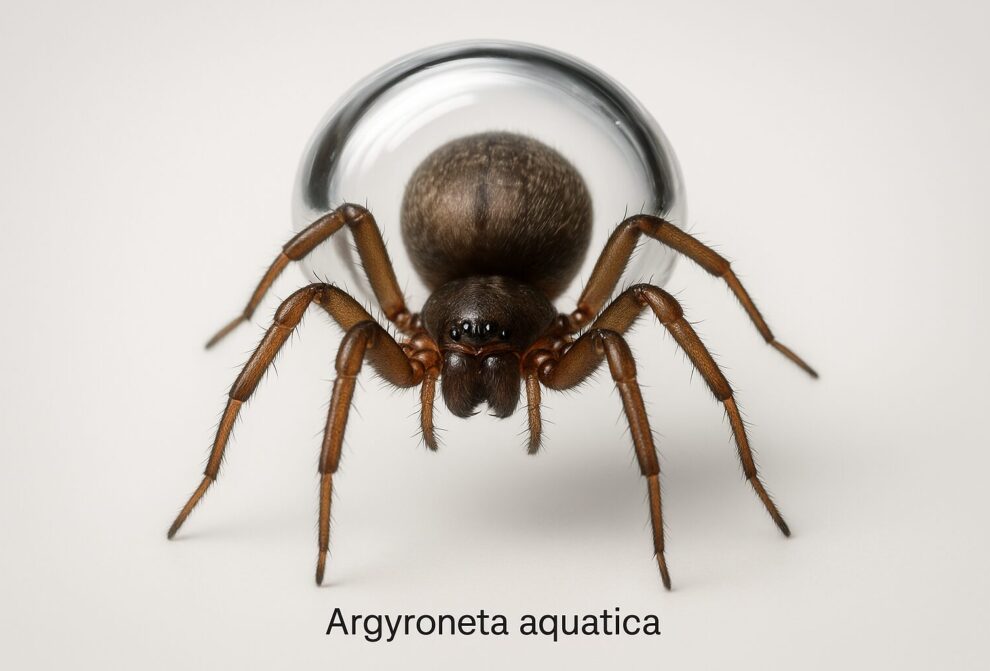
AI Generated Image
Adorning a bell shape, the water spider is the only spider that spends its lifetime residing underwater. One can identify this aquatic spider by the silvery air bubble it carries on its body hair. In contrast, it appears grey-brown out of water. Male water spiders are found to be larger than females in terms of size.
Water spiders are observed in lakes, ponds throughout Britain and Europe. The intriguing mechanism of these creatures consists of carrying bubbles of oxygen trapped in their body hairs from the surface of the water through their bell-shaped web. A silk sheet suspended and attached to the aquatic vegetation is spun by the spider, with the air bubbles deposited onto it. This makes it easier for the spider to breathe underwater, and it also serves to trap aquatic prey onto it.
Gazing into the depths of a pond, it’s hard to miss the insects that whirl and zip beneath the surface. However, only one species of spider has joined them: the diving bell spider, Argyroneta aquatica. ‘It is an iconic animal; I had read about the spider as a small boy in popular literature about ponds,’ says Roger Seymour from the University of Adelaide. According to Seymour, each spider constructs a net of silk in vegetation beneath the surface and fills it with air carried down on its abdomen.
The spiders spend their entire lives submerged and even lay their eggs in their diving bells. Having already used an oxygen-measuring device called an optode to discover how aquatic insects extract oxygen from water through thin bubbles of air stretched across their abdomens, Seymour was looking for other small bubbles to test his optode.
‘The famous water spider came to mind,’ remembers Seymour, and when he mentioned the possibility to Stefan Hetz from Humboldt University, Germany, Hetz jumped at the idea. Inviting Seymour to his lab, the duo decided to collect some of the arachnids to find out how they use their diving bells. The duo report their discovery that the spiders can use the diving bell like a gill to extract oxygen from water to remain hidden beneath the surface in The Journal of Experimental Biology at http://jeb.biologists.org/content/214/13/2175.abstract
Sadly, diving bell spiders are becoming increasingly rare in Europe; however, after obtaining a permit to collect the elusive animals, the duo eventually struck lucky in the Eider River. ‘My philosophy is to make some measurements and be amazed because if you observe nature it tells you much more than you could have imagined,’ says Seymour. So, returning to the lab, the team reproduced the conditions in a warm stagnant weedy pond on a hot summer’s day to find out how the spiders fare in the most challenging of conditions.
After watching the spiders build their shimmering diving bells, the duo gingerly poked an oxygen sensing optode into the bubble to see how the animal reacted. Miraculously, the spider was unperturbed, so they continued recording the oxygen level. ‘Then it occurred to me that we could use the bubble as a respirometer,’ says Seymour, to find out how much oxygen the spiders consume.
Taking a series of oxygen measurements in the bubble and surrounding water, the team calculated the amount of oxygen flowing into the bubble before calculating the spider’s oxygen consumption rate and found that the diving bell could extract oxygen from the most stagnant water even on a hot day. Also, the metabolic rate of the aquatic spider was low and similar to the low metabolic rates of other spiders that sit waiting for prey to pass.
However, despite satisfying the spider’s oxygen demands, the bubble continually shrinks because nitrogen diffuses back into the water, eventually forcing the occupant to venture to the surface to resupply the diving bell. So how long could the bubble survive before the spider had to dash up for air? Calculating the diffusion rate of nitrogen out of the bubble, Seymour and Hetz were surprised to find that the spiders could sit tight for more than a day. ‘The previous literature suggested they had to come to the surface as often as every 20min throughout the day,’ comments Seymour, who adds, ‘It is advantageous for the spiders to stay still for so long without having to go to the surface to renew the bubble, not only to protect themselves from predation but also so they don’t alert potential prey that come near.’
REFERENCE: Seymour, R. S. and Hetz, S. K. (2011). The diving bell and the spider: the physical gill of Argyroneta aquatica. J. Exp. Biol. 214, 2175-2181.
Since the water spider is found primarily in Europe and parts of Asia, local organizations and environmental institutes are working to preserve and conserve freshwater ecosystems. Due to its unique features, much attention is placed on protecting it, although it isn’t considered an endangered species per se. As a predator, the water spider is known to be beneficial in aquatic ecosystems by balancing out the aquatic population of mosquito larvae and aquatic insects.
Water spiders are known to live for around 2 years when held in captivity. They are considered to be solitary and territorial arachnids that tend to connect mostly with other spiders during mating. However, they assist fellow aquatic lifeforms such as fish during times when water levels have low oxygen content and low pH. This makes them an important contributor to the aquatic ecosystem and one of nature’s enigmatic discoveries.




The appearance of a hot sauce or pepper doesn’t reveal whether it’s mild or likely to scorch someone’s taste buds. So, researchers made an artificial tongue to quickly detect spiciness. Inspired by milk’s casein proteins, which bind to capsaicin and relieve the burn of spicy foods, the researchers incorporated milk powder into a gel sensor. The prototype, reported in ACS Sensors, detected capsaicin and pungent-flavored compounds (like those behind garlic’s zing) in various foods. “Our flexible artificial tongue holds tremendous…
Unless you’ve owned reptiles, you might not know that many of them “pee” crystals. Researchers publishing in the Journal of the American Chemical Society investigated the solid urine of more than 20 reptile species and found spheres of uric acid in all of them. This work reveals how reptiles uniquely package up and eliminate crystalline waste, which could inform future treatments for human conditions that also involve uric acid crystals: kidney stones and gout. Most living things have some sort…
Enabled by a new high-resolution mapping technique, the findings overturn a long-held belief that the genome loses its 3D structure when cells divide CAMBRIDGE, MA — Before cells can divide, they first need to replicate all of their chromosomes, so that each of the daughter cells can receive a full set of genetic material. Until now, scientists had believed that as division occurs, the genome loses the distinctive 3D internal structure that it typically forms. Once division is complete, it…
Researchers at Chalmers University of Technology in Sweden and the US space agency NASA have made an unexpected discovery that challenges one of the basic rules of chemistry and provides new knowledge about Saturn’s enigmatic moon Titan. In its extremely cold environment, normally incompatible substances can still be mixed. This discovery broadens our understanding of chemistry before the emergence of life. Scientists have long been interested in Saturn’s largest, orange-coloured moon as its evolution can teach us more about our…
 Feedback
