



Feeding 9 Billion: Innovations in Agricultural Modeling
Residents of the town of Badger, located in the central region of Newfoundland and Labrador, are accessing satellite radar imagery used for forecasting floods straight from their computers. This service has been funded by the Global Monitoring for Environment and Security (GMES), an EU-led initiative in partnership with ESA.
Badger, situated at the confluence of three rivers, has a long history of flooding due to ice build up in the Exploits River – the largest of the three. In February 2003, the water level rose 2.3 metres in less than one hour. The flood waters froze, putting parts of the town in ice for weeks.
The Newfoundland and Labrador Minister for the Department of Environment and Conservation Clyde Jackman said: “The flood forecasting service, which uses a computer model to simulate ice conditions on the Exploits River, is crucial for providing advance warning to the residents of Badger and our Emergency Measures Organization.
“Remote sensing is increasingly being used for environmental disaster prevention and management. The GMES programme helps by making remote sensing data available to end users, such as the Newfoundland and Labrador Department of Environment and Conservation, who use it to add value to their existing environmental disaster prevention services.”
The GMES initiative represents a concerted effort to combine ground- and space-based observations to develop an integrated environmental monitoring capability to benefit citizens.
The flood forecasting service combines satellite radar images, provided by ESA’s Envisat and the Canadian Space Agency’s RADARSAT satellites, weather forecasts and field observations.
Using a computer simulation programme called the ‘Ice Progression Model’, which inputs data from real-time flows, weather conditions and forecasts, the Water Resources Management Division (WRMD) simulates ice conditions on the Exploits River. When conditions warrant, forecasts or warnings are issued to the town and emergency officials.
The WRMD has been testing the use of radar imagery to improve flood forecasting since December 2003. The Department of Environment and Conservation has been offering the online flood forecasting service via its website since February 2006.
“Based on our experience with the 2003 flood, I believe the use of radar imagery would have significantly improved our ability to provide a timely forecast and to direct the post flood response,” Minister Jackman said.
Radar imagery plays a key role in the process by providing ice conditions as well as the location of ice, which was previously only available by observers.
“The radar imagery offers a ‘big picture’ view of a large segment of the Exploits River at one instance and is able to work in all weather as the radar sees through rain, snow and fog. It is able to safely provide information on areas of the Exploits River where we would have safety concerns in sending observers,” Minister Jackman said. “When ice conditions are changing rapidly, observations can be made by the satellite twice daily. It also helps us analyse how the ice conditions change between images.”
The flood forecasting service is provided by the Canadian company C-CORE under the Polar View initiative, which is a satellite remote-sensing programme provided through an ESA activity known as the GMES Services Element (GSE) that promotes the utilisation of satellites for public good and public policy support.




Earthquakes in the American state of Utah, the Soultz-sous-Forêts region of France or in the Dutch province of Groningen should not be able to occur even if the subsurface has been exploited for decades. This is because the shallow subsurface behaves in such a way that faults there become stronger as soon as they start moving. At least that is what geology textbooks teach us. And so, in theory, it should not be possible for earthquakes to occur. So why…
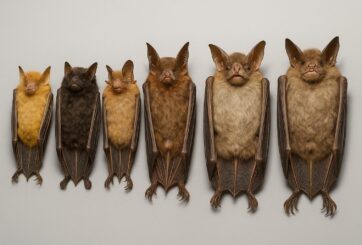
Just in time for Halloween, researchers from the Royal Ontario Museum (ROM), the Field Museum in Chicago, and Lawrence University in Wisconsin have announced the discovery of six new species of bats. These newly identified species, all found in the Philippines, belong to the group known as tube-nosed bats—a fascinating and diverse branch of the mammal family tree. Expanding the Tree of Life Formally recognized as new species through morphological and genetic analysis, this discovery expands the already impressive global…
In a recent study published today in the European Geosciences Union (EGU) journal Biogeosciences, scientists have confirmed that mercury pollution from artisanal and small-scale gold mining (ASGM) is contaminating food crops not through the soil, as previously believed, but directly from the air. Driven by the surging price of gold, which has increased by more than tenfold since 2000, the rapid expansion of unregulated mining in these regions raises urgent questions about food security, human health, and environmental justice The…
A new study from Iceland’s Surtsey island shows that birds carried most of the plants that colonised the island, challenging long-held beliefs that seed or fruit shape determines how plants spread — offering fresh insight into life’s adaptation to c When the volcanic island of Surtsey rose from the North Atlantic Ocean in 1963, it offered scientists a once-in-a-lifetime opportunity to observe how life takes hold on a brand-new and barren land. For decades, ecologists believed that plants’ ability to…
 Feedback
