



Feeding 9 Billion: Innovations in Agricultural Modeling
The ancient sea was more like a giant salty lake than a rolling ocean, report scientists from Imperial College London in the May edition of the Journal of the Geological Society. A new computer model that simulates how tides in North West Europe would have behaved 300 million years ago shows a sea with so little movement that it was unlike any on Earth today.
Using information on the ancient land masses and the tidal pull of the Moon, the new computer modelling system reveals a picture of a Palaeozoic ocean in which even basic lifeforms would have struggled to survive. Without tides, shallow coastal water is not mixed up, preventing life-saving oxygen from being circulated.
This shortage of oxygen causes lifeforms such as plankton to die and the decay of these lifeforms uses up further oxygen, contributing to the creation of an environment unable to support life. The Palaeozoic period lasted from 570 to 245 million years ago.
Dr Peter Allison, from the Department of Earth Sciences and Engineering and one of the authors of the study, said: “It is very difficult to understand how these huge ancient seas behaved, since we have no examples of this sort of water body on Earth today.
“We have used a new computer model to deduce the tidal range in ancient seas and show that they were almost tideless. Understanding the behaviour of these vast shallow expanses is critical to our knowledge of the ancient climate and environments and to understand how early marine life evolved and diversified,” says Dr Allison.
According to the researchers’ estimates, the new computer programme can model the behaviour of the sea many times faster than existing modelling systems. The model, developed by Dr Chris Pain, Dr Matthew Piggott and Martin Wells, has great potential for examining other patterns of ocean behaviour.
PhD student Martin Wells adds: “The modelling technology developed here at Imperial is a novel and fascinating means of investigating the ancient Earth. Although this is ‘blue-skies’ research now, we are validating an exciting new modelling technology which will ultimately help us to predict climate change.”




Earthquakes in the American state of Utah, the Soultz-sous-Forêts region of France or in the Dutch province of Groningen should not be able to occur even if the subsurface has been exploited for decades. This is because the shallow subsurface behaves in such a way that faults there become stronger as soon as they start moving. At least that is what geology textbooks teach us. And so, in theory, it should not be possible for earthquakes to occur. So why…
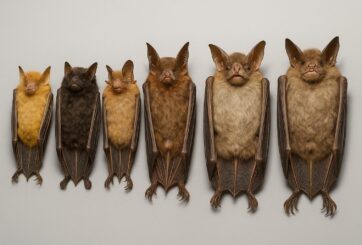
Just in time for Halloween, researchers from the Royal Ontario Museum (ROM), the Field Museum in Chicago, and Lawrence University in Wisconsin have announced the discovery of six new species of bats. These newly identified species, all found in the Philippines, belong to the group known as tube-nosed bats—a fascinating and diverse branch of the mammal family tree. Expanding the Tree of Life Formally recognized as new species through morphological and genetic analysis, this discovery expands the already impressive global…
In a recent study published today in the European Geosciences Union (EGU) journal Biogeosciences, scientists have confirmed that mercury pollution from artisanal and small-scale gold mining (ASGM) is contaminating food crops not through the soil, as previously believed, but directly from the air. Driven by the surging price of gold, which has increased by more than tenfold since 2000, the rapid expansion of unregulated mining in these regions raises urgent questions about food security, human health, and environmental justice The…
A new study from Iceland’s Surtsey island shows that birds carried most of the plants that colonised the island, challenging long-held beliefs that seed or fruit shape determines how plants spread — offering fresh insight into life’s adaptation to c When the volcanic island of Surtsey rose from the North Atlantic Ocean in 1963, it offered scientists a once-in-a-lifetime opportunity to observe how life takes hold on a brand-new and barren land. For decades, ecologists believed that plants’ ability to…
 Feedback
