



Feeding 9 Billion: Innovations in Agricultural Modeling
Since the time billions of years ago when Mars was formed, it has never been a spherically symmetric planet, nor is it composed of similar materials throughout, say scientists who have studied the planet. Since its formation, it has changed its shape, for example, through the development of the Tharsis bulge, an eight kilometer [five mile] high feature that covers one-sixth of the Martian surface, and through volcanic activity. As a result of these and other factors, its polar axis has not been stable relative to surface features and is known to have wandered through the eons as Mars rotated around it and revolved around the Sun.
Now, a Canadian researcher has calculated the location of Mars’ ancient poles, based upon the location of five giant impact basins on the planet’s surface. Jafar Arkani-Hamed of McGill University in Montreal, Quebec, has determined that these five basins, named Argyre, Hellas, Isidis, Thaumasia, and Utopia, all lie along the arc of a great circle. This suggests that the projectiles that caused the basins originated with a single source and that the impacts trace the Martian equator at the time of impact, which was prior to the development of the Tharsis bulge, he says.
Writing in the Journal of Geophysical Research (Planets), Arkani-Hamed calculates that the source of the five projectiles was an asteroid that had been circling the Sun in the same plane as Mars and most of the other planets. At one point, it passed close to the planet, until the force of Martian gravity surpassed the tensile strength of the asteroid, at which point it fragmented. The five large fragments would have remained in the same plane, that of Mars’ then-equator. They hit in different spots around the Martian globe, due to Mars’ rotation on its then-axis and the differing lengths of time the fragments took before impacting on Mars.
Arkani-Hamed describes the locations of the resulting basins, only three of which are well preserved. The two others have been detected by analysis of Martian gravitational anomalies. The great circle they describe on the Martian surface has its center at latitude -30 and longitude 175. By realigning the map of Mars with that spot as the south pole, the great circle marks the ancient equator.
Arkani-Hamed estimates that the mass of the asteroid captured by Mars was about one percent of that of Earth’s Moon. Its diameter was in the range of 800 to 1,000 kilometers [500 to 600 miles], depending upon its density, which cannot be determined.
The significance of Arkani-Hamed’s findings, if borne out by further research, is that the extent of presumed underground water on Mars would have to be reassessed. “The region near the present equator was at the pole when running water most likely existed,” he said in a statement. “As surface water diminished, the polar caps remained the main source of water that most likely penetrated to deeper strata and has remained as permafrost, underlain by a thick groundwater reservoir. This is important for future manned missions to Mars.”




Earthquakes in the American state of Utah, the Soultz-sous-Forêts region of France or in the Dutch province of Groningen should not be able to occur even if the subsurface has been exploited for decades. This is because the shallow subsurface behaves in such a way that faults there become stronger as soon as they start moving. At least that is what geology textbooks teach us. And so, in theory, it should not be possible for earthquakes to occur. So why…
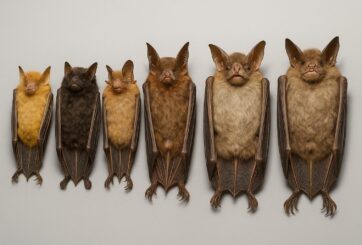
Just in time for Halloween, researchers from the Royal Ontario Museum (ROM), the Field Museum in Chicago, and Lawrence University in Wisconsin have announced the discovery of six new species of bats. These newly identified species, all found in the Philippines, belong to the group known as tube-nosed bats—a fascinating and diverse branch of the mammal family tree. Expanding the Tree of Life Formally recognized as new species through morphological and genetic analysis, this discovery expands the already impressive global…
In a recent study published today in the European Geosciences Union (EGU) journal Biogeosciences, scientists have confirmed that mercury pollution from artisanal and small-scale gold mining (ASGM) is contaminating food crops not through the soil, as previously believed, but directly from the air. Driven by the surging price of gold, which has increased by more than tenfold since 2000, the rapid expansion of unregulated mining in these regions raises urgent questions about food security, human health, and environmental justice The…
A new study from Iceland’s Surtsey island shows that birds carried most of the plants that colonised the island, challenging long-held beliefs that seed or fruit shape determines how plants spread — offering fresh insight into life’s adaptation to c When the volcanic island of Surtsey rose from the North Atlantic Ocean in 1963, it offered scientists a once-in-a-lifetime opportunity to observe how life takes hold on a brand-new and barren land. For decades, ecologists believed that plants’ ability to…
 Feedback
