



Feeding 9 Billion: Innovations in Agricultural Modeling
They will come by land, sea, and air to probe the skies and take measure of the air we breathe. And the University of New Hampshire will be at the center of it all – the largest and most complex air quality-climate study ever attempted.
Satellites will fly overhead scanning the Earth’s atmosphere, research aircraft will make tight spirals down a 40,000-foot column of air and “sniff” for hundreds of chemical species. Planes will fly wingtip-to-wingtip gathering air samples and comparing measurements to gauge instrument accuracy. Small, high-tech balloons that adjust their height to stay inside a polluted air mass will be launched in hopes of crossing the Atlantic Ocean to see what the United States exports to Europe.
The initiative kicks off when the National Oceanic and Atmospheric Administration’s (NOAA) 274-foot Research Vessel Ronald H. Brown steams into Portsmouth Harbor at the end of June to load the scientific instruments designed for the six-week field experiment. Known as the International Consortium for Atmospheric Research on Transport and Transformation or ICARTT, the study will involve five countries, universities and government agencies, and hundreds of scientists, including researchers, technicians, and students from UNH, which will be the host institution.
In addition to the R/V Brown, scientific platforms will include 12 research aircraft, among them NASA’s DC-8 Airborne Science Lab and the NOAA P-3, three Earth-orbiting satellites – Aqua, Terra, and Envisat, “Smart Balloons,” and ground-based platforms, most prominently UNH’s four AIRMAP (Atmospheric Investigation, Regional Modeling, Analysis and Prediction) observatories strategically located atop Mt. Washington, in Durham and Moultonborough, and on Appledore Island.
The permanent, ground-based AIRMAP atmospheric observatories – some of the most sophisticated in the world – will sample the air day and night for 180 chemicals critical to the region’s air quality. The UNH observatories will serve as the foundation for the study by providing a continuous, long-term record to put into context the snapshots of air quality gathered by the mobile platforms from July 1 to August 15.
“The combination of all these measurements will give us an unprecedented amount of data to better understand regional air quality and help launch the forecasting that NOAA plans for later this year,” says Robert Talbot, who directs both AIRMAP and UNH’s Climate Change Research Center within the Institute for the Study of Earth, Oceans, and Space (EOS).
The three focus areas of the research are regional air quality, intercontinental transport of polluted air masses, and the effects of pollutants on atmospheric cooling and warming. The goal of ICARTT is to enhance the ability to predict and monitor air quality changes, and provide the scientific knowledge needed to make informed decisions. A large contingent of computer modelers and meteorologists will be based at the Pease International Tradeport (as will many of the aircraft) at the ICARTT science “command center,” which will be housed at the New Hampshire Community Technical College. For the science flights that will occur every other day, the modelers and forecasters will predict where planes should be deployed to sample plumes of polluted air. After samples are gathered and measurements are made, the models will be adjusted to improve their forecasting capabilities.
NOAA is mandated to have air quality forecasts up and running soon. Trial forecasts will begin in New England this fall.
An added component of the field campaign, which will be led by UNH researchers and broadens the science to include human health effects, is a study entitled the Integrated Human Health and Air Quality Assessment (INHALE) that directly measures and correlates health effects (e.g., asthma) with changes in air quality. In addition, an economic analysis of the relationship between air quality and emergency room visits, health care system usage, and worker absenteeism and productivity will be conducted.




Earthquakes in the American state of Utah, the Soultz-sous-Forêts region of France or in the Dutch province of Groningen should not be able to occur even if the subsurface has been exploited for decades. This is because the shallow subsurface behaves in such a way that faults there become stronger as soon as they start moving. At least that is what geology textbooks teach us. And so, in theory, it should not be possible for earthquakes to occur. So why…
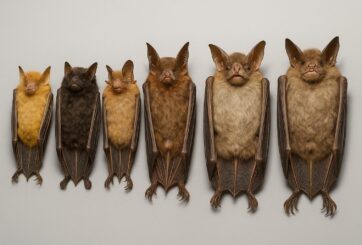
Just in time for Halloween, researchers from the Royal Ontario Museum (ROM), the Field Museum in Chicago, and Lawrence University in Wisconsin have announced the discovery of six new species of bats. These newly identified species, all found in the Philippines, belong to the group known as tube-nosed bats—a fascinating and diverse branch of the mammal family tree. Expanding the Tree of Life Formally recognized as new species through morphological and genetic analysis, this discovery expands the already impressive global…
In a recent study published today in the European Geosciences Union (EGU) journal Biogeosciences, scientists have confirmed that mercury pollution from artisanal and small-scale gold mining (ASGM) is contaminating food crops not through the soil, as previously believed, but directly from the air. Driven by the surging price of gold, which has increased by more than tenfold since 2000, the rapid expansion of unregulated mining in these regions raises urgent questions about food security, human health, and environmental justice The…
A new study from Iceland’s Surtsey island shows that birds carried most of the plants that colonised the island, challenging long-held beliefs that seed or fruit shape determines how plants spread — offering fresh insight into life’s adaptation to c When the volcanic island of Surtsey rose from the North Atlantic Ocean in 1963, it offered scientists a once-in-a-lifetime opportunity to observe how life takes hold on a brand-new and barren land. For decades, ecologists believed that plants’ ability to…
 Feedback
