



Feeding 9 Billion: Innovations in Agricultural Modeling
Two swarms of microscopic cometary dust blasted NASA’s Stardust spacecraft in short but intense bursts as it approached within 150 miles of Comet Wild 2 last January, data from a University of Chicago instrument flying aboard the spacecraft has revealed.
“These things were like a thunderbolt,” said Anthony Tuzzolino, a Senior Scientist at the University of Chicago’s Enrico Fermi Institute. “I didn’t anticipate running into this kind of show.” Tuzzolino and Thanasis Economou, also a Senior Scientist at the Fermi Institute, will report their findings in the June 17 issue of the journal Science.
The materials streaming from a comet range in size from particles that could fit on the head of a pin to boulders the size of a truck. Stardust mission planners correctly estimated that their spacecraft could safely avoid the hazardous larger objects by passing the comet at a distance of approximately 150 miles and using very effective dust particle shields.
Based on the data collected by the Dust Flux Monitor Instrument, Tuzzolino and Economou estimate that NASA achieved its goal of collecting at least 1,000 samples measuring at least one-third the width of a human hair or larger during the flyby.
The Stardust spacecraft is scheduled to return the samples to Earth in January 2006. Scientists will study the samples, the first ever returned to Earth from a comet, for insights into the early history of the solar system.
The Dust Flux Monitor Instrument collected data for 30 minutes when the spacecraft passed closest to the comet last Jan. 2. Stardust encountered the first swarm of dust particles when the spacecraft passed within 146.5 miles of the comet’s nucleus. The monitor detected a second intense swarm after passing the comet when the spacecraft was approximately 2,350 miles from the nucleus.
“We believe that we see fragmentation of large dust lumps into swarms of small particles after they are coming out from the nucleus,” Economou said.
In between the particle swarms, the impact of which lasted just a few seconds each, the dust monitor went for periods of several minutes before it detected another particle.
This isn’t Tuzzolino’s first encounter with a comet, though it is by far the closest. He helped design, build and test the Dust Counter and Mass Analyzer instrument that passed Comet Halley at a distance of 5,000 miles or more in 1986 aboard two Soviet Vega spacecraft. Halley had emitted a spray of dust “much smoother” than that of Wild 2, Tuzzolino recalled.
“In general, one thinks of a comet as emitting gas and dust in a nice, uniform steady state, sort of like a hose,” he said. Halley did show fluctuations, “but not to this extent.”
The dust monitor detected its first impact when Stardust was 1,010 miles from the cometary nucleus. The last impact was recorded at a distance of 3,500 miles as the spacecraft sped away. During one intense event, the dust monitor detected more than 1,100 impacts in one second. The largest particle measured during the cometary flyby measured an estimated 500ths of an inch in diameter.
A similar instrument to the University of Chicago Dust Flux Monitor Instrument is a component on NASA’s Cassini mission to Saturn. Cassini’s High-Rate Detector, which Tuzzolino also built, is part of a larger instrument, Germany’s Cosmic Dust Analyzer, which will study the ice and dust particles that form the major components of Saturn’s ring system. Cassini is scheduled to become the first spacecraft ever to orbit Saturn on June 30.




Earthquakes in the American state of Utah, the Soultz-sous-Forêts region of France or in the Dutch province of Groningen should not be able to occur even if the subsurface has been exploited for decades. This is because the shallow subsurface behaves in such a way that faults there become stronger as soon as they start moving. At least that is what geology textbooks teach us. And so, in theory, it should not be possible for earthquakes to occur. So why…
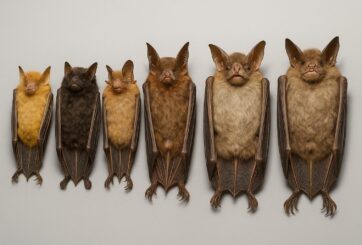
Just in time for Halloween, researchers from the Royal Ontario Museum (ROM), the Field Museum in Chicago, and Lawrence University in Wisconsin have announced the discovery of six new species of bats. These newly identified species, all found in the Philippines, belong to the group known as tube-nosed bats—a fascinating and diverse branch of the mammal family tree. Expanding the Tree of Life Formally recognized as new species through morphological and genetic analysis, this discovery expands the already impressive global…
In a recent study published today in the European Geosciences Union (EGU) journal Biogeosciences, scientists have confirmed that mercury pollution from artisanal and small-scale gold mining (ASGM) is contaminating food crops not through the soil, as previously believed, but directly from the air. Driven by the surging price of gold, which has increased by more than tenfold since 2000, the rapid expansion of unregulated mining in these regions raises urgent questions about food security, human health, and environmental justice The…
A new study from Iceland’s Surtsey island shows that birds carried most of the plants that colonised the island, challenging long-held beliefs that seed or fruit shape determines how plants spread — offering fresh insight into life’s adaptation to c When the volcanic island of Surtsey rose from the North Atlantic Ocean in 1963, it offered scientists a once-in-a-lifetime opportunity to observe how life takes hold on a brand-new and barren land. For decades, ecologists believed that plants’ ability to…
 Feedback
