



Feeding 9 Billion: Innovations in Agricultural Modeling
The most northerly active volcano on Russia’s Kamchatka Peninsula is once again erupting, dusting the surrounding snow-white landscape with a wide expanse of dark ash that is visible from 800 km away in space.
This image of the Kamchatka Peninsula on Russia’s East Coast was acquired on 11 May 2004 by the Medium Resolution Imaging Spectrometer (MERIS) instrument on ESA’s Envisat satellite in reduced resolution mode.
Two thirds of the way up the Peninsula can be seen a roughly circular band of ash, and at the high point of this band is located the steep-sided 3283-metre-high Shiveluch stratovolcano. An aerial cloud of steam and possibly ash originating from the peak is also faintly visible against the ocean to the east of the Peninsula.
Part of the volcanic ’Ring of Fire’ chain located around the Pacific, Shiveluch – also known as Sheveluch – last erupted in 2001. After a two-year lull volcanic activity began again at the start of this year, and on 9 May the volcano underwent an explosive eruption, propelling ash and volcanic gases into the atmosphere up to eight km above sea level.
The locally-based Kamchatkan Volcanic Eruptions Response Team has observed a lava dome growing in the crater and warn that another explosive eruption could be due at any time. Strong volcanic tremors and surface earthquakes have been detected, while heavy mudslides from Shiveluch have also blocked roads in the area.




Earthquakes in the American state of Utah, the Soultz-sous-Forêts region of France or in the Dutch province of Groningen should not be able to occur even if the subsurface has been exploited for decades. This is because the shallow subsurface behaves in such a way that faults there become stronger as soon as they start moving. At least that is what geology textbooks teach us. And so, in theory, it should not be possible for earthquakes to occur. So why…
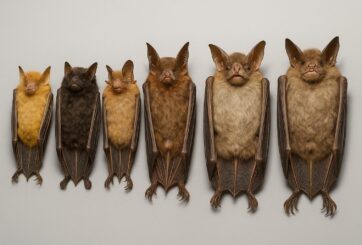
Just in time for Halloween, researchers from the Royal Ontario Museum (ROM), the Field Museum in Chicago, and Lawrence University in Wisconsin have announced the discovery of six new species of bats. These newly identified species, all found in the Philippines, belong to the group known as tube-nosed bats—a fascinating and diverse branch of the mammal family tree. Expanding the Tree of Life Formally recognized as new species through morphological and genetic analysis, this discovery expands the already impressive global…
In a recent study published today in the European Geosciences Union (EGU) journal Biogeosciences, scientists have confirmed that mercury pollution from artisanal and small-scale gold mining (ASGM) is contaminating food crops not through the soil, as previously believed, but directly from the air. Driven by the surging price of gold, which has increased by more than tenfold since 2000, the rapid expansion of unregulated mining in these regions raises urgent questions about food security, human health, and environmental justice The…
A new study from Iceland’s Surtsey island shows that birds carried most of the plants that colonised the island, challenging long-held beliefs that seed or fruit shape determines how plants spread — offering fresh insight into life’s adaptation to c When the volcanic island of Surtsey rose from the North Atlantic Ocean in 1963, it offered scientists a once-in-a-lifetime opportunity to observe how life takes hold on a brand-new and barren land. For decades, ecologists believed that plants’ ability to…
 Feedback
