



Feeding 9 Billion: Innovations in Agricultural Modeling
Shipboard marine scientists from Rutgers, The State University of New Jersey, will release a nontoxic red dye into the Atlantic Ocean off New Jersey during the week of May 2 to help reveal the contents and fate of Hudson River water after it joins the Atlantic.
The dye release is the first of three experiments in Rutgers’ ongoing study of the Hudson River Plume – the mix of river water and substances that flow into the ocean at a rate of 500 billion gallons per day. Preliminary studies indicate that the plume tends to sweep southward along the New Jersey coast.
The exact location and time of the dye release will be determined by the position of the plume and other conditions. Robert J. Chant, professor of physical oceanography with Rutgers’ Institute of Marine and Coastal Sciences (IMCS), said he hopes to release the dye sometime Sunday or Monday in an area a few miles southeast of Sandy Hook.
The dye initially will be visible on the ocean as a red patch, perhaps a mile or more long, Chant said. “It will then disperse and gradually become invisible to the human eye, but remain detectable by our sensors. Essentially we’re tagging a piece of the ocean and following it.”
Chant and a crew of fellow oceanographers plan to follow the flow of the dye on a research vessel for about five days, and possibly 100 or miles more. Throughout the voyage, they will be testing the water to increase their knowledge about where the plume goes and what it contains.
A live streaming video and audio feed of experiment activities and scientists’ commentary during the cruise will available online at http://marine.rutgers.edu/cool/latte. IMCS will take aerial photos of the dye patch and then post and later archive the images online.
The five-year study, called the Lagrangian Transport and Transformation Experiment (LaTTE), also involves the ongoing use of unmanned submarines, satellites, coastal radar and other technologies. It is funded through a $4.2 million grant from the National Science Foundation.
As the study progresses, Rutgers scientists will add the data to computer models for predicting plume behavior and content under a wide range of conditions. Such information will be useful, for example, in predicting potentially dangerous algae blooms along the coast and making decisions about sewage disposal.
Chant is the principal investigator on the study. He is working along with fellow IMCS scientists Scott M. Glenn, Oscar Schofield and John L. Wilkin, and John R. Reinfelder of Rutgers’ environmental sciences department.
Facts




Earthquakes in the American state of Utah, the Soultz-sous-Forêts region of France or in the Dutch province of Groningen should not be able to occur even if the subsurface has been exploited for decades. This is because the shallow subsurface behaves in such a way that faults there become stronger as soon as they start moving. At least that is what geology textbooks teach us. And so, in theory, it should not be possible for earthquakes to occur. So why…
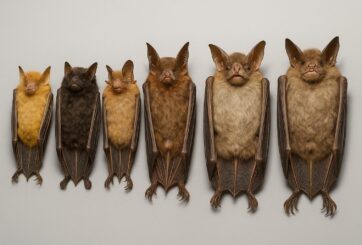
Just in time for Halloween, researchers from the Royal Ontario Museum (ROM), the Field Museum in Chicago, and Lawrence University in Wisconsin have announced the discovery of six new species of bats. These newly identified species, all found in the Philippines, belong to the group known as tube-nosed bats—a fascinating and diverse branch of the mammal family tree. Expanding the Tree of Life Formally recognized as new species through morphological and genetic analysis, this discovery expands the already impressive global…
In a recent study published today in the European Geosciences Union (EGU) journal Biogeosciences, scientists have confirmed that mercury pollution from artisanal and small-scale gold mining (ASGM) is contaminating food crops not through the soil, as previously believed, but directly from the air. Driven by the surging price of gold, which has increased by more than tenfold since 2000, the rapid expansion of unregulated mining in these regions raises urgent questions about food security, human health, and environmental justice The…
A new study from Iceland’s Surtsey island shows that birds carried most of the plants that colonised the island, challenging long-held beliefs that seed or fruit shape determines how plants spread — offering fresh insight into life’s adaptation to c When the volcanic island of Surtsey rose from the North Atlantic Ocean in 1963, it offered scientists a once-in-a-lifetime opportunity to observe how life takes hold on a brand-new and barren land. For decades, ecologists believed that plants’ ability to…
 Feedback
