



Feeding 9 Billion: Innovations in Agricultural Modeling
Using a unique combination of ground-based and space-based tools, scientists have determined for the first time how drought conditions, and possibly carbon uptake, in the Amazon rainforest can be quantified over large forest areas from space. The results are published in the on-line early edition of the Proceedings of the National Academy of Sciences, April 5-9.
“Understanding the Amazon environment is an essential puzzle piece needed to understand how the biosphere interacts with the climate system,” said lead author Dr. Gregory Asner of the Department of Global Ecology at the Carnegie Institution* in Stanford, California. “The Amazon is simply too big and complex to study on the ground alone,” he continued. “Thus far it’s been impossible to determine some of the most basic properties of the forest that we need in order to understand what happens during common climatic events–such as the El Niño dry periods–and what that means to forest growth and the amount of carbon that is locked up in the forest via photosynthesis. Without these measurements we will fall short in understanding how large a role tropical forests play in mediating the effects of fossil-fuel emissions from human activities.”
Amazonia, the world’s largest rainforest, experiences a big range in rainfall from the rainy to dry seasons and during global climatic events such as El Niño. The amount of precipitation affects forest dynamics, land use, and fire susceptibility. To evaluate drought conditions the researchers conducted the first forest canopy experiment in the region. They covered over 10,000 square meters of the central Brazilian Amazon forest with plastic making a “drydown” site and then measured rainfall, soil moisture, leaf and canopy characteristics over time. They coupled these data with a new space-based technology called imaging spectroscopy from the NASA Earth Observing-1 (EO-1) satellite launched in November of 2000. They found that the spectra collected by the satellite from reflected sunlight correlates with on-ground measurements indicating a decrease in soil water and dehydrated leaves.
“The fact that we confirmed that satellite imaging can be used to measure something as detailed as the physiology of the rainforest canopy, means that this technique might be useful for understanding other types of ecological phenomena at both large and small scales,” Asner remarked. ” We believe that space-based technology like this is the wave of the future for analyzing our planet, ” he concluded.
*Other authors include Daniel Nepstad (Woods Hole Research Center and Instituto de Pesquisa Ambiental da Amazonia, Belém, Brazil), Gina Cardinot ( Instituto de Pesquisa Ambiental da Amazonia), and David Ray ( Woods Hole Research Center). This study was supported by NASA, The Mellon Foundation, and the Carnegie Institution.
The Carnegie Institution of Washington (www.CarnegieInstitution.org) has been a pioneering force in basic scientific research since 1902. It is a private, nonprofit organization with six research departments in the U.S.: Embryology, in Baltimore, MD; the Department of Terrestrial Magnetism and the Geophysical Laboratory in Washington, DC; The Observatories in Pasadena, CA, and Chile; and Plant Biology and Global Ecology in Stanford, CA.




Earthquakes in the American state of Utah, the Soultz-sous-Forêts region of France or in the Dutch province of Groningen should not be able to occur even if the subsurface has been exploited for decades. This is because the shallow subsurface behaves in such a way that faults there become stronger as soon as they start moving. At least that is what geology textbooks teach us. And so, in theory, it should not be possible for earthquakes to occur. So why…
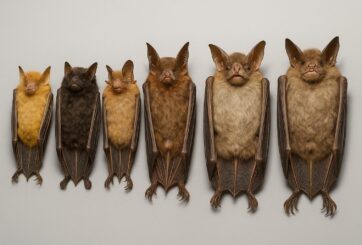
Just in time for Halloween, researchers from the Royal Ontario Museum (ROM), the Field Museum in Chicago, and Lawrence University in Wisconsin have announced the discovery of six new species of bats. These newly identified species, all found in the Philippines, belong to the group known as tube-nosed bats—a fascinating and diverse branch of the mammal family tree. Expanding the Tree of Life Formally recognized as new species through morphological and genetic analysis, this discovery expands the already impressive global…
In a recent study published today in the European Geosciences Union (EGU) journal Biogeosciences, scientists have confirmed that mercury pollution from artisanal and small-scale gold mining (ASGM) is contaminating food crops not through the soil, as previously believed, but directly from the air. Driven by the surging price of gold, which has increased by more than tenfold since 2000, the rapid expansion of unregulated mining in these regions raises urgent questions about food security, human health, and environmental justice The…
A new study from Iceland’s Surtsey island shows that birds carried most of the plants that colonised the island, challenging long-held beliefs that seed or fruit shape determines how plants spread — offering fresh insight into life’s adaptation to c When the volcanic island of Surtsey rose from the North Atlantic Ocean in 1963, it offered scientists a once-in-a-lifetime opportunity to observe how life takes hold on a brand-new and barren land. For decades, ecologists believed that plants’ ability to…
 Feedback
