



Feeding 9 Billion: Innovations in Agricultural Modeling
Scientists from the Universities of Sheffield and Leeds will soon be able to study some of the most elusive particles known to man, thanks to a giant telescope under the sea that looks down towards the centre of the Earth rather than up into the sky.
Together with fellow scientists from across Europe they are building a telescope 2400m (one and a half miles) under the Mediterranean Sea to detect neutrinos. These tiny elementary particles hardly exist at all, having no charge and almost no mass. Neutrinos zoom through the earth at almost the speed of light, travelling here from some of the most extreme regions of the cosmos. Understanding them will give us a new view of the Universe and may allow scientists to confirm the existence of dark matter. Dark matter is believed to make up some of the 90 per cent of the missing mass of the Universe that has never been detected.
The project, costing 20 million Euros, is the result of collaboration between 150 physicists and astronomers from sixteen European organisations.
The telescope will consist of ten 480m long strings fixed to the seabed, each with a weight at one end and a buoy at the other. Each string will have around 30 light detection photo-multipliers distributed along the entire length. The strings are connected, via a junction box on the seabed, to a 40km fibre optic cable, which relays information back to a base station on the south coast of France. Today the Nautille submarine has connected the first string to the cable using a robotic arm.
Dr Lee Thompson of the Physics and Astronomy Department at University of Sheffield is the UK project leader for Antares. He explains how the telescope works, “The photo-multipliers detect the light given off on the rare occasions when neutrinos interact with material (such as rock in the seabed or even seawater) and become muons. Muons are particles that are similar to electrons but heavier. When travelling through the water the muons give off a blue light, which the telescope will detect and record.
“Neutrinos have no charge so they always travel in a straight line. By following the path of the muons we will be able to determine where the neutrinos came from and discover the source of their creation.
“The reason that we need to build the telescope under the sea is that the water prevents muons from cosmic rays in the atmosphere from contaminating our study. By looking down the Earth also acts as a filter, as muons that haven?t been created from a neutrino will be absorbed before they can get into the study area.”




Earthquakes in the American state of Utah, the Soultz-sous-Forêts region of France or in the Dutch province of Groningen should not be able to occur even if the subsurface has been exploited for decades. This is because the shallow subsurface behaves in such a way that faults there become stronger as soon as they start moving. At least that is what geology textbooks teach us. And so, in theory, it should not be possible for earthquakes to occur. So why…
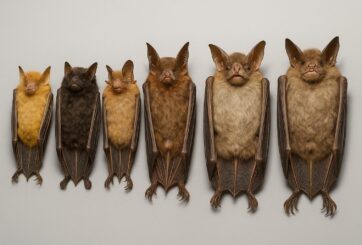
Just in time for Halloween, researchers from the Royal Ontario Museum (ROM), the Field Museum in Chicago, and Lawrence University in Wisconsin have announced the discovery of six new species of bats. These newly identified species, all found in the Philippines, belong to the group known as tube-nosed bats—a fascinating and diverse branch of the mammal family tree. Expanding the Tree of Life Formally recognized as new species through morphological and genetic analysis, this discovery expands the already impressive global…
In a recent study published today in the European Geosciences Union (EGU) journal Biogeosciences, scientists have confirmed that mercury pollution from artisanal and small-scale gold mining (ASGM) is contaminating food crops not through the soil, as previously believed, but directly from the air. Driven by the surging price of gold, which has increased by more than tenfold since 2000, the rapid expansion of unregulated mining in these regions raises urgent questions about food security, human health, and environmental justice The…
A new study from Iceland’s Surtsey island shows that birds carried most of the plants that colonised the island, challenging long-held beliefs that seed or fruit shape determines how plants spread — offering fresh insight into life’s adaptation to c When the volcanic island of Surtsey rose from the North Atlantic Ocean in 1963, it offered scientists a once-in-a-lifetime opportunity to observe how life takes hold on a brand-new and barren land. For decades, ecologists believed that plants’ ability to…
 Feedback
