



Feeding 9 Billion: Innovations in Agricultural Modeling
Two University of York graduates have found and preserved the giant tusk of the largest elephant fossil of its type ever to be found in the Middle East.
The tusk, two-and-a-half metres long and thought to be between six and eight million years old, was discovered by Dr Mark Beech, who finished his PhD at York recently and is now senior resident archaeologist for the Abu Dhabi Islands Archaeological Survey (ADIAS).
Mark discovered the tusk in Abu Dhabi’s Western Region last October during survey work for a construction company. When the tusk was exposed
it became obvious that it was extremely fragile and that special conservation techniques would be required while it was moved. It could not be left where it was because the site is to be used for a waste disposal plant.
Mark, joined by fellow York graduate Will Higgs, who is now a research associate in the University of York’s Department of Archaeology, returned to the site in December and treated the tusk with chemicals to prevent it disintegrating, before covering it with a special foam and transporting it to be stored with a collection of fossils in the city of Abu Dhabi.
Dr Beech said: “We were stunned by the discovery. Only a small part of the tusk was initially visible on the surface although we suspected it might be an important find. It is incredible that the tusk survived. Other elephant remains have been found in the Western Region of Abu Dhabi but this is much bigger. It is also the first complete tusk found in the region.”
The tusk dates from a time nearly eight million years ago when the Western Region of Abu Dhabi was a forested Savannah area with slow-moving rivers.
Mr Higgs added: “I am returning to Abu Dhabi in February to aid Mark with further fossil excavation. It’s incredibly exciting work.”




Earthquakes in the American state of Utah, the Soultz-sous-Forêts region of France or in the Dutch province of Groningen should not be able to occur even if the subsurface has been exploited for decades. This is because the shallow subsurface behaves in such a way that faults there become stronger as soon as they start moving. At least that is what geology textbooks teach us. And so, in theory, it should not be possible for earthquakes to occur. So why…
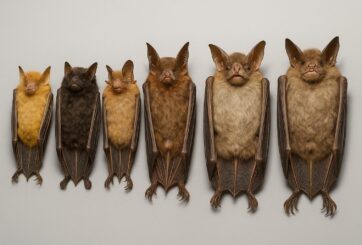
Just in time for Halloween, researchers from the Royal Ontario Museum (ROM), the Field Museum in Chicago, and Lawrence University in Wisconsin have announced the discovery of six new species of bats. These newly identified species, all found in the Philippines, belong to the group known as tube-nosed bats—a fascinating and diverse branch of the mammal family tree. Expanding the Tree of Life Formally recognized as new species through morphological and genetic analysis, this discovery expands the already impressive global…
In a recent study published today in the European Geosciences Union (EGU) journal Biogeosciences, scientists have confirmed that mercury pollution from artisanal and small-scale gold mining (ASGM) is contaminating food crops not through the soil, as previously believed, but directly from the air. Driven by the surging price of gold, which has increased by more than tenfold since 2000, the rapid expansion of unregulated mining in these regions raises urgent questions about food security, human health, and environmental justice The…
A new study from Iceland’s Surtsey island shows that birds carried most of the plants that colonised the island, challenging long-held beliefs that seed or fruit shape determines how plants spread — offering fresh insight into life’s adaptation to c When the volcanic island of Surtsey rose from the North Atlantic Ocean in 1963, it offered scientists a once-in-a-lifetime opportunity to observe how life takes hold on a brand-new and barren land. For decades, ecologists believed that plants’ ability to…
 Feedback
