



Feeding 9 Billion: Innovations in Agricultural Modeling
Study suggests macroscopic bilaterian animals did not appear until 555 million years ago
The traces left behind by ancient animals may hold the key to determining when macroscopic bilaterians — animals that are symmetric about a central axis, with a body divided into equivalent right and left halves, and with an anterior-posterior polarity (e.g., this includes worms, ants, and ranging up to humans) — first appeared. A team led by Dr. Mary Droser, professor of geology at the University of California, Riverside, studied “trace” fossils, e.g., burrows, trails and tracks left behind by the earliest bilaterian animals. Results from their study suggest that bilaterian animals did not appear until approximately 555 million years ago.
The authors publish their findings in a paper entitled “Trace fossils and substrates of the terminal Proterozoic-Cambrian transition: Implications for the record of early bilaterians and sediment mixing” in the Proceedings of the National Academy of Sciences (PNAS). They report that these trace fossils, found in many different locations around the world, were preserved very well in sediment beds from the Early Cambrian (544 to 510 million years ago), both in terms of quality of detail and in preserving traces made close to this sediment-water interface. Trace fossils can shed light on an organism’s behavioral activity.
“The timing of the appearance of bilaterian animals, while clearly by 555 million years ago, is the subject of some debate,” said Droser. “One of the most important pieces of evidence for early animals is the record of trace fossils. That is, animal burrows, tracks and trails preserved in the rock record. Based on evidence from functional morphology, many of the features that define bilaterians could only have originated in a relatively large animal that inhabited the seafloor and thus produced trace fossils. Early bilaterians, in particular, were soft-bodied and thus difficult to preserve.”
The trace fossils examined in the study are from the transition between the Proterozoic Era (2.5 billion to 544 million years ago), where few animal body fossils are found, and the Cambrian (544 to 490 million years ago), where diverse animal body fossils such as trilobites are found. Proterozoic trace fossils, typically only a few millimeters wide, are found at the interface between water and sediment. The Cambrian trace fossils are more diverse in size, shape and depth of penetration into the sediment.
The researchers examined and did field work on thousands of meters of rock. “We collected samples from Australia, Newfoundland, the western United States, Scandinavia and Namibia,” said Soren Jensen, co-author of the PNAS paper and a postdoctoral researcher in the department of earth sciences at UC Riverside. “These samples of ancient marine rocks were then carefully inspected, x-rayed, and thin-sectioned for microscopic examination to provide us with an even closer look.”
The authors attribute the exceptional preservation of Early Cambrian trace fossils to the low levels of sediment mixing, which resulted in relatively firm substrates less prone to resuspension. Close inspection of these fossils could help determine exactly when bilaterian animals emerged, a topic of much controversy.
“There have been reports of trace fossils as old as 1 billion years old,” said Droser. “But these records are scarce and, on critical examination, are not convincing. On examining the trace fossil record from 565 million years ago through until 535 million years ago, we found that the substrate conditions — for example, the bottom of the ocean — were such that if animals were burrowing or walking or crawling along the seafloor, their traces would have likely been preserved. We see a gradual increase in diversity and complexity of trace fossils from about 555 million years ago, known as the Cambrian Explosion and which likely reflects the appearance of bilaterians. We found no evidence for a long history of large animals before this time.”
News Media Contact:
Name: Iqbal Pittalwala
Phone: 909.787.2645
Email: iqbal@citrus.ucr.edu




Earthquakes in the American state of Utah, the Soultz-sous-Forêts region of France or in the Dutch province of Groningen should not be able to occur even if the subsurface has been exploited for decades. This is because the shallow subsurface behaves in such a way that faults there become stronger as soon as they start moving. At least that is what geology textbooks teach us. And so, in theory, it should not be possible for earthquakes to occur. So why…
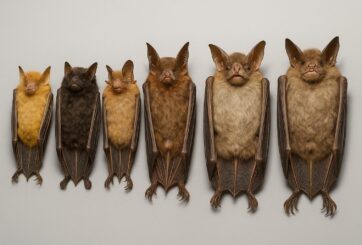
Just in time for Halloween, researchers from the Royal Ontario Museum (ROM), the Field Museum in Chicago, and Lawrence University in Wisconsin have announced the discovery of six new species of bats. These newly identified species, all found in the Philippines, belong to the group known as tube-nosed bats—a fascinating and diverse branch of the mammal family tree. Expanding the Tree of Life Formally recognized as new species through morphological and genetic analysis, this discovery expands the already impressive global…
In a recent study published today in the European Geosciences Union (EGU) journal Biogeosciences, scientists have confirmed that mercury pollution from artisanal and small-scale gold mining (ASGM) is contaminating food crops not through the soil, as previously believed, but directly from the air. Driven by the surging price of gold, which has increased by more than tenfold since 2000, the rapid expansion of unregulated mining in these regions raises urgent questions about food security, human health, and environmental justice The…
A new study from Iceland’s Surtsey island shows that birds carried most of the plants that colonised the island, challenging long-held beliefs that seed or fruit shape determines how plants spread — offering fresh insight into life’s adaptation to c When the volcanic island of Surtsey rose from the North Atlantic Ocean in 1963, it offered scientists a once-in-a-lifetime opportunity to observe how life takes hold on a brand-new and barren land. For decades, ecologists believed that plants’ ability to…
 Feedback
