



Feeding 9 Billion: Innovations in Agricultural Modeling
The new maps, based on nearly a decade of data from NASA's QuikSCAT satellite, have many potential uses, including planning the locations of offshore wind farms to convert wind energy into electric energy.
“Wind energy is environmentally friendly. After the initial energy investment to build and install wind turbines, you don't burn fossil fuels that emit carbon,” says study lead author Tim Liu of NASA's Jet Propulsion Laboratory (JPL) in Pasadena, Calif. “Like solar power, wind energy is green energy.”
The research by Liu and his colleagues was published 8 July 2008 in Geophysical Research Letters, a journal of the American Geophysical Union, or AGU.
QuikSCAT, launched in 1999, tracks the speed, direction and power of winds near the ocean surface. Data from the satellite, collected continuously by a specialized microwave radar instrument named SeaWinds, also are used to examine how ocean winds affect weather and climate, to predict storms, and to enhance the accuracy of weather forecasts.
Wind energy has the potential to provide 10 to 15 percent of future world energy requirements, according to Paul Dimotakis, chief technologist at JPL. If ocean areas with high winds were tapped for wind energy, they could potentially generate 500 to 800 watts of energy per square meter, according to Liu's research. Dimotakis notes that, while this is less than solar energy (which generates about one kilowatt of energy per square meter), wind power can be converted to electricity more efficiently than solar energy and at a lower cost per watt of electricity produced.
According to Liu, new technology has made floating wind farms in the open ocean possible. A number of wind farms are already in operation worldwide. Ocean wind farms have less environmental impact than onshore wind farms, whose noise tends to disturb sensitive wildlife in their immediate area. Also, winds are generally stronger over the ocean than on land because there is less friction over water to slow the winds down–there are no hills or mountains to block the wind's path.
Ideally, offshore wind farms should be located in areas where winds blow continuously at high speeds. The new research identifies such areas and offers explanations for the physical mechanisms that produce the high winds.
An example of one such high-wind mechanism is located off the coast of Northern California near Cape Mendocino. The protruding land mass of the cape deflects northerly winds along the California coast, creating a local wind jet that blows year-round. Similar jets are formed from westerly winds blowing around Tasmania, New Zealand, and Tierra del Fuego in South America, among other locations. Areas with large-scale, high wind power potential also can be found in regions of the mid-latitudes of the Atlantic and Pacific oceans, where winter storms normally track.
The new QuikSCAT maps, which add to previous generations of QuikSCAT wind atlases, also might prove beneficial to the shipping industry by highlighting ocean areas where high winds could be hazardous to ships, allowing the vessels to steer clear of these areas.
NASA's Earth Science Division funded this research.




Earthquakes in the American state of Utah, the Soultz-sous-Forêts region of France or in the Dutch province of Groningen should not be able to occur even if the subsurface has been exploited for decades. This is because the shallow subsurface behaves in such a way that faults there become stronger as soon as they start moving. At least that is what geology textbooks teach us. And so, in theory, it should not be possible for earthquakes to occur. So why…
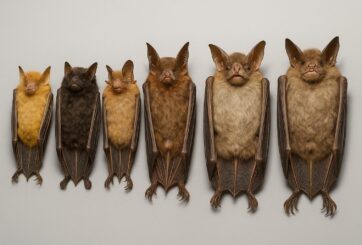
Just in time for Halloween, researchers from the Royal Ontario Museum (ROM), the Field Museum in Chicago, and Lawrence University in Wisconsin have announced the discovery of six new species of bats. These newly identified species, all found in the Philippines, belong to the group known as tube-nosed bats—a fascinating and diverse branch of the mammal family tree. Expanding the Tree of Life Formally recognized as new species through morphological and genetic analysis, this discovery expands the already impressive global…
In a recent study published today in the European Geosciences Union (EGU) journal Biogeosciences, scientists have confirmed that mercury pollution from artisanal and small-scale gold mining (ASGM) is contaminating food crops not through the soil, as previously believed, but directly from the air. Driven by the surging price of gold, which has increased by more than tenfold since 2000, the rapid expansion of unregulated mining in these regions raises urgent questions about food security, human health, and environmental justice The…
A new study from Iceland’s Surtsey island shows that birds carried most of the plants that colonised the island, challenging long-held beliefs that seed or fruit shape determines how plants spread — offering fresh insight into life’s adaptation to c When the volcanic island of Surtsey rose from the North Atlantic Ocean in 1963, it offered scientists a once-in-a-lifetime opportunity to observe how life takes hold on a brand-new and barren land. For decades, ecologists believed that plants’ ability to…
 Feedback
