



Feeding 9 Billion: Innovations in Agricultural Modeling
Fang-Zhen Teng, assistant professor of geosciences and a member of the Arkansas Center for Space and Planetary Sciences, Nicholas Dauphas of the department of geophysical sciences and a member of the Enrico Fermi Institute at the University of Chicago, and Rosalind T. Helz of the U.S. Geological Survey report their findings in the June 20 issue of the journal Science.
The researchers examined iron isotopes in basalt samples from the Kilauea Iki lava lake on the main island of Hawaii. Isotopes have the same chemical properties but different weights, so some processes cause what looks like the same material to behave differently – often separating the two. Such separation can tell scientists something about how the material containing the isotopes formed.
However, until now scientists thought that such isotope fractionation only occurred at low temperatures and with elements of low molecular weight. Because of the heat and iron’s molecular weight, scientists thought that the process that formed basalts did not separate iron isotopes.
“There is a huge dispute on this topic,” Teng said. “Our research shows that there is clearly fractionation.”
Teng likens the change in iron isotopic composition in basalts to the baking of a cake: With a cake, you start out with certain ingredients, but the baking process changes the ingredients and their proportions within the cake. In the same way, the process that makes basalt magma through partial melting of the mantle peridotites, or rocks, changes the iron isotope compositions.
Past studies have examined basalts, but found little or no separation of iron isotopes. However, no one was studying the individual minerals found within a basaltic rock.
“We analyzed not only the whole rocks, but the separate minerals,” Teng said. The minerals examined showed a significant separation of iron isotopes, in contrast to the whole rocks. The researchers looked at olivine crystals, better known as peridot in the jewelry world, which formed and sank as the lava lake cooled.
“This research gives scientists a new tool to investigate the question of planetary differentiation,” said Dauphas. If basalts from the moon or Mars have similar iron isotope separation, it suggests that they formed through heat processes similar to those on Earth. However, if rocks from these planetary bodies do not have iron isotope separation, it suggests that they were formed in a different way.
The next project by Teng, who teaches in the J. William Fulbright College of Arts and Sciences, will be to study the isotopic composition of iron in lunar basalts returned by the Apollo missions.
CONTACT:
Fang-Zhen Teng, assistant professor, geosciences
J. William Fulbright College of Arts and Sciences
(479) 575-4524, fteng@uark.edu
* Cell phone in Beijing, China: (01186) 13718307470




Earthquakes in the American state of Utah, the Soultz-sous-Forêts region of France or in the Dutch province of Groningen should not be able to occur even if the subsurface has been exploited for decades. This is because the shallow subsurface behaves in such a way that faults there become stronger as soon as they start moving. At least that is what geology textbooks teach us. And so, in theory, it should not be possible for earthquakes to occur. So why…
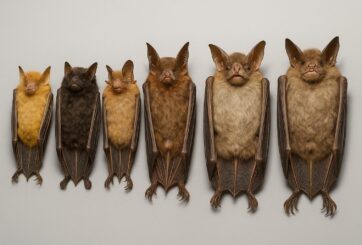
Just in time for Halloween, researchers from the Royal Ontario Museum (ROM), the Field Museum in Chicago, and Lawrence University in Wisconsin have announced the discovery of six new species of bats. These newly identified species, all found in the Philippines, belong to the group known as tube-nosed bats—a fascinating and diverse branch of the mammal family tree. Expanding the Tree of Life Formally recognized as new species through morphological and genetic analysis, this discovery expands the already impressive global…
In a recent study published today in the European Geosciences Union (EGU) journal Biogeosciences, scientists have confirmed that mercury pollution from artisanal and small-scale gold mining (ASGM) is contaminating food crops not through the soil, as previously believed, but directly from the air. Driven by the surging price of gold, which has increased by more than tenfold since 2000, the rapid expansion of unregulated mining in these regions raises urgent questions about food security, human health, and environmental justice The…
A new study from Iceland’s Surtsey island shows that birds carried most of the plants that colonised the island, challenging long-held beliefs that seed or fruit shape determines how plants spread — offering fresh insight into life’s adaptation to c When the volcanic island of Surtsey rose from the North Atlantic Ocean in 1963, it offered scientists a once-in-a-lifetime opportunity to observe how life takes hold on a brand-new and barren land. For decades, ecologists believed that plants’ ability to…
 Feedback
