



Feeding 9 Billion: Innovations in Agricultural Modeling
Palaeontologists have discovered fossil remains in Scandinavia of parrots dating back 55 million years. Reported today in the current issue of the journal Palaeontology, the fossils indicate that parrots once flew wild over what is now Norway and Denmark.
Parrots today live only in the tropics and southern hemisphere, but this new research, which was supported by the Irish Research Council for Science, Engineering and Technology (IRCSET) and University College Dublin (UCD), suggests that they first evolved in the North, much earlier than had been thought.
The fossil parrot was discovered on the Isle of Mors in the northwest of Denmark – far from where you’d normally expect to find a parrot. It’s a new species, officially named 'Mopsitta tanta'. However, already its nick-name is the ‘Danish Blue Parrot’, a term derived from a famous comedy sketch about a 'Norwegian Blue Parrot' in the 1970s BBC television programme ‘Monty Python’. (video link to sketch below)
The Scandinavian connection makes links to Monty Python’s notoriously demised bird irresistible, but the parallels go further. The famous sketch revolves around establishing that a bird purchased by John Cleese is a dead parrot, and in dealing with these fossils, palaeontologists were faced with the same problem.
As Dr David Waterhouse, lead author of the paper, explains: “Obviously, we are dealing with a bird that is bereft of life, but the tricky bit is establishing that it was a parrot. As with many fragile bird fossils, it is a wonder that anything remains at all, and all that remains of this early Danish parrot is a single upper wing bone (humerus). But, this small bone contains characteristic features that show that it is clearly from a member of the parrot family, about the size of a Yellow-crested Cockatoo.”
Dr David Waterhouse was funded by a UCD postgraduate scholarship from 2002 to 2006. He is currently Assistant Curator of Natural History at Norfolk Museums Service. Dr Bent Lindow was an IRCSET ‘Basic Research Grant’ scholar at UCD and the University of Copenhagen from 2004 to 2007. He is currently postdoctoral researcher in palaeontology at the Natural History Museum of Denmark in Copenhagen.
At around 55 million years old, this is very much an ex-parrot. Indeed, Mopsitta represents the oldest and most northerly convincing remains of a parrot ever to have been discovered.
Waterhouse continues: “It isn’t as unbelievable as you might at first think that a parrot was found so far north. When Mopsitta was alive, most of Northern Europe was experiencing a warm period, with a large shallow tropical lagoon covering much of Germany, South East England and Denmark. We have to remember that this was only 10 million years after the dinosaurs were wiped out, and some strange things were happening with animal life all over the planet.”
“No Southern Hemisphere fossil parrot has been found older than about 15 million years old, so this new evidence suggests that parrots evolved right here in the Northern Hemisphere before diversifying further South in the tropics later on.”
So was Danish Mopsitta “pinin’ for the fjords”? “It’s a lovely image,” says Waterhouse, “but we can say with certainty that it was not. This parrot shuffled off its mortal coil around 55 million years ago, but the fjords of Norway were formed during the last ice age and are less than a million years old.”
To view the famous 'Monty Python' sketch, please visit:
http://ie.youtube.com/watch?v=KmRdrsvdvaY




Earthquakes in the American state of Utah, the Soultz-sous-Forêts region of France or in the Dutch province of Groningen should not be able to occur even if the subsurface has been exploited for decades. This is because the shallow subsurface behaves in such a way that faults there become stronger as soon as they start moving. At least that is what geology textbooks teach us. And so, in theory, it should not be possible for earthquakes to occur. So why…
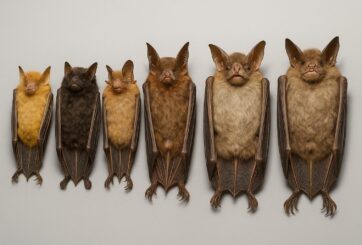
Just in time for Halloween, researchers from the Royal Ontario Museum (ROM), the Field Museum in Chicago, and Lawrence University in Wisconsin have announced the discovery of six new species of bats. These newly identified species, all found in the Philippines, belong to the group known as tube-nosed bats—a fascinating and diverse branch of the mammal family tree. Expanding the Tree of Life Formally recognized as new species through morphological and genetic analysis, this discovery expands the already impressive global…
In a recent study published today in the European Geosciences Union (EGU) journal Biogeosciences, scientists have confirmed that mercury pollution from artisanal and small-scale gold mining (ASGM) is contaminating food crops not through the soil, as previously believed, but directly from the air. Driven by the surging price of gold, which has increased by more than tenfold since 2000, the rapid expansion of unregulated mining in these regions raises urgent questions about food security, human health, and environmental justice The…
A new study from Iceland’s Surtsey island shows that birds carried most of the plants that colonised the island, challenging long-held beliefs that seed or fruit shape determines how plants spread — offering fresh insight into life’s adaptation to c When the volcanic island of Surtsey rose from the North Atlantic Ocean in 1963, it offered scientists a once-in-a-lifetime opportunity to observe how life takes hold on a brand-new and barren land. For decades, ecologists believed that plants’ ability to…
 Feedback
