



Feeding 9 Billion: Innovations in Agricultural Modeling
The Arch, a sculpture dismantled 12 years ago due to safety concerns, could be re-erected at its original site on the banks of the Serpentine Lake following a project exploring the use of rock engineering techniques for cultural heritage conservation.
Engineers at Imperial College London, in collaboration with the International Drawing Institute, Glasgow School of Art, and Tate, carried out a detailed analysis of the Arch to see whether engineering computer simulation and analysis techniques could be used to understand and preserve complex artefacts which experience structural problems.
The Arch, a six metre tall sculpture modelled on sheep collar bones joined together, was created in 1980 by Henry Moore and was dismantled into its seven component pieces in 1996 because of structural instabilities which caused it to be unsafe.
In order to allow the sculpture to be preserved and resurrected, the team needed to find out why it was structurally unsound. By testing rock samples and using laser scanning technologies which examined the large dismantled stone blocks, they gathered data which was used to generate 3D computer simulations of the sculpture for analysis.
By modelling how the structural stresses exerted pressures on the Arch, researchers found that its unusual shape, the poor location of the structural joints which held the blocks together, and the use of brittle travertine stone all contributed to its unsteadiness.
Using this information, the team believes that it has devised a new method to allow the sculpture to be held together without compromising its structure. This includes attaching the rock legs and top section together with fibreglass bolts and dowels and placing the structure on a base of specially reinforced concrete.
Dr John Harrison from Imperial College London’s Department of Earth Science and Engineering said:
“Rock engineering techniques are usually used for stabilisation of tunnels and rock slopes, but the basic concepts of understanding how rock behaves when it is subjected to loads are immediately applicable to stone sculptures. We can now apply this knowledge to preserving some of the nation’s most important and historic artworks.”
Dr Angela Geary from the International Drawing Research Institute, The Glasgow School of Art, added:
“We were delighted when the Henry Moore Foundation invited us to study the Arch as a subject for our research. It was a huge practical challenge, but it was very exciting and motivating to be working on such a significant real-world problem.”
Derek Pullen, Head of Sculpture Conservation at Tate, concluded:
“The outcome is a positive one for everyone involved, and our aim is now to expand across a wide range of artefacts from armoury to pottery and painting. Our methods could remove much of the guesswork from planning conservation treatment and could become an indispensable tool in the care of collections.”
The research was funded as part of the Finite Elements with Laser Scanning for mechanical analysis of Sculptural Objects (FELSSO) project by the Arts and Humanities Research Council, the Henry Moore Foundation with assistance also from the Royal Parks. The team is currently waiting for further funding to resurrect the Arch in Kensington Gardens.




Earthquakes in the American state of Utah, the Soultz-sous-Forêts region of France or in the Dutch province of Groningen should not be able to occur even if the subsurface has been exploited for decades. This is because the shallow subsurface behaves in such a way that faults there become stronger as soon as they start moving. At least that is what geology textbooks teach us. And so, in theory, it should not be possible for earthquakes to occur. So why…
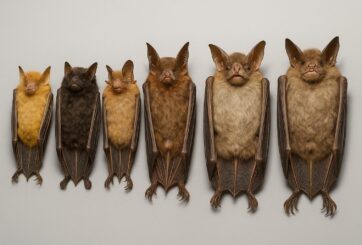
Just in time for Halloween, researchers from the Royal Ontario Museum (ROM), the Field Museum in Chicago, and Lawrence University in Wisconsin have announced the discovery of six new species of bats. These newly identified species, all found in the Philippines, belong to the group known as tube-nosed bats—a fascinating and diverse branch of the mammal family tree. Expanding the Tree of Life Formally recognized as new species through morphological and genetic analysis, this discovery expands the already impressive global…
In a recent study published today in the European Geosciences Union (EGU) journal Biogeosciences, scientists have confirmed that mercury pollution from artisanal and small-scale gold mining (ASGM) is contaminating food crops not through the soil, as previously believed, but directly from the air. Driven by the surging price of gold, which has increased by more than tenfold since 2000, the rapid expansion of unregulated mining in these regions raises urgent questions about food security, human health, and environmental justice The…
A new study from Iceland’s Surtsey island shows that birds carried most of the plants that colonised the island, challenging long-held beliefs that seed or fruit shape determines how plants spread — offering fresh insight into life’s adaptation to c When the volcanic island of Surtsey rose from the North Atlantic Ocean in 1963, it offered scientists a once-in-a-lifetime opportunity to observe how life takes hold on a brand-new and barren land. For decades, ecologists believed that plants’ ability to…
 Feedback
