



Feeding 9 Billion: Innovations in Agricultural Modeling
On 4 May, the United Nations Office for the Coordination of Humanitarian Affairs (OCHA) asked the International Charter on 'Space and Major Disasters' for support. The initiative, referred to as ‘The Charter’, was founded in October 2000 by ESA, the French space agency (CNES) and the Canadian Space Agency (CSA). It is aimed at providing satellite data free of charge to those affected by disasters anywhere in the world.
With inundated areas typically visible from space, Earth Observation (EO) is increasingly being used for flood response and mitigation. One of the biggest problems during flooding emergencies is obtaining an overall view of the phenomenon, with a clear idea of the extent of the flooded area.
The series of Envisat radar images highlights the extent of flooding in the Irrawaddy delta caused by the cyclone. Envisat’s Advanced Synthetic Aperture Radar (ASAR) acquired the image on the left on 5 February 2007, and the image on the right on Monday (5 May 2008).
The left image shows the situation approximately one year ago. The black and dark areas in the image on the right indicate areas potentially still flooded two days after the event. ASAR data are especially well suited for delivering information on floods, which are usually accompanied by rain and therefore cloudy conditions. Radar sensors can peer through clouds, rain or local darkness and are especially sensitive to moisture on the ground.
The recent image was delivered in Near Real Time and processed to correlate to the previous image. Both images have a 75 m pixel grid on the ground and show an area approximately 100 km wide.




Earthquakes in the American state of Utah, the Soultz-sous-Forêts region of France or in the Dutch province of Groningen should not be able to occur even if the subsurface has been exploited for decades. This is because the shallow subsurface behaves in such a way that faults there become stronger as soon as they start moving. At least that is what geology textbooks teach us. And so, in theory, it should not be possible for earthquakes to occur. So why…
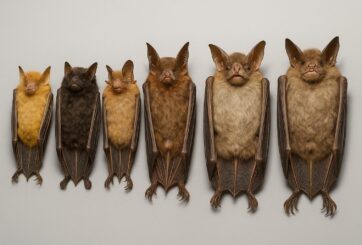
Just in time for Halloween, researchers from the Royal Ontario Museum (ROM), the Field Museum in Chicago, and Lawrence University in Wisconsin have announced the discovery of six new species of bats. These newly identified species, all found in the Philippines, belong to the group known as tube-nosed bats—a fascinating and diverse branch of the mammal family tree. Expanding the Tree of Life Formally recognized as new species through morphological and genetic analysis, this discovery expands the already impressive global…
In a recent study published today in the European Geosciences Union (EGU) journal Biogeosciences, scientists have confirmed that mercury pollution from artisanal and small-scale gold mining (ASGM) is contaminating food crops not through the soil, as previously believed, but directly from the air. Driven by the surging price of gold, which has increased by more than tenfold since 2000, the rapid expansion of unregulated mining in these regions raises urgent questions about food security, human health, and environmental justice The…
A new study from Iceland’s Surtsey island shows that birds carried most of the plants that colonised the island, challenging long-held beliefs that seed or fruit shape determines how plants spread — offering fresh insight into life’s adaptation to c When the volcanic island of Surtsey rose from the North Atlantic Ocean in 1963, it offered scientists a once-in-a-lifetime opportunity to observe how life takes hold on a brand-new and barren land. For decades, ecologists believed that plants’ ability to…
 Feedback
