



Feeding 9 Billion: Innovations in Agricultural Modeling
However, the opposite may also occur – that new and more varied animal life arises following such a catastrophe, is shown by new research conducted by the Natural History Museum of Denmark, University of Copenhagen, and which is now attracting international attention.
Together with colleagues from Lund University in Sweden, two palaeontologists, Svend Stouge and Dave Harper, have discovered that the Earth in the so-called Ordovician period 490-440 million years ago was struck by more than 100 meteorites at one time, and that in the wake of this event, new and more varied life evolved in the oceans, which at that time were home to virtually all life on Earth.
“You could say that biological evolution experienced a serious boost within a relatively short period of time. And, as is the case with, for example, volcanic eruptions or large forest fires, the impacts initially had a devastating effect on all life, but from the ashes arose a much richer fauna than had existed previously. And another interesting aspect is that this situation occurred 40 million years after the so-called Cambrian explosion. It was during this explosion that the first complex multicellular creatures appeared, even though scientists are still discussing whether this evolution was a rapid explosion or whether it took place over a longer period of time,” says Dave Harper from the University of Copenhagen.
The conclusions of the two scientists are, among other things, based on computer analyses, chemical samples from meteorites, fossils and examination of different craters in Sweden, for example the large Lockne crater near Østersund in northern Sweden, which has a diameter of 7.5 km.
“So far, our research has shown that it was a regional phenomenon around Baltica, the Baltic Sea of that time. The area underwent an extraordinary change during a short period of time in terms of the evolution of new species, primarily shellfish, e.g. the so-called brachiopods, which resemble today’s mussels, but which already at that time were quite different. We will now be studying whether this was a global phenomenon. It will be really exciting for the entire history of evolution, especially as it does seem that there is some truth in it and in the impact theory. We have now found meteorites in southern China with the same chemical composition as those we have studied in Sweden. Consequently, we are going to be studying craters and meteorites in China and in the USA to establish whether it was a global phenomenon,” says Svend Stouge from the Natural History Museum of Denmark.
The findings of the two scientists have been published in the British journal Nature Geoscience.




Earthquakes in the American state of Utah, the Soultz-sous-Forêts region of France or in the Dutch province of Groningen should not be able to occur even if the subsurface has been exploited for decades. This is because the shallow subsurface behaves in such a way that faults there become stronger as soon as they start moving. At least that is what geology textbooks teach us. And so, in theory, it should not be possible for earthquakes to occur. So why…
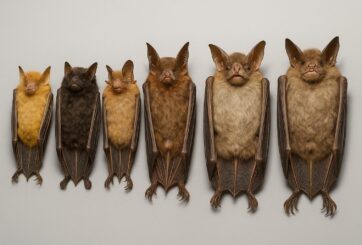
Just in time for Halloween, researchers from the Royal Ontario Museum (ROM), the Field Museum in Chicago, and Lawrence University in Wisconsin have announced the discovery of six new species of bats. These newly identified species, all found in the Philippines, belong to the group known as tube-nosed bats—a fascinating and diverse branch of the mammal family tree. Expanding the Tree of Life Formally recognized as new species through morphological and genetic analysis, this discovery expands the already impressive global…
In a recent study published today in the European Geosciences Union (EGU) journal Biogeosciences, scientists have confirmed that mercury pollution from artisanal and small-scale gold mining (ASGM) is contaminating food crops not through the soil, as previously believed, but directly from the air. Driven by the surging price of gold, which has increased by more than tenfold since 2000, the rapid expansion of unregulated mining in these regions raises urgent questions about food security, human health, and environmental justice The…
A new study from Iceland’s Surtsey island shows that birds carried most of the plants that colonised the island, challenging long-held beliefs that seed or fruit shape determines how plants spread — offering fresh insight into life’s adaptation to c When the volcanic island of Surtsey rose from the North Atlantic Ocean in 1963, it offered scientists a once-in-a-lifetime opportunity to observe how life takes hold on a brand-new and barren land. For decades, ecologists believed that plants’ ability to…
 Feedback
