
Progression of Duchenne Muscle Dystrophy (DMD) can be delayed in mice by supplementing their diets with Urolithin A, according to new results reported today. The findings, published in Science Translational Medicine, raise hopes that new treatment options could one-day be developed for DMD, an uncurable genetic condition characterized by progressive muscle degeneration. About 1 in 3,500 boys are born with DMD, which usually develops in childhood and significantly reduces life expectancy. The new research carried out at the laboratory of…
Nobel laureate in physics Richard Feynman once described turbulence as “the most important unsolved problem of classical physics.” Understanding turbulence in classical fluids like water and air is difficult partly because of the challenge in identifying the vortices swirling within those fluids. Locating vortex tubes and tracking their motion could greatly simplify the modeling of turbulence. But that challenge is easier in quantum fluids, which exist at low enough temperatures that quantum mechanics — which deals with physics on the…
Machine-learning methods lead to discovery of rare “quadruply imaged quasars” that can help solve cosmological puzzles. With the help of machine-learning techniques, a team of astronomers has discovered a dozen quasars that have been warped by a naturally occurring cosmic “lens” and split into four similar images. Quasars are extremely luminous cores of distant galaxies that are powered by supermassive black holes. Over the past four decades, astronomers had found about 50 of these “quadruply imaged quasars,” or quads for…
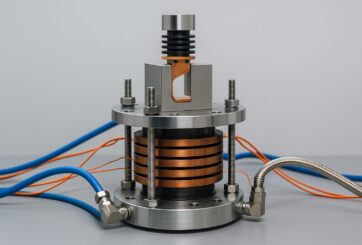
New material improves magnetic cooling near absolute zero … Cooling is a long-standing technological challenge. Standard cooling cycle based on vapor compression exploits expensive helium gas to reach temperatures near absolute zero. Adiabatic demagnetization known since nearly a century could be a viable alternative if compact and durable paramagnetic materials were available. A team of researchers from the University of Augsburg used their recent experience in creating quantum-disordered magnetic states to design a promising new material for adiabatic demagnetization cooling….
Nanothin antimicrobial coating could prevent and treat potentially deadly infections. Researchers have developed a new superbug-destroying coating that could be used on wound dressings and implants to prevent and treat potentially deadly bacterial and fungal infections. The material is one of the thinnest antimicrobial coatings developed to date and is effective against a broad range of drug-resistant bacteria and fungal cells, while leaving human cells unharmed. Antibiotic resistance is a major global health threat, causing at least 700,000 deaths a…
Experiments at the University of Stuttgart cast doubts on the existence of quantum spin liquids – report in Science. A quantum spin liquid is a state of matter in which interacting quantum spins do not align even at lowest temperatures, but remain disordered. Research on this state has been going on for almost 50 years, but whether it really exists has never been proven beyond doubt. An international team led by physicist Prof. Martin Dressel at the University of Stuttgart…
… as environmentally friendly and cost-efficient alternative. The SUPERSMART research project funded by EIT RawMaterials has shown proof: printed electronic components such as sensors and smart labels on paper can play an essential role in building a smart environment for production, retail and logistics. Efficient and reliable production processes make them economically competitive. In terms of resource conservation, climate and the environment, electronics printed on paper have outstanding advantages over conventional substrates and manufacturing processes for smart electronic components. Yesterday…
Telescope launching this autumn could spot biosignatures on other planets within three days. Research shows that a new telescope could detect a potential signature of life on other planets in as little as 60 hours. “What really surprised me about the results is that we may realistically find signs of life on other planets in the next 5 to 10 years,” said Caprice Phillips, a graduate student at The Ohio State University, who will share preliminary findings at a press…
Scientists at Sanford Burnham Prebys have identified a set of human genes that fight SARS-CoV-2 infection, the virus that causes COVID-19. Knowing which genes help control viral infection can greatly assist researchers’ understanding of factors that affect disease severity and also suggest possible therapeutic options. The genes in question are related to interferons, the body’s frontline virus fighters. The study was published in the journal Molecular Cell. “We wanted to gain a better understanding of the cellular response to SARS-CoV-2,…
Austrian pyhsicists are able to devise a design principle for the self-assembly of functionalized molecules. The production of nanomaterials involves self-assembly processes of functionalized (organic) molecules on inorganic surfaces. This combination of organic and inorganic components is essential for applications in organic electronics and other areas of nanotechnology. Until now, certain desired surface properties were often achieved on a trial-and-error basis. Molecules were chemically modified until the best result for the desired surface property was found. However, the processes controlling…
Coronavirus researchers under Prof. Rolf Hilgenfeld of the University of Lübeck and Dr. Albrecht von Brunn of the Ludwig-Maximilians University of Munich published a research breakthrough in the highly ranked “EMBO Journal”. They discovered how SARS viruses enhance the production of viral proteins in infected cells, so that many new copies of the virus can be generated. Other coronaviruses apart from SARS-CoV and SARS-CoV-2 do not use this mechanism, thereby providing a possible explanation for the much higher pathogenicity of…
Discovery a ‘coup’ in astrophysics involving observations with nine instruments. A team of astronomers including Carnegie’s Alycia Weinberger and former-Carnegie postdoc Meredith MacGregor, now an assistant professor at the University of Colorado Boulder, spotted an extreme outburst, or flare, from the Sun’s nearest neighbor–the star Proxima Centauri. Their work, which could help guide the search for life beyond our Solar System, is published in The Astrophysical Journal Letters. Proxima Centauri is a “red dwarf” with about one-eighth the mass of…
A group of astronomers, led by the Italian National Institute of Astrophysics (INAF) and the Max Planck Institute for Radio Astronomy (MPIfR) in Bonn, Germany, has discovered 8 millisecond pulsars located within dense clusters of stars, known as “globular clusters”, using South Africa’s MeerKAT radio telescope. Millisecond pulsars are neutron stars, the most compact star known, that spin up to 700 times per second. This result comes from the synergic work of two international collaborations, TRAPUM and MeerTIME, with the…
Potential COVID-19 treatment pairs nanoparticles with human immune system to search and destroy viruses. Researchers at the Pritzker School of Molecular Engineering (PME) at the University of Chicago have designed a completely novel potential treatment for COVID-19: nanoparticles that capture SARS-CoV-2 viruses within the body and then use the body’s own immune system to destroy it. These “Nanotraps” attract the virus by mimicking the target cells the virus infects. When the virus binds to the Nanotraps, the traps then sequester…
Researchers demonstrate that magnetism and superconductivity can coexist in graphene, opening a pathway towards graphene-based topological qubits. In the quantum realm, electrons can group together to behave in interesting ways. Magnetism is one of these behaviors that we see in our day-to-day life, as is the rarer phenomena of superconductivity. Intriguingly, these two behaviors are often antagonists, meaning that the existence of one of them often destroys the other. However, if these two opposite quantum states are forced to coexist…
A genetically encoded sensor to detect hallucinogenic compounds has been developed by researchers at the University of California, Davis. Named psychLight, the sensor could be used in discovering new treatments for mental illness, in neuroscience research and to detect drugs of abuse. The work is published April 28 in the journal Cell. Compounds related to psychedelic drugs such as LSD and dimethyltryptamine (DMT) show great promise for treating disorders such as depression, post-traumatic stress disorder, and substance use disorder. These…
Coral reefs provide shelter, sustenance and stability to a range of organisms, but these vital ecosystems would not exist if not for the skeletal structure created by stony corals. Now, KAUST scientists together with an international team have revealed the underlying genetic story of how corals evolved from soft-bodied organisms to build the myriad calcified structures we see today. “While the processes involved in coral calcification are well understood, it is less clear how corals’ ability to grow calcium carbonate…
A curiously yellow pre-supernova star has caused astrophysicists to re-evaluate what’s possible at the deaths of our Universe’s most massive stars. The team describe the peculiar star and its resulting supernova in a new study published today in Monthly Notices of the Royal Astronomical Society. At the end of their lives, cool, yellow stars are typically shrouded in hydrogen, which conceals the star’s hot, blue interior. But this yellow star, located 35 million light years from Earth in the Virgo…
Worldwide network headed by Goethe University develops protocols for laboratories. For the development of drugs or vaccines against COVID-19, research needs virus proteins of high purity. For most of the SARS-CoV-2 proteins, scientists at Goethe University Frankfurt and a total of 36 partner laboratories have now developed protocols that enable the production of several milligrams of each of these proteins with high purity, and allow the determination of the three-dimensional protein structures. The laboratory protocols and the required genetic tools…
Imagine an entire twenty storey concrete building which can store energy like a giant battery. Thanks to unique research from Chalmers University of Technology, Sweden, such a vision could someday be a reality. Researchers from the Department of Architecture and Civil Engineering recently published an article outlining a new concept for rechargeable batteries – made of cement. The ever-growing need for sustainable building materials poses great challenges for researchers. Doctor Emma Zhang, formerly of Chalmers University of Technology, Sweden, joined…
 Feedback


