



Feeding 9 Billion: Innovations in Agricultural Modeling
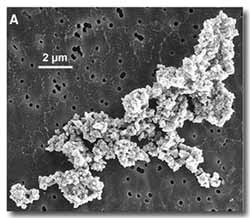
Carbon and silicate grains in interplanetary dust particles are helping scientists solve a 40-year-old astronomical mystery.
Using a transmission electron microscope, researchers from Lawrence Livermore National Laboratory have detected a 5.7-electron volt or 2175 Å (angstrom) wavelength feature in interstellar grains that were embedded within interplanetary dust particles (IDPs). They found that this feature is carried by carbon and amorphous silicate grains that are abundant in IDPs and may help explain how some IDPs formed from interstellar materials.
The research appears in the Jan. 14 edition of the research journal Science.
Interplanetary dust particles gathered from the Earth’s stratosphere are complex collections of primitive solar system and presolar grains from the interstellar medium. The strongest ultraviolet spectral signature of dust in the interstellar medium (the gas and dust between stars, which fills the plane of a galaxy) is the astronomical 2175 angstrom feature or “2175 Å bump.” Production of this interstellar feature is generally believed to originate from electronic transitions associated with the surfaces of very small grains.
The carbon and silicate grains may have been produced by irradiation of dust in the interstellar medium. The measurements may help explain how interstellar organic matter was incorporated into the solar system. In addition, they provide new information for computational modeling, laboratory synthesis of similar grains and laboratory ultraviolet photo-absorption measurements.
“Our finding potentially breaks a log-jam in the search for the carrier of the astronomical 2175 Å feature,” said John Bradley, director of Livermore’s Institute for Geophysics and Planetary Physics and lead author of the paper. “Over the past 40 years, a whole variety of exotic materials have been proposed, including nano-diamonds, fullerenes, carbon ‘onions’ and even interstellar organisms. Our findings suggest that organic carbonaceous matter and silicates, the ‘common stuff’ of interstellar space, may be responsible for the 2175 Å feature.”
Other Livermore scientists on the project include Zu Rong Dai, Giles Graham, Peter Weber, Julie Smith, Ian Hutcheon, Hope Ishii and Sasa Bajt.
Outside collaborators include researchers from UC Davis, Lawrence Berkeley National Laboratory, Washington University and NASA-Ames Research Center.
Founded in 1952, Lawrence Livermore National Laboratory is a national security laboratory, with a mission to ensure national security and apply science and technology to the important issues of our time. Lawrence Livermore National Laboratory is managed by the University of California for the U.S. Department of Energy’s National Nuclear Security Administration.




Researchers have achieved a breakthrough in solar physics by providing the first direct evidence of small-scale torsional Alfvén waves in the Sun’s corona – elusive magnetic waves that scientists have been searching for since the 1940s. Researchers have achieved a breakthrough in solar physics by providing the first direct evidence of small-scale torsional Alfvén waves in the Sun’s corona – elusive magnetic waves that scientists have been searching for since the 1940s. The discovery, published today in Nature Astronomy, was…
Using a global network of telescopes, astronomers have detected the lowest-mass dark object yet found in the universe. Finding more such objects and understanding their nature could rule out some theories about the nature of dark matter, the mystery substance that makes up about a quarter of the universe. The work is described in two papers published Oct. 9 in Nature Astronomy and Monthly Notices of the Royal Astronomical Society. Because the object does not emit any light or other radiation, it was…
Scientists digging through data collected by the Cassini spacecraft have found new complex organic molecules spewing from Saturn’s moon Enceladus. This is a clear sign that complex chemical reactions are taking place within its underground ocean. Some of these reactions could be part of chains that lead to even more complex, potentially biologically relevant molecules. Published today in Nature Astronomy, this discovery further strengthens the case for a dedicated European Space Agency (ESA) mission to orbit and land on Enceladus….
European astronomers have produced the most accurate three-dimensional map to date of star-forming regions within our Milky Way galaxy, using data from the European Space Agency’s Gaia space telescope. The new map offers an unprecedented look at the dense, cloudy regions where new stars are born, shedding light on the young, hot stars that sculpt these cosmic nurseries. Mapping Star Formation Hidden Behind Dust Studying star-forming regions is challenging because thick clouds of gas and dust obscure them from view,…
 Feedback
