Magnetism shapes beauty in the heavens
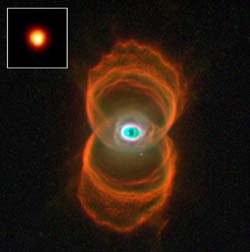
The main image is of the "Hourglass" Planetary Nebula observed by the Hubble Space Telescope. The inset image is that of an old "red giant" star of the type observed in the observations, also imaged by the Hubble Space Telescope
Using a technique based on the work of the 1902 Nobel Prizewinner, Pieter Zeeman, an international team of astronomers have, for the first time, provided conclusive proof that the magnetic field close to a number of aging stars is 10 to 100 times stronger than that of our own Sun. These observations suggest a solution to the long outstanding problem as to how, at the end of their lives, a perfectly spherical star can give rise to the complex and often far from spherical structure seen in the resulting planetary nebula – some of the most beautiful objects in our heavens.
When stars like our Sun reach the end of their lives, they eject a large amount of material into the space around them. This material, produced by nuclear fusion reactions in the star, forms a thick dust shell which eventually evolves into a planetary nebula – so called because they appear rather like planetary discs. Due to turbulent gas flows around the star the strong magnetic fields that have been discovered will have very different shapes. The material which is ejected from the star “feels” this strong magnetic field and so, as a result, the planetary nebula can have a very complicated structure. The ejected material, containing elements such as carbon and oxygen, in eventually recycled into new stars and planets and the building blocks of life itself.
The group, lead by Wouter Vlemmings of Leiden Observatory, observed 4 old stars with the U.S. National Science Foundation`s VLBA, the network of radio telescopes operated by the American National Radio Astronomy Observatory. They detected radio emission which originates from clouds of water vapor ejected by the stars. In some circumstances, such a cloud can become a maser: the equivalent of a laser for radiation with longer wavelengths. One specific frequency of the emitted radiation, which is characteristic for the H2O molecule, is amplified enormously, resulting in a bright, clear signal. In this signal, the group was able to detect the Zeeman-effect for the first time: subtle changes in the spectrum of the emission that can only be caused by a strong magnetic field at the location of the maser.
The magnetic fields measured are as strong as the magnetic field at the Earth`s surface, between 0.5 and 1 Gauss. As observations have shown that the water masers occur at a large distance from the star (at about twice the distance between the furthest planet in our solar system, Pluto, and the Sun), the magnetic field strength at the surface of the star will be much higher, approximately 50 to 500 Gauss, which is 10 to 100 times the magnetic field strength of the Sun. This is sufficiently strong that the magnetic field can play an important role in the formation of aspherical planetary nebulae and in the process of mass-loss which creates the dusty circumstellar envelopes.
The Zeeman-effect, which has enabled these observations to be made, was named after the Leiden physicist Pieter Zeeman, who discovered the effect of a magnetic field on the spectrum of a light source in 1896. As this effect is extremely small in water molecules, the observations for the research by Vlemmings had to be extremely precise. Because of this, the data of the different telescopes of the VLBI-network were specially processed in the correlator at Socorro, New Mexico, USA to give the highest possible accuracy.
The astronomers, whose work has just been published in Astronomy & Astrophysics, were Wouter Vlemmings of Leiden Observatory, Philip Diamond of the University of Manchester and Huib Jan van Langevelde of the Joint Institute for VLBI in Europe (JIVE).
Media Contact
More Information:
http://www.jb.man.ac.uk/news/magnetism/All latest news from the category: Physics and Astronomy
This area deals with the fundamental laws and building blocks of nature and how they interact, the properties and the behavior of matter, and research into space and time and their structures.
innovations-report provides in-depth reports and articles on subjects such as astrophysics, laser technologies, nuclear, quantum, particle and solid-state physics, nanotechnologies, planetary research and findings (Mars, Venus) and developments related to the Hubble Telescope.


Newest articles
Superradiant atoms could push the boundaries of how precisely time can be measured
Superradiant atoms can help us measure time more precisely than ever. In a new study, researchers from the University of Copenhagen present a new method for measuring the time interval,…
Ion thermoelectric conversion devices for near room temperature
The electrode sheet of the thermoelectric device consists of ionic hydrogel, which is sandwiched between the electrodes to form, and the Prussian blue on the electrode undergoes a redox reaction…
Zap Energy achieves 37-million-degree temperatures in a compact device
New publication reports record electron temperatures for a small-scale, sheared-flow-stabilized Z-pinch fusion device. In the nine decades since humans first produced fusion reactions, only a few fusion technologies have demonstrated…