



Feeding 9 Billion: Innovations in Agricultural Modeling
Researchers from the Universitat Autònoma de Barcelona and the Organización Nacional de Ciegos Españoles (ONCE) have developed a Braille keyboard for PCs that has some unique features. The keyboard provides more applications for blind people and is particularly useful for scientific texts and musical scores.
The new keyboard, which connects to the PC through the USB port, will make using a computer much easier for blind people who are accustomed to using Braille typewriters, since this is the first Braille keyboard to combine the function and movement keys of a conventional keyboard with eight Braille keys that allow the user to write in any language. Users can also select between a cumulative and a corrective writing mode. In the cumulative mode, the dots of a Braille symbol are indicated by pressing the keys one after another; in the corrective mode, this is done by pressing the necessary keys simultaneously.
The keyboard also provides the possibility to update its features as upgrades to the firmware (internal programmes that control the features) are developed in the future.
This new computer keyboard gives blind people enormous possibilities for working with mathematical formulae and scorewriter programmes. Until now, assistance was required from a sighted person for this kind of task.
The project, which began in March 2004 at the proposal of ONCE, was coordinated by the UAB Department of Microelectronics and Electronic Systems researcher Jordi Roig, who has been visually impaired for three years and is a member of ONCE. Teachers from the UAB School of Engineering and the UAB School of Computer Science in Sabadell participated in the research. The group is currently working on other projects that will enable blind people to work autonomously with technological applications. These projects include developing an automatic conversion tool for websites that are not currently accessible to blind people and creating a touchable screens that raises the information so that it can be felt.



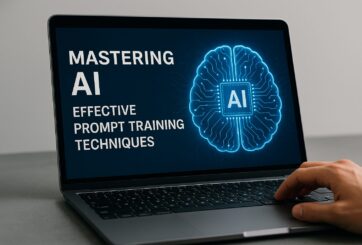
Research from Carnegie Mellon’s School of Computer Science suggests prompt engineering could be as important as coding Today’s generative artificial intelligence models can create everything from images to computer applications, but the quality of their output depends largely on the prompt a human user provides. Carnegie Mellon University researchers have proposed a new approach for teaching everyday users how to create these prompts and improving their interactions with generative artificial intelligence models. The method, called Requirement-Oriented Prompt Engineering (ROPE), shifts…

A new quantum random number generator is almost 1000 times faster than other generators and much smaller, promising to change data management and cybersecurity in several industries including health, finance, and defense A joint team of researchers led by scientists at King Abdullah University of Science and Technology (KAUST) and King Abdulaziz City for Science and Technology (KACST) has reported the fastest quantum random number generator (QRNG) to date based on international benchmarks. The QRNG, which passed the required randomness…

Very secure and highly efficient: encryption and decryption with luminescent perovskites To guarantee high data security, encryption must be unbreakable while the data remains rapidly and easily readable. A novel strategy for optical encryption/decryption of information has now been introduced in the journal Angewandte Chemie by a Chinese research team. It is based on compounds with carefully modulated luminescent properties that change in response to external stimuli. The compounds are hybrid two-dimensional organic-inorganic metal-halide perovskites, whose structure consists of inorganic…

Researchers at the University of Utah’s Department of Psychiatry and Huntsman Mental Health Institute today published a paper introducing RiskPath, an open source software toolkit that uses Explainable Artificial Intelligence (XAI) to predict whether individuals will develop progressive and chronic diseases years before symptoms appear, potentially transforming how preventive healthcare is delivered. XAI is an artificial intelligence system that can explain complex decisions in ways humans can understand. The new technology represents a significant advancement in disease prediction and prevention…
 Feedback
