



Feeding 9 Billion: Innovations in Agricultural Modeling
The University of Manchester team, comprising biologists and palaeontologists, has found that theropod dinosaurs like the Velociraptor had similar respiratory systems to present-day diving birds, such as marine birds and wildfowl.
The findings, published in the Proceedings of the Royal Society B: Biological Sciences tomorrow (Wednesday), present for the first time an explanation of how these dinosaurs may have breathed.
“A number of studies have shown that dinosaurs were the direct ancestors of birds and have identified a suite of avian characteristics in theropods,” said Dr Jonathan Codd, who led the research in the Faculty of Life Sciences.
“Our findings support this view and show that the similarities also extend to breathing structures and that these dinosaurs possessed everything they needed to breathe using an avian-like air-sac respiratory system.”
Birds, and in particular diving birds, have one of the most efficient respiratory systems of all vertebrates which they need in order to supply their bodies with enough oxygen to sustain the high levels of energy required for flight.
Palaeontologist and co-author Dr Phil Manning, in Manchester’s School of Earth, Atmospheric and Environmental Sciences, studied the fossilised remains of maniraptoran dinosaurs and extinct birds such as Archaeopteryx and found that breathing structures, known as uncinate processes, were also present in the dinosaurs.
Dr Codd said: “Our work on modern birds has shown that the way these animals breathe is more complex than originally thought. The uncinate processes are small bones that act as levers to move the ribs and sternum during breathing. Interestingly, these structures are different lengths in different birds – they are shortest in running birds, intermediate in flying birds and longest in diving birds.
“The dinosaurs we studied from the fossil record had long uncinate processes similar in structure to those of diving birds. This suggests both dinosaurs and diving birds need longer lever arms to help them breathe.
“Finding these structures in modern birds and their extinct dinosaur ancestors suggests that these running dinosaurs had an efficient respiratory system and supports the theory that they were highly active animals that could run relatively quickly when pursuing their prey.”
The research was funded by the German Research Council and The University of Manchester.




Earthquakes in the American state of Utah, the Soultz-sous-Forêts region of France or in the Dutch province of Groningen should not be able to occur even if the subsurface has been exploited for decades. This is because the shallow subsurface behaves in such a way that faults there become stronger as soon as they start moving. At least that is what geology textbooks teach us. And so, in theory, it should not be possible for earthquakes to occur. So why…
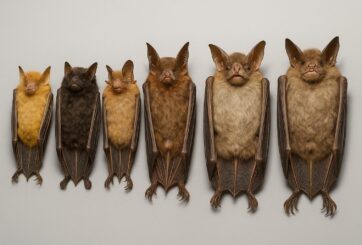
Just in time for Halloween, researchers from the Royal Ontario Museum (ROM), the Field Museum in Chicago, and Lawrence University in Wisconsin have announced the discovery of six new species of bats. These newly identified species, all found in the Philippines, belong to the group known as tube-nosed bats—a fascinating and diverse branch of the mammal family tree. Expanding the Tree of Life Formally recognized as new species through morphological and genetic analysis, this discovery expands the already impressive global…
In a recent study published today in the European Geosciences Union (EGU) journal Biogeosciences, scientists have confirmed that mercury pollution from artisanal and small-scale gold mining (ASGM) is contaminating food crops not through the soil, as previously believed, but directly from the air. Driven by the surging price of gold, which has increased by more than tenfold since 2000, the rapid expansion of unregulated mining in these regions raises urgent questions about food security, human health, and environmental justice The…
A new study from Iceland’s Surtsey island shows that birds carried most of the plants that colonised the island, challenging long-held beliefs that seed or fruit shape determines how plants spread — offering fresh insight into life’s adaptation to c When the volcanic island of Surtsey rose from the North Atlantic Ocean in 1963, it offered scientists a once-in-a-lifetime opportunity to observe how life takes hold on a brand-new and barren land. For decades, ecologists believed that plants’ ability to…
 Feedback
