



Feeding 9 Billion: Innovations in Agricultural Modeling
QUT media and communication lecturer Dr Christy Collis said that, with its massive resources of fresh water and unknown quantities of oil, Antarctica could be ripe for exploitation once resources in the rest of the world became scarcer.
Dr Collis said this issue was particularly important for Australia as it laid claim to 42 per cent of Antarctica, giving it ownership of 10 per cent of the world's available land.
Her claims coincide with this week's news that Britain is planning to claim sovereign rights over more than a million square kilometres of the territory.
Dr Collis is researching the cultural, legal and geopolitical aspects of Antarctica and said the treaty between 45 nations which governed the icy continent did not make the continent's future entirely stable or secure.
“So far, the Antarctic Treaty is a triumph of environmental protection and there is an unprecedented genuine shared goal to protect the environment,” Dr Collis said.
“There's a moratorium on mining until 2048, but the issue is that, if someone started to mine in the Australian territory for example, what would happen?
“Would Australia act as a force to intervene, or would the Treaty as a whole somehow respond if there needed to be physical intervention?”
The Antarctic Treaty, which is contentious because the land claims it contains are not recognised by all nations, partitions ownership between Australia, Norway, Argentina, Chile, France, New Zealand and the UK.
“There are a lot of question marks around the future,” she said. “I don't want to sound negative because …legally, all that can be done is being done to protect Antarctica,” she said.
“In the 1950s, India and more recently Malaysia suggested Antarctica be under UN jurisdiction but there was heavy resistance to that notion from claimants.”
Dr Collis' research focuses on the cultural approaches to Antarctica by the seven nations which have colonised the continent. She said, as a Canadian who now lived in Australia, she was fascinated with the “mechanisms through which we got these huge tracts of land”.
“Antarctica, the high seas, outer space and international shared spaces… for a long time we've divided the world into countries so I'm interested in how we think about these other spaces.”
This year is the International Polar Year, which is the largest international research program in the polar regions.




Earthquakes in the American state of Utah, the Soultz-sous-Forêts region of France or in the Dutch province of Groningen should not be able to occur even if the subsurface has been exploited for decades. This is because the shallow subsurface behaves in such a way that faults there become stronger as soon as they start moving. At least that is what geology textbooks teach us. And so, in theory, it should not be possible for earthquakes to occur. So why…
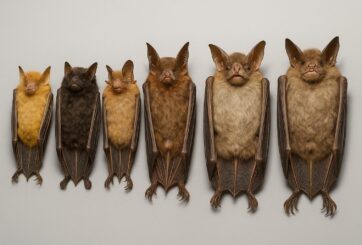
Just in time for Halloween, researchers from the Royal Ontario Museum (ROM), the Field Museum in Chicago, and Lawrence University in Wisconsin have announced the discovery of six new species of bats. These newly identified species, all found in the Philippines, belong to the group known as tube-nosed bats—a fascinating and diverse branch of the mammal family tree. Expanding the Tree of Life Formally recognized as new species through morphological and genetic analysis, this discovery expands the already impressive global…
In a recent study published today in the European Geosciences Union (EGU) journal Biogeosciences, scientists have confirmed that mercury pollution from artisanal and small-scale gold mining (ASGM) is contaminating food crops not through the soil, as previously believed, but directly from the air. Driven by the surging price of gold, which has increased by more than tenfold since 2000, the rapid expansion of unregulated mining in these regions raises urgent questions about food security, human health, and environmental justice The…
A new study from Iceland’s Surtsey island shows that birds carried most of the plants that colonised the island, challenging long-held beliefs that seed or fruit shape determines how plants spread — offering fresh insight into life’s adaptation to c When the volcanic island of Surtsey rose from the North Atlantic Ocean in 1963, it offered scientists a once-in-a-lifetime opportunity to observe how life takes hold on a brand-new and barren land. For decades, ecologists believed that plants’ ability to…
 Feedback
