



Feeding 9 Billion: Innovations in Agricultural Modeling
Professor Priede said: “It is like surveying a new continent half way between America and Europe. We can recognise the creatures, but familiar ones are absent and unusual ones are common. We are finding species that are rare or unknown elsewhere in the world.”
One of the world’s most advanced research vessels, the RRS James Cook, will be docking at Fairlie Pier by Largs tomorrow (Saturday, August 18), bringing samples of rare animals and a vast archive of pictures and videos, which will help us to understand more about life in the oceans.
The RRS James Cook is the latest addition to the Natural Environment Research Council’s fleet of oceanographic research ships.
The team of scientists mapped over 1,500 square miles, exploring the deep sea creatures living in the depths of the Mid-Atlantic Ridge. They used the latest technology to learn more about what is living in this remote and relatively unexplored deep-sea environment using remotely operated vehicles equipped with digital cameras.
With a suite of eight deep sea cameras they were able to capture images of life on the peaks and valleys of very rugged terrain. Colourful sponges and corals encrust rocky cliffs, whereas areas of soft sediment are populated by starfish, brittle-stars, sea cucumbers and burrowing worms. Fishes, crabs and shrimps forage over the ridge exploiting whatever they can find. Trawls, traps and corers have brought back thousands of specimens for study back in the laboratory.
Professor Priede said: “We are trying to imagine what the north Atlantic would be like without the ridge that literally cuts it in half, as we think it has a major effect on ocean currents, productivity and biodiversity of the North Atlantic Ocean.
“The RRS James Cook ship is an absolutely fantastic facility and is allowing marine researchers to explore new environments, find new animals and study global changes in the world’s oceans.”
The aim of the voyage is to contribute to the wider MAR-ECO project studying biodiversity along mid-ocean ridges (www.mar-eco.no) and to the global Census research programme. Census of Marine Life is a 10-year global scientific initiative to assess and explain the diversity, distribution and abundance of life in the oceans. The team already think they may have discovered a new species of Ostracod (or seed shrimp) that was found swarming in large numbers on the western side of the ridge. Specimens are on their way to experts in Southampton where world-renowned expert, Professor Martin Angel, will ultimately determine whether this is a new species, describe it and allocate a name.
Dr Steven Wilson, Director of Science & Innovation for the Natural Environment Research Council, said: “The Mid-Atlantic Ridge is still relatively unexplored so this voyage will have played a vital role in expanding our knowledge of the biodiversity of the region.”
Water currents and tides over the ridge were studied intensively and daily measurements were made of productivity in surface waters. The team left behind automatic equipment on the sea floor at six observing stations that will continue measurements and photography over the next two years. Further voyages are planned in 2008 and 2009 that will include retrieval of the gear.
Oceanlab was responsible for assisting with the expedition management and deployed three deep ocean lander vehicles recording luminescent displays from animals living in the darkness on one of the peaks of the mid ocean ridge.
The expedition is run under ECOMAR, a £2million consortium project funded by the UK Natural Environment Research Council, led by the University of Aberdeen with participation from: National Oceanography Centre, Southampton, University of St Andrews, Scottish Association for Marine Science, Plymouth Marine Laboratory, University of Durham and University of Newcastle. It provides a contribution to the wider MAR-ECO project co-ordinated by Odd Aksel Bergstad of Norway and the Census of Marine Life, a global project involving over 2,000 scientists. ECOMAR is also a European Census of Marine Life affiliated project.




Earthquakes in the American state of Utah, the Soultz-sous-Forêts region of France or in the Dutch province of Groningen should not be able to occur even if the subsurface has been exploited for decades. This is because the shallow subsurface behaves in such a way that faults there become stronger as soon as they start moving. At least that is what geology textbooks teach us. And so, in theory, it should not be possible for earthquakes to occur. So why…
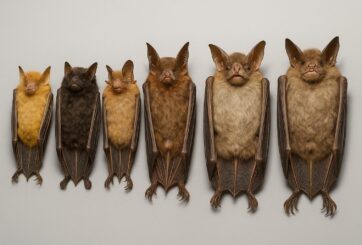
Just in time for Halloween, researchers from the Royal Ontario Museum (ROM), the Field Museum in Chicago, and Lawrence University in Wisconsin have announced the discovery of six new species of bats. These newly identified species, all found in the Philippines, belong to the group known as tube-nosed bats—a fascinating and diverse branch of the mammal family tree. Expanding the Tree of Life Formally recognized as new species through morphological and genetic analysis, this discovery expands the already impressive global…
In a recent study published today in the European Geosciences Union (EGU) journal Biogeosciences, scientists have confirmed that mercury pollution from artisanal and small-scale gold mining (ASGM) is contaminating food crops not through the soil, as previously believed, but directly from the air. Driven by the surging price of gold, which has increased by more than tenfold since 2000, the rapid expansion of unregulated mining in these regions raises urgent questions about food security, human health, and environmental justice The…
A new study from Iceland’s Surtsey island shows that birds carried most of the plants that colonised the island, challenging long-held beliefs that seed or fruit shape determines how plants spread — offering fresh insight into life’s adaptation to c When the volcanic island of Surtsey rose from the North Atlantic Ocean in 1963, it offered scientists a once-in-a-lifetime opportunity to observe how life takes hold on a brand-new and barren land. For decades, ecologists believed that plants’ ability to…
 Feedback
