



Feeding 9 Billion: Innovations in Agricultural Modeling
This forecasting system is scheduled to be ready in time for the Olympic Games in China in August 2008. Although it will initially benefit the sailing competitions held in the Yellow Sea, the system will later be of assistance to local fishermen and merchant fleets.
“Our colleagues in China and Korea will supply measurement data on things such as the depth of the sea, the amount of water flowing in from rivers and all available information on weather, water and sea conditions,” says coastal researcher Dr. Heinz Günther from GKSS in Geesthacht by way of explaining the work that lies ahead. “The existing measurement network, which consists of buoys and measurement platforms, will be expanded further in the coming months. At the same time, we will be combining the weather and sea modelling systems of all of the participating researchers and adapting them to the conditions found in the Yellow Sea.”
By adding a component for suspended particles, the experts from Geesthacht have expanded the mathematical model’s capabilities beyond those of systems designed merely to forecast winds, waves and currents. That’s because suspended particles are mainly composed of inorganic sediment that is transported into the sea by rivers, for example. These particles determine how much and how far light can penetrate the water. This, in turn, influences the growth of plankton and water plants, which serve as the basic nourishment for many species of fish and shrimp. In addition, these particles can also contain toxic materials from agriculture and industry. As a result, predicting how suspended particles will be distributed in the sea and along the coasts can be of great help in protecting the environment and managing crises such as accidental toxic spills. “Our existing three-dimensional models for the North Sea and the Baltic Sea can calculate the influx of suspended particles following storms and floods in advance,” says GKSS researcher Gerhard Gayer, who incorporated the Geesthacht computer model into the basic Danish system.
“The colleagues from China and Korea are incredibly skilled and we are benefiting a lot from their measurement systems and computer models,” adds Günther. “Although the Olympics will serve as a milestone for the EU’s YEOS project, our contribution of a suspended particle calculation component will introduce our colleagues in Asia to the world of ecosystem modelling. We think this is very important, since it will allow them to increasingly take environmental aspects into account when monitoring the Yellow Sea.”




Earthquakes in the American state of Utah, the Soultz-sous-Forêts region of France or in the Dutch province of Groningen should not be able to occur even if the subsurface has been exploited for decades. This is because the shallow subsurface behaves in such a way that faults there become stronger as soon as they start moving. At least that is what geology textbooks teach us. And so, in theory, it should not be possible for earthquakes to occur. So why…
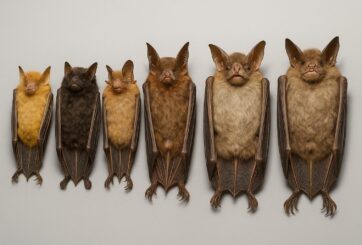
Just in time for Halloween, researchers from the Royal Ontario Museum (ROM), the Field Museum in Chicago, and Lawrence University in Wisconsin have announced the discovery of six new species of bats. These newly identified species, all found in the Philippines, belong to the group known as tube-nosed bats—a fascinating and diverse branch of the mammal family tree. Expanding the Tree of Life Formally recognized as new species through morphological and genetic analysis, this discovery expands the already impressive global…
In a recent study published today in the European Geosciences Union (EGU) journal Biogeosciences, scientists have confirmed that mercury pollution from artisanal and small-scale gold mining (ASGM) is contaminating food crops not through the soil, as previously believed, but directly from the air. Driven by the surging price of gold, which has increased by more than tenfold since 2000, the rapid expansion of unregulated mining in these regions raises urgent questions about food security, human health, and environmental justice The…
A new study from Iceland’s Surtsey island shows that birds carried most of the plants that colonised the island, challenging long-held beliefs that seed or fruit shape determines how plants spread — offering fresh insight into life’s adaptation to c When the volcanic island of Surtsey rose from the North Atlantic Ocean in 1963, it offered scientists a once-in-a-lifetime opportunity to observe how life takes hold on a brand-new and barren land. For decades, ecologists believed that plants’ ability to…
 Feedback
