



Feeding 9 Billion: Innovations in Agricultural Modeling
Professor Richard Davies of Durham University’s Centre for Research into Earth Energy Systems (CeREES), said the volcano, known locally as Lusi, was most likely caused by the drilling of a nearby exploratory borehole (1) looking for gas.
He reiterated the findings of a Durham University-led study, first published in the February issue of US Journal GSA Today, following publication of a new paper led by the University of Oslo which said the eruption in May 2006 might have been caused by an earthquake that occurred two days earlier.
The Durham-led research discounted the effect of the earthquake as a cause of the eruption.
Professor Richard Davies, of Durham University’s Centre for Research into Earth Energy Systems (CeREES), said: “There were several problems with the exploration well prior to the eruption of the mud volcano, but it was when they started to pull the drill bit out of the hole that they probably sucked gas and water into the wellbore.
“We have calculated that a water or gas influx would have caused a critical increase in the pressure in the hole, sufficient to fracture the rock strata underground.
“It is very unlikely that the Yoyakarta earthquake had a significant role to play in the development of the mud volcano.
“We still maintain that the mud volcano was most likely triggered by operations during drilling. There is no need to evoke an earthquake trigger for this.”
Lusi first erupted on May 29 2006 in the Porong sub-district of Sidoarjo in Eastern Java, close to Indonesia’s second city of Surabaya.
The volcano has continued to spew out an estimated 150,000 cubic metres of mud every day and now covers an area of 10 square kilometres.
Around 20,000 to 30,000 people have lost their homes and factories have been destroyed. Thirteen people have also died as a result of a rupture in a natural gas pipeline that lay underneath one of the holding dams built to retain the mud.
(1) The borehole is owned by Indonesian oil and gas company Lapindo Brantas.




Earthquakes in the American state of Utah, the Soultz-sous-Forêts region of France or in the Dutch province of Groningen should not be able to occur even if the subsurface has been exploited for decades. This is because the shallow subsurface behaves in such a way that faults there become stronger as soon as they start moving. At least that is what geology textbooks teach us. And so, in theory, it should not be possible for earthquakes to occur. So why…
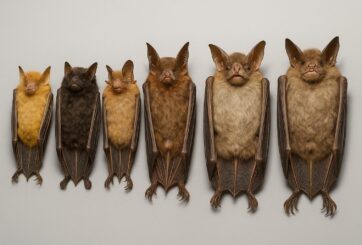
Just in time for Halloween, researchers from the Royal Ontario Museum (ROM), the Field Museum in Chicago, and Lawrence University in Wisconsin have announced the discovery of six new species of bats. These newly identified species, all found in the Philippines, belong to the group known as tube-nosed bats—a fascinating and diverse branch of the mammal family tree. Expanding the Tree of Life Formally recognized as new species through morphological and genetic analysis, this discovery expands the already impressive global…
In a recent study published today in the European Geosciences Union (EGU) journal Biogeosciences, scientists have confirmed that mercury pollution from artisanal and small-scale gold mining (ASGM) is contaminating food crops not through the soil, as previously believed, but directly from the air. Driven by the surging price of gold, which has increased by more than tenfold since 2000, the rapid expansion of unregulated mining in these regions raises urgent questions about food security, human health, and environmental justice The…
A new study from Iceland’s Surtsey island shows that birds carried most of the plants that colonised the island, challenging long-held beliefs that seed or fruit shape determines how plants spread — offering fresh insight into life’s adaptation to c When the volcanic island of Surtsey rose from the North Atlantic Ocean in 1963, it offered scientists a once-in-a-lifetime opportunity to observe how life takes hold on a brand-new and barren land. For decades, ecologists believed that plants’ ability to…
 Feedback
