



Feeding 9 Billion: Innovations in Agricultural Modeling
“Tsunami are water waves generated by earthquakes, underwater landslides, volcanic eruptions or major debris slides,” said Dr Rossetto. “The waves travel across oceans with small vertical displacements and in open water you could easily bob over one without noticing. It’s when the waves approach the coastline, hit shallower water, slow down, and grow taller that you get the huge wall of water that people visualise when you mention a tsunami.
“The main gap in our knowledge is about what happens when the tsunami wave approaches the nearshore region and then runs inland. These flow processes cannot be simplified using mathematical models because of the complex interaction that takes place with beaches, sediment, coastal defences and then in and around buildings.
“It is possible for the whole process to be simulated with hydraulic models, but to get meaningful data the tsunami wave has to be accurately generated in the first place. Conventional wave generators haven’t been able to replicate tsunami because of the unusually long wavelength that is required.”
Professor William Allsop of HRW said: “Our new machine will control the flow of a large mass of water by using air suction within an inverted tank. We have used this technology over many years to make model tides in large scale models and our collaboration with UCL means we will be able to produce a unique research facility.”
The new tsunami generator will be able to create multiple waves, replicating the three or four peaks experienced during the Boxing Day tsunami that hit the Indian Ocean in 2004. The tsunami will pass down a 45m long flume at realistic wavelengths, mimicking the characteristics of waves which have passed from deep water (approx. 200m) into shallow water (20m – 50m) as they approach the coast. The wave flume will be equipped to measure coastal processes, inundation and wave forces as the tsunami travels up a shelving seabed, breeches the coastline and flows inland.
After the initial series of experiments, a team of researchers from UCL and HRW will go on to examine the effects of retreating and repeated waves on seawalls and beaches. The tests will measure the force exerted by the waves on representative buildings and quantify the wave’s ability to erode the coast, potentially destabilising structures completely.
The tsunami experiments will take place at HR Wallingford’s laboratories in Oxfordshire and construction of the generator is scheduled for completion in the summer of 2008. UCL and HRW plan to make the facility available to international teams of researchers in autumn 2009.




Earthquakes in the American state of Utah, the Soultz-sous-Forêts region of France or in the Dutch province of Groningen should not be able to occur even if the subsurface has been exploited for decades. This is because the shallow subsurface behaves in such a way that faults there become stronger as soon as they start moving. At least that is what geology textbooks teach us. And so, in theory, it should not be possible for earthquakes to occur. So why…
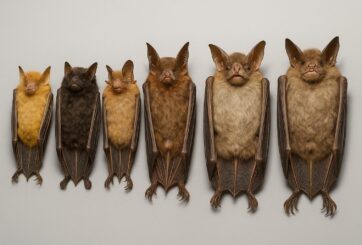
Just in time for Halloween, researchers from the Royal Ontario Museum (ROM), the Field Museum in Chicago, and Lawrence University in Wisconsin have announced the discovery of six new species of bats. These newly identified species, all found in the Philippines, belong to the group known as tube-nosed bats—a fascinating and diverse branch of the mammal family tree. Expanding the Tree of Life Formally recognized as new species through morphological and genetic analysis, this discovery expands the already impressive global…
In a recent study published today in the European Geosciences Union (EGU) journal Biogeosciences, scientists have confirmed that mercury pollution from artisanal and small-scale gold mining (ASGM) is contaminating food crops not through the soil, as previously believed, but directly from the air. Driven by the surging price of gold, which has increased by more than tenfold since 2000, the rapid expansion of unregulated mining in these regions raises urgent questions about food security, human health, and environmental justice The…
A new study from Iceland’s Surtsey island shows that birds carried most of the plants that colonised the island, challenging long-held beliefs that seed or fruit shape determines how plants spread — offering fresh insight into life’s adaptation to c When the volcanic island of Surtsey rose from the North Atlantic Ocean in 1963, it offered scientists a once-in-a-lifetime opportunity to observe how life takes hold on a brand-new and barren land. For decades, ecologists believed that plants’ ability to…
 Feedback
