



Feeding 9 Billion: Innovations in Agricultural Modeling
Knee-high relative of Triceratops unearthed.
The fearsome horns and bony neck plates of Triceratops have scared generations of kids. Now fossil finds reveal that its predecessor was a little more huggable: it was a dog-sized creature with a beak.
Triceratops is the most famous member of the late ceratopsians, which were rhinoceros-like dinosaurs with horns. Little is known about the early evolution of this large and varied group of plant-eaters because their fossils are scarce.
Now the oldest ceratopsian ever found has been uncovered in China. Unlike its daunting relative, Liaoceratops was about the size of a large dog. It had a blunt beak and a dainty neck frill1.
“He’s like a precursor to Triceratops,” explains palaeontologist Cathy Forster of the State University of New York. Liaoceratops may also have walked on hind legs, she speculates, whereas later family members lumbered on four.
The creature sorts out some details of ceratopsian evolution. The original group split into two – beaked psittacosaurids and horned neoceratopsians – but it is not clear exactly when.
Liaoceratops has a mix of subtle features previously thought to belong to one group or the other. “He fills the gap between the two,” says his discoverer, Xing Xu of the Chinese Academy of Sciences in Beijing. The sequence in which such characteristics appeared now has to be re-ordered, a common process when new specimens are found.
Horns and frills
Xu and his team found Liaoceratops skulls and skeletons in the Yixian formation, a rich fossil bed in northeast China.
Liaoceratops was a puny forebear of the feisty Triceratops. Size, horns and spectacular frills came later in ceratopsian evolution. By the time the dinosaurs became extinct at the end of the Cretaceous period around 65 million years ago, Triceratops could take on the mighty Tyrannosoarus.
The flamboyant accoutrements of ceratopsians have led people to wonder about their function. Some think they were for protection, others for show. Those on Liaoceratops seem to have a practical explanation: the small neck frill appears to be for muscle attachment.
References




Earthquakes in the American state of Utah, the Soultz-sous-Forêts region of France or in the Dutch province of Groningen should not be able to occur even if the subsurface has been exploited for decades. This is because the shallow subsurface behaves in such a way that faults there become stronger as soon as they start moving. At least that is what geology textbooks teach us. And so, in theory, it should not be possible for earthquakes to occur. So why…
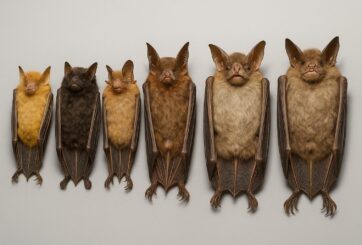
Just in time for Halloween, researchers from the Royal Ontario Museum (ROM), the Field Museum in Chicago, and Lawrence University in Wisconsin have announced the discovery of six new species of bats. These newly identified species, all found in the Philippines, belong to the group known as tube-nosed bats—a fascinating and diverse branch of the mammal family tree. Expanding the Tree of Life Formally recognized as new species through morphological and genetic analysis, this discovery expands the already impressive global…
In a recent study published today in the European Geosciences Union (EGU) journal Biogeosciences, scientists have confirmed that mercury pollution from artisanal and small-scale gold mining (ASGM) is contaminating food crops not through the soil, as previously believed, but directly from the air. Driven by the surging price of gold, which has increased by more than tenfold since 2000, the rapid expansion of unregulated mining in these regions raises urgent questions about food security, human health, and environmental justice The…
A new study from Iceland’s Surtsey island shows that birds carried most of the plants that colonised the island, challenging long-held beliefs that seed or fruit shape determines how plants spread — offering fresh insight into life’s adaptation to c When the volcanic island of Surtsey rose from the North Atlantic Ocean in 1963, it offered scientists a once-in-a-lifetime opportunity to observe how life takes hold on a brand-new and barren land. For decades, ecologists believed that plants’ ability to…
 Feedback
