



Feeding 9 Billion: Innovations in Agricultural Modeling
Blue jets connect Earth’s electric circuit.
Video images captured in Puerto Rico suggest that blue flashes of light, much like lightning, feed energy from thunderstorms up into the Earth’s ionosphere – a blanket of electrically charged air some 70 kilometres above the ground1.
Some researchers suspect that such phenomena may also fix nitrogen for plants to use and interact with the ozone layer2.
The images, taken in September 2001, show the largest blue jet ever to be caught on camera. “It really was a gigantic flash,” says Victor Pasko of Pennsylvania State University, who led the observation team. “With the naked eye you could even see it rising,” he recalls.
Blue jets are often associated with thunderstorms, but until now were thought to be relatively small. The Puerto Rican jet stretched from the top of a small thunderstorm to the lower edge of the ionosphere, filling an estimated 6,000 cubic kilometres of atmosphere.
Flashes this big might explain the 300,000-volt difference between the charge of the ionosphere and the ground. Physicists have long agreed that something must link the two regions to complete the global electrical circuit (GEC). Until the latest film, nothing had been seen that reached high enough from the cloud tops to do the job.
“We knew the currents were there, but there was no visual evidence” says Davis Sentman, the physicist at the University of Alaska in Fairbanks who discovered blue jets in 1994. The film “really advances the science in this field”, he says.
That the sighting was associated with the kind of small, localized storm common worldwide, suggests that large blue jets could also be common. If so, they might influence atmospheric chemistry: their electrical energy could encourage gases to react with one another. “The effect may be there but we don’t know if it’s dramatically important,” admits Pasko.
Sprites, elves, trolls and pixies
In the past decade, high-speed, light-sensitive cameras have allowed scientists to describe a menagerie of electrical phenomena, which bear names that would be more at home in a Tolkien novel than a physics textbook. Sprites, blue jets and associated flashes called elves, crawlers, trolls and pixies are all fleeting electrical discharges that accompany thunderstorms.
All these phenomena are hard to spot, as they last for less than a blink of an eye and are obscured from below by cloud. They can be glimpsed along storm fronts and from aeroplanes flying above the clouds.
Sprites, which might also help to maintain the GEC, work a bit like blue jets in reverse. They are pink, or sometimes red, and occur when current from just below the ionosphere moves downwards towards thunderstorms. As with jets, this current excites atoms along the way, causing them to emit light.
References




Earthquakes in the American state of Utah, the Soultz-sous-Forêts region of France or in the Dutch province of Groningen should not be able to occur even if the subsurface has been exploited for decades. This is because the shallow subsurface behaves in such a way that faults there become stronger as soon as they start moving. At least that is what geology textbooks teach us. And so, in theory, it should not be possible for earthquakes to occur. So why…
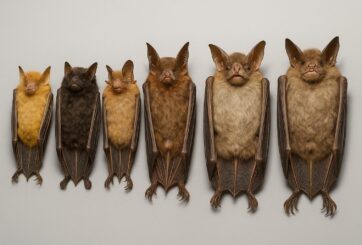
Just in time for Halloween, researchers from the Royal Ontario Museum (ROM), the Field Museum in Chicago, and Lawrence University in Wisconsin have announced the discovery of six new species of bats. These newly identified species, all found in the Philippines, belong to the group known as tube-nosed bats—a fascinating and diverse branch of the mammal family tree. Expanding the Tree of Life Formally recognized as new species through morphological and genetic analysis, this discovery expands the already impressive global…
In a recent study published today in the European Geosciences Union (EGU) journal Biogeosciences, scientists have confirmed that mercury pollution from artisanal and small-scale gold mining (ASGM) is contaminating food crops not through the soil, as previously believed, but directly from the air. Driven by the surging price of gold, which has increased by more than tenfold since 2000, the rapid expansion of unregulated mining in these regions raises urgent questions about food security, human health, and environmental justice The…
A new study from Iceland’s Surtsey island shows that birds carried most of the plants that colonised the island, challenging long-held beliefs that seed or fruit shape determines how plants spread — offering fresh insight into life’s adaptation to c When the volcanic island of Surtsey rose from the North Atlantic Ocean in 1963, it offered scientists a once-in-a-lifetime opportunity to observe how life takes hold on a brand-new and barren land. For decades, ecologists believed that plants’ ability to…
 Feedback
