



Feeding 9 Billion: Innovations in Agricultural Modeling
Cutbacks and reallocations within the National Aeronautics and Space Administration (NASA) and the National Oceanic and Atmospheric Administration (NOAA) are “already causing harm” to Earth-observing satellites, and “will become rapidly worse unless the Congress and the Administration take prompt action to reverse the recent trends,” the American Association for the Advancement of Science (AAAS) cautioned.
“The network of satellites upon which the United States and the world have relied for indispensable observations of Earth from space is in jeopardy,” the AAAS Board of Directors concluded in a consensus statement. (See www.aaas.org/EOS.) “Declines will result in major gaps in the continuity and quality of the data gathered about the Earth from space.”
This week’s AAAS Board statement reaffirms an earlier, 400-page analysis by the National Research Council, which concluded that U.S. global observations are “at great risk,” while the next generation of U.S. Earth-observing satellites are “generally less capable” than their current counterparts.
AAAS joined the NRC in calling for the restoration of key NOAA satellites; acceleration of NASA’s current launch schedule to “shrink data gaps;” and support for the 17 highest-priority new Earth-observation missions for the 2010-2020 time period. Achieving these goals will require returning NASA’s Earth-science budget to its 1998-2000 level and stabilizing the budget of NOAA’s National Environmental Satellite Data and Information Service at a level only slightly higher than the 2007 amount, adjusted for inflation, AAAS said.
The U.S. House of Representatives Committee on Science and Technology plans a hearing Wednesday, 2 May on NASA’s Space Science Programs and Fiscal Year 2008 Budget Issues. The hearing will take place from 10:00 am until Noon in the Rayburn House Office Building, Room 2318.
Another hearing the U.S. global climate-change research program will take place Thursday, 3 May, from 2:00 pm until 4:00 pm, in the same location.
In addition, AAAS will release its much-awaited annual analysis of proposed 2008 federal research funding, during the 32nd Annual AAAS Forum on Science and Technology Policy, Thursday and Friday this week. For details, see www.aaas.org/forum.
Kei Koizumi, director of the AAAS R&D Budget and Policy Program, said the President’s proposed 2008 budget calls for large increases to three physical sciences agencies relevant to the American Competitiveness Initiative (ACI) and additional support for weapons and spacecraft — but less funding for all other research. “Many agencies such as the National Institutes of Health would see their R&D funding fall,” said Koizumi. “In real terms, the federal research investment would fall for the fourth year in a row after peaking in 2004.”




Earthquakes in the American state of Utah, the Soultz-sous-Forêts region of France or in the Dutch province of Groningen should not be able to occur even if the subsurface has been exploited for decades. This is because the shallow subsurface behaves in such a way that faults there become stronger as soon as they start moving. At least that is what geology textbooks teach us. And so, in theory, it should not be possible for earthquakes to occur. So why…
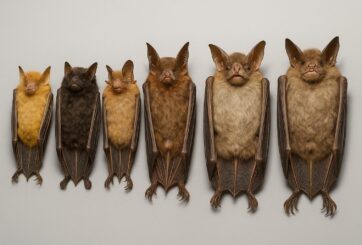
Just in time for Halloween, researchers from the Royal Ontario Museum (ROM), the Field Museum in Chicago, and Lawrence University in Wisconsin have announced the discovery of six new species of bats. These newly identified species, all found in the Philippines, belong to the group known as tube-nosed bats—a fascinating and diverse branch of the mammal family tree. Expanding the Tree of Life Formally recognized as new species through morphological and genetic analysis, this discovery expands the already impressive global…
In a recent study published today in the European Geosciences Union (EGU) journal Biogeosciences, scientists have confirmed that mercury pollution from artisanal and small-scale gold mining (ASGM) is contaminating food crops not through the soil, as previously believed, but directly from the air. Driven by the surging price of gold, which has increased by more than tenfold since 2000, the rapid expansion of unregulated mining in these regions raises urgent questions about food security, human health, and environmental justice The…
A new study from Iceland’s Surtsey island shows that birds carried most of the plants that colonised the island, challenging long-held beliefs that seed or fruit shape determines how plants spread — offering fresh insight into life’s adaptation to c When the volcanic island of Surtsey rose from the North Atlantic Ocean in 1963, it offered scientists a once-in-a-lifetime opportunity to observe how life takes hold on a brand-new and barren land. For decades, ecologists believed that plants’ ability to…
 Feedback
