



Feeding 9 Billion: Innovations in Agricultural Modeling
An odd, six-sided, honeycomb-shaped feature circling the entire north pole of Saturn has captured the interest of scientists with NASA's Cassini mission.
NASA¹s Voyager 1 and 2 spacecraft imaged the feature over two decades ago. The fact that it has appeared in Cassini images indicates that it is a long-lived feature. A second hexagon, significantly darker than the brighter historical feature, is also visible in the Cassini pictures. The spacecraft's visual and infrared mapping spectrometer is the first instrument to capture the entire hexagon feature in one image.
³This is a very strange feature, lying in a precise geometric fashion with six nearly equally straight sides,² said Kevin Baines, atmospheric expert and member of Cassini¹s visual and infrared mapping spectrometer team at NASA¹s Jet Propulsion Laboratory, Pasadena, Calif. ³We¹ve never seen anything like this on any other planet. Indeed, Saturn¹s thick atmosphere where circularly-shaped waves and convective cells dominate is perhaps the last place you¹d expect to see such a six-sided geometric figure, yet there it is.²
The hexagon is similar to Earth¹s polar vortex, which has winds blowing in a circular pattern around the polar region. On Saturn, the vortex has a hexagonal rather than circular shape. The hexagon is nearly 25,000 kilometers (15,000 miles) across. Nearly four Earths could fit inside it.
The new images taken in thermal-infrared light show the hexagon extends much deeper down into the atmosphere than previously expected, some 100 kilometers (60 miles) below the cloud tops. A system of clouds lies within the hexagon. The clouds appear to be whipping around the hexagon like cars on a racetrack.
³It¹s amazing to see such striking differences on opposite ends of Saturn¹s poles,² said Bob Brown, team leader of the Cassini visual and infrared mapping spectrometer, University of Arizona, Tucson. ³At the south pole we have what appears to be a hurricane with a giant eye, and at the north pole of Saturn we have this geometric feature, which is completely different.²
The Saturn north pole hexagon has not been visible to Cassini¹s visual cameras, because it¹s winter in that area, so the hexagon is under the cover of the long polar night, which lasts about 15 years. The infrared mapping spectrometer can image Saturn in both daytime and nighttime conditions and see deep inside. It imaged the feature with thermal wavelengths near 5 microns (seven times the wavelength visible to the human eye) during a 12-day period beginning on Oct. 30, 2006. As winter wanes over the next two years, the feature may become visible to the visual cameras.
Based on the new images and more information on the depth of the feature, scientists think it is not linked to Saturn¹s radio emissions or to auroral activity, as once contemplated, even though Saturn¹s northern aurora lies nearly overhead.
The hexagon appears to have remained fixed with Saturn¹s rotation rate and axis since first glimpsed by Voyager 26 years ago. The actual rotation rate of Saturn is still uncertain.
³Once we understand its dynamical nature, this long-lived, deep-seated polar hexagon may give us a clue to the true rotation rate of the deep atmosphere and perhaps the interior,² added Baines.
The hexagon images and movie, including the north polar auroras are available at: http://nasa.gov/cassini and http://saturn.jpl.nasa.gov and http://wwwvims.lpl.arizona.edu.
The Cassini-Huygens mission is a cooperative project of NASA, the European Space Agency and the Italian Space Agency. The Jet Propulsion Laboratory, a division of the California Institute of Technology in Pasadena, manages the Cassini-Huygens mission for NASA¹s Science Mission Directorate, Washington. The Cassini orbiter was designed, developed and assembled at JPL. The Visual and Infrared Mapping Spectrometer team is based at the University of Arizona.
Science Contact Information Robert H. Brown, UA, VIMS principal investigator (520) 626-9045 rhb@lpl.arizona.edu
Media Contact Information Carolina Martinez/Jane Platt, JPL Media Relations Office (818) 354-9382/354-088




Earthquakes in the American state of Utah, the Soultz-sous-Forêts region of France or in the Dutch province of Groningen should not be able to occur even if the subsurface has been exploited for decades. This is because the shallow subsurface behaves in such a way that faults there become stronger as soon as they start moving. At least that is what geology textbooks teach us. And so, in theory, it should not be possible for earthquakes to occur. So why…
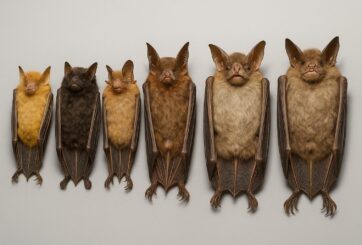
Just in time for Halloween, researchers from the Royal Ontario Museum (ROM), the Field Museum in Chicago, and Lawrence University in Wisconsin have announced the discovery of six new species of bats. These newly identified species, all found in the Philippines, belong to the group known as tube-nosed bats—a fascinating and diverse branch of the mammal family tree. Expanding the Tree of Life Formally recognized as new species through morphological and genetic analysis, this discovery expands the already impressive global…
In a recent study published today in the European Geosciences Union (EGU) journal Biogeosciences, scientists have confirmed that mercury pollution from artisanal and small-scale gold mining (ASGM) is contaminating food crops not through the soil, as previously believed, but directly from the air. Driven by the surging price of gold, which has increased by more than tenfold since 2000, the rapid expansion of unregulated mining in these regions raises urgent questions about food security, human health, and environmental justice The…
A new study from Iceland’s Surtsey island shows that birds carried most of the plants that colonised the island, challenging long-held beliefs that seed or fruit shape determines how plants spread — offering fresh insight into life’s adaptation to c When the volcanic island of Surtsey rose from the North Atlantic Ocean in 1963, it offered scientists a once-in-a-lifetime opportunity to observe how life takes hold on a brand-new and barren land. For decades, ecologists believed that plants’ ability to…
 Feedback
