



Feeding 9 Billion: Innovations in Agricultural Modeling
Satellites see through snow to steer safely across Antarctica.
Satellite images that expose perilous crevasses now reveal safe overland routes to the South Pole. Carolyn Merry of Ohio State University in Columbus has pieced together high-resolution satellite pictures that see through the snow, to map the passable Pole1.
Since a snow tractor, floundered into a hidden fissure in 1991, all supplies have been flown into the US South Pole research station. Safe transport routes might be a cheaper way to bring in bulk provisions or building materials for the new polar station currently being built.
“It would be a very good tool,” says Cecilie Rolstad of the British Antarctic Survey in Cambridge, UK. In future, polar explorers might study satellite maps before setting out, she predicts. Yawning abysses the length of a football pitch “are a real danger”, says Rolstad.
Merry used infrared images from the Landsat satellite, to pick out light and dark features on snow and ice, plus a visible light image from the SPOT satellite. She mapped routes starting at the McMurdo station, the main port into Antarctica, across the vast Ross Ice Shelf.
Like isobars on a weather map, sweeping lines and rifts on Merry’s map reveal the direction and rates that the ice is flowing and shearing. “It shows areas you should avoid,” she says.
Snow fall
“The surface was white snow for miles around; we could see no relief,” recalls tractor driver Quinton Rhoton: “Then gravity struck.”
In 1991, Rhoton and his companion were driving a snow tractor out from McMurdo dragging a sled full of explosives too dangerous to ship by air. They plummeted into a hidden crevasse. “Shattered glass from the cab window and snow streamed into the cab,” remembers Rhoton. Wedged by a V-shaped gash in the ice, 16 tonnes of cargo were left teetering on the icy lip above them.
Without handholds on the sheer walls, the two waited in the tractor for several hours before other group members hauled them out with ropes.
The crevasse was hidden under an ice bridge – undetectable to the eye – but visible in Cherry’s satellite images. The map suggests that the crevasse formed upstream of the crash site, as stresses on the ice appear insufficient at that spot. “I would have told them not to go there,” says Merry.
References




Earthquakes in the American state of Utah, the Soultz-sous-Forêts region of France or in the Dutch province of Groningen should not be able to occur even if the subsurface has been exploited for decades. This is because the shallow subsurface behaves in such a way that faults there become stronger as soon as they start moving. At least that is what geology textbooks teach us. And so, in theory, it should not be possible for earthquakes to occur. So why…
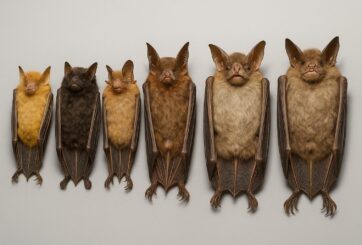
Just in time for Halloween, researchers from the Royal Ontario Museum (ROM), the Field Museum in Chicago, and Lawrence University in Wisconsin have announced the discovery of six new species of bats. These newly identified species, all found in the Philippines, belong to the group known as tube-nosed bats—a fascinating and diverse branch of the mammal family tree. Expanding the Tree of Life Formally recognized as new species through morphological and genetic analysis, this discovery expands the already impressive global…
In a recent study published today in the European Geosciences Union (EGU) journal Biogeosciences, scientists have confirmed that mercury pollution from artisanal and small-scale gold mining (ASGM) is contaminating food crops not through the soil, as previously believed, but directly from the air. Driven by the surging price of gold, which has increased by more than tenfold since 2000, the rapid expansion of unregulated mining in these regions raises urgent questions about food security, human health, and environmental justice The…
A new study from Iceland’s Surtsey island shows that birds carried most of the plants that colonised the island, challenging long-held beliefs that seed or fruit shape determines how plants spread — offering fresh insight into life’s adaptation to c When the volcanic island of Surtsey rose from the North Atlantic Ocean in 1963, it offered scientists a once-in-a-lifetime opportunity to observe how life takes hold on a brand-new and barren land. For decades, ecologists believed that plants’ ability to…
 Feedback
