



Feeding 9 Billion: Innovations in Agricultural Modeling
Leading scientists will describe how the international scientific community will work together to address the serious global threat of climate change, sea-level rise and the impact these will have on people all over the world.
Recent international reports such as the Stern Review and the Intergovernmental Panel on Climate Change emphasise the uncertainties regarding the contribution that the polar regions will make to future climate change and sea-level rise. International Polar Year 2007-2008 addresses the urgent need for a global response.
Professor Chris Rapley CBE, Director of British Antarctic Survey (BAS) is one of the architects of International Polar Year. In a video message from Antarctica he says,
'The change of phase from snow and ice to water is the biggest tipping point in the Earth's system and so, although the International Polar Year covers a huge range of science, for me the big issue is climate change and the impact that it's having here. So, over the next two years, I'm looking forward to major progress on key issues, such as 'How are the ice sheets responding?' and indeed the trillion dollar question from the point of view of sea-level rise, 'How much, how quickly?'
The UK has been a leader in polar science and exploration for more than two centuries, and is playing a major role in IPY. Some 65 UK institutions – including 40 universities, research council institutes, government departments, museums and science centres – are taking part in around 120 IPY projects.
Speakers at the UK launch event include: Lord Martin Rees, President of the Royal Society; Dr Eric Wolff, British Antarctic Survey; Dr Corinne Le Quéré, University of East Anglia; Prof Martin Siegert, University of Edinburgh; and Prof Mark Nuttall, University of Alberta, Canada.
Messages of support have come from luminaries including Sir David Attenborough, Dame Ellen MacArthur, Sir Ranulf Fiennes, Sir Menzies Campbell, MP, Sir David King, Baroness Susan Greenfield and Science & Innovation Minister Malcolm Wicks.
IPY is co-sponsored by the World Meteorological Organization (WMO) and the International Council for Science (ICSU).




Earthquakes in the American state of Utah, the Soultz-sous-Forêts region of France or in the Dutch province of Groningen should not be able to occur even if the subsurface has been exploited for decades. This is because the shallow subsurface behaves in such a way that faults there become stronger as soon as they start moving. At least that is what geology textbooks teach us. And so, in theory, it should not be possible for earthquakes to occur. So why…
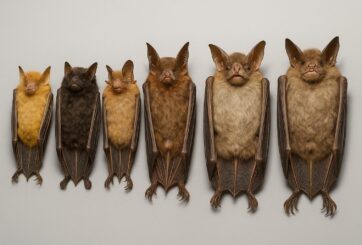
Just in time for Halloween, researchers from the Royal Ontario Museum (ROM), the Field Museum in Chicago, and Lawrence University in Wisconsin have announced the discovery of six new species of bats. These newly identified species, all found in the Philippines, belong to the group known as tube-nosed bats—a fascinating and diverse branch of the mammal family tree. Expanding the Tree of Life Formally recognized as new species through morphological and genetic analysis, this discovery expands the already impressive global…
In a recent study published today in the European Geosciences Union (EGU) journal Biogeosciences, scientists have confirmed that mercury pollution from artisanal and small-scale gold mining (ASGM) is contaminating food crops not through the soil, as previously believed, but directly from the air. Driven by the surging price of gold, which has increased by more than tenfold since 2000, the rapid expansion of unregulated mining in these regions raises urgent questions about food security, human health, and environmental justice The…
A new study from Iceland’s Surtsey island shows that birds carried most of the plants that colonised the island, challenging long-held beliefs that seed or fruit shape determines how plants spread — offering fresh insight into life’s adaptation to c When the volcanic island of Surtsey rose from the North Atlantic Ocean in 1963, it offered scientists a once-in-a-lifetime opportunity to observe how life takes hold on a brand-new and barren land. For decades, ecologists believed that plants’ ability to…
 Feedback
