



Feeding 9 Billion: Innovations in Agricultural Modeling
Their research, published in the journal, Planet Earth, reveals that CO2 can be contained in cool geological aquifers or reservoirs, where it can remain harmlessly for many thousands of years.
PhD research student, Ameena Camps, is working with Professor Mike Lovell at the University’s Department of Geology and with Chris Rochelle at BGS, investigating the storage of CO2.
Storing the gas in a solid form as a gas hydrate, or as a pool of liquid CO2 below a cap of hydrate cemented sediments, is believed to offer an alternative method of geological sequestration to the current practices of storage in warm, deep sediments in the North Sea.
Recently quoted in Planet Earth Ameena Camps explained: “Hydrates (also known as clathrates) are ice-like crystalline minerals that look like normal ice and form when gas and water freeze together at low temperature and high pressure. They are made of a cage of frozen water molecules with the gas molecules trapped inside.”
Although gas hydrates were first discovered two centuries ago, the possible use of carbon dioxide hydrate as a means to help resolve problems of global climate change, and of naturally occurring methane hydrate as a future source of energy, have only recently been suggested.
Laboratory experiments carried out as part of Ameena Camps’ PhD project have indicated that carbon dioxide hydrate should form stable structures in sediments under oceans. By employing geophysical techniques and computer modelling, Ms Camps has identified a number of sites in Western Europe with the potential to store carbon dioxide by this method.
She is also exploring further implications of her research that may benefit geologists’ understanding of the stability of deep submarine slopes and contribute to improvements in global water supplies through further understanding of desalination processes.
Professor Mike Lovell, of the University of Leicester Department of Geology commented: “Ms Camps’ work is at the forefront of gas hydrate research, and has produced some very exciting results, highlighting the importance of investment in further studies of hydrates.
“Investigations of natural methane hydrates will help our understanding of their role as a natural hazard, while carbon dioxide hydrates are a potential sink for greenhouse gas emissions. This work also has application in other fields such as space research into hydrates on other planetary bodies.”




Earthquakes in the American state of Utah, the Soultz-sous-Forêts region of France or in the Dutch province of Groningen should not be able to occur even if the subsurface has been exploited for decades. This is because the shallow subsurface behaves in such a way that faults there become stronger as soon as they start moving. At least that is what geology textbooks teach us. And so, in theory, it should not be possible for earthquakes to occur. So why…
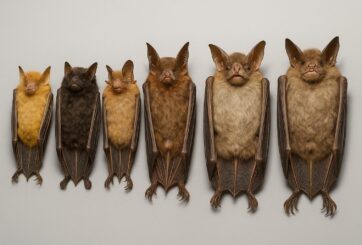
Just in time for Halloween, researchers from the Royal Ontario Museum (ROM), the Field Museum in Chicago, and Lawrence University in Wisconsin have announced the discovery of six new species of bats. These newly identified species, all found in the Philippines, belong to the group known as tube-nosed bats—a fascinating and diverse branch of the mammal family tree. Expanding the Tree of Life Formally recognized as new species through morphological and genetic analysis, this discovery expands the already impressive global…
In a recent study published today in the European Geosciences Union (EGU) journal Biogeosciences, scientists have confirmed that mercury pollution from artisanal and small-scale gold mining (ASGM) is contaminating food crops not through the soil, as previously believed, but directly from the air. Driven by the surging price of gold, which has increased by more than tenfold since 2000, the rapid expansion of unregulated mining in these regions raises urgent questions about food security, human health, and environmental justice The…
A new study from Iceland’s Surtsey island shows that birds carried most of the plants that colonised the island, challenging long-held beliefs that seed or fruit shape determines how plants spread — offering fresh insight into life’s adaptation to c When the volcanic island of Surtsey rose from the North Atlantic Ocean in 1963, it offered scientists a once-in-a-lifetime opportunity to observe how life takes hold on a brand-new and barren land. For decades, ecologists believed that plants’ ability to…
 Feedback
