



Feeding 9 Billion: Innovations in Agricultural Modeling
Volcanic regions are connected with young mountain systems that are located at the periphery of Eurasian platform. The major part of these regions lies in the territory of Russia. Volcanic regions differ not only by territory, but also by the age, activity, erupted rock and other peculiarities. The researchers mark out volcanic regions of mid-oceanic ridges, island arks, continental collision zones and intraplatform ones.
The most active are island arks volcanoes, including, the Kuriles and Kamchatka islands. These are quite young volcano regions, they are only three million years old, and the contemporary relief of the area is determined mainly by volcanoes formed within the last 40-50 thousand years. There is not a single year without an eruption taking place in the region.
This volcanic region is known for big conic volcanoes such as Klyuchevskaya Sopka, Avachinsly, and Kronotsky, which erupt hundreds of cubic kilometers of volcanic products. Klyuchevskaya Sopka’s eruption happen once in several years, but for multiple volcanoes, calm periods can last for centuries. If a volcano has not erupted in 3,000 – 3,500 years, the volcano is dead.
Volcanoes of the continental collision zone (i.e. the zone of where the Eurasian platform collides with the Arabian-African and the Indian platforms) behave more calmly. The zone stretches from the central regions of the Tibet in the east through Pyrenean peninsular in the west. The scientists distinguish two branches: the Asian and the Anatolian-European ones.
The Asian branch combines volcanoes allocated inside the Asian continent, in the zone of collision between the Indian and the Arabic platforms. The larger volcanoes include Elbruz, Demavend, Sahand and Bazman. Volcanoes of this type erupt occasionally, with periods of calm lasting from several thousands of years to dozens of thousands of years.
Volcanoes of Anatolian-Balkan branches stretch along the northern coast of the Mediterranean Sea. In this region, there are both lava table lands and big volcanoes, among which are also infamous Santorin and Vesuvius volcanoes. Among intraplate volcanic zones, volcanoes of Eastern and Central Asia draw attention. These areas are predominated by lava dome folds and table lands that appear in case of interstitial lava flow. Low volcanic activity also takes place in Chukotka.
Two transcontinental submeridional rift zones are singled out by the scientists into a special group of intraplatform volcanic regions. One of them crosses Central Europe and Mediterranean, and goes off to the territory of North-Western Africa down to Gulf of Guinea. The other zone can be tracked from the Caucasus foothills (the region of Mineralnye Vody) through Tanzania. Both zones retain volcanic activity particularly at the intersections with the continental collision zones. Etna, Vesuvius, Tendurek, Nemrut, Elbruz and Kazbek volcanoes erupted back in historic times.




Earthquakes in the American state of Utah, the Soultz-sous-Forêts region of France or in the Dutch province of Groningen should not be able to occur even if the subsurface has been exploited for decades. This is because the shallow subsurface behaves in such a way that faults there become stronger as soon as they start moving. At least that is what geology textbooks teach us. And so, in theory, it should not be possible for earthquakes to occur. So why…
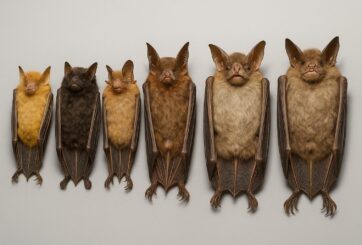
Just in time for Halloween, researchers from the Royal Ontario Museum (ROM), the Field Museum in Chicago, and Lawrence University in Wisconsin have announced the discovery of six new species of bats. These newly identified species, all found in the Philippines, belong to the group known as tube-nosed bats—a fascinating and diverse branch of the mammal family tree. Expanding the Tree of Life Formally recognized as new species through morphological and genetic analysis, this discovery expands the already impressive global…
In a recent study published today in the European Geosciences Union (EGU) journal Biogeosciences, scientists have confirmed that mercury pollution from artisanal and small-scale gold mining (ASGM) is contaminating food crops not through the soil, as previously believed, but directly from the air. Driven by the surging price of gold, which has increased by more than tenfold since 2000, the rapid expansion of unregulated mining in these regions raises urgent questions about food security, human health, and environmental justice The…
A new study from Iceland’s Surtsey island shows that birds carried most of the plants that colonised the island, challenging long-held beliefs that seed or fruit shape determines how plants spread — offering fresh insight into life’s adaptation to c When the volcanic island of Surtsey rose from the North Atlantic Ocean in 1963, it offered scientists a once-in-a-lifetime opportunity to observe how life takes hold on a brand-new and barren land. For decades, ecologists believed that plants’ ability to…
 Feedback
