



Feeding 9 Billion: Innovations in Agricultural Modeling
A decade ago, Shuhai Xiao, associate professor of geosciences at Virginia Tech, and his colleagues discovered thousands of 600-million-year-old embryo microfossils in the Doushantuo Formation, a fossil site near Weng'an, South China. In 2000, Xiao's team reported the discovery of a tubular coral-like animal that might be a candidate for parenthood.
In the February issue of Geology, the journal of the Geological Society of America, Xiao will report discoveries about the intermediary stage that links the embryo to the adult. (Cover story “Rare helical spheroidal fossils from the Doushantuo Lagerstatte: Ediacaran animal embryos come of age?” by Xiao, James W. Hagadorn of Amherst, and Chuanming Zhou and Xunlai Yuan of Nanjing Institute of Geology and Paleontology.)
While there are thousands of early-stage embryos, there are only 80 have been recovered that have advanced to an intermediary stage of development. The intermediary stage embryos have an envelope similar to that of earlier embryonic stage, and they have a coiled tubular embryo within the envelope. Their envelope has a groove on the surface, consisting of three clockwise coils. Using microfocus X-ray computed tomography (microCT) imaging, the scientists virtually peeled off the envelope and exposed the embryo inside. The tubular embryo is also coiled, with three clockwise coils. In some specimens, the scientists found signs of uncoiling. “This is further evidence that these embryos would have grown into the tubular organisms,” Xiao said.
In the article, the researchers state, “… if this possibility holds up to further testing, the new fossils may bridge the developmental gap between two previously described Doushantuo forms.”
“The discovery of additional intermediary stages and even more advanced specimens would be the ultimate test,” Xiao said. But the conditions that preserved the ancient embryos may not have been favorable for preserving or fossilizing more developed life forms, the researchers note. Connecting the first moments of animal evolution will likely require more use of advanced imaging techniques.




Earthquakes in the American state of Utah, the Soultz-sous-Forêts region of France or in the Dutch province of Groningen should not be able to occur even if the subsurface has been exploited for decades. This is because the shallow subsurface behaves in such a way that faults there become stronger as soon as they start moving. At least that is what geology textbooks teach us. And so, in theory, it should not be possible for earthquakes to occur. So why…
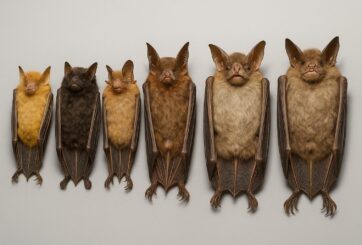
Just in time for Halloween, researchers from the Royal Ontario Museum (ROM), the Field Museum in Chicago, and Lawrence University in Wisconsin have announced the discovery of six new species of bats. These newly identified species, all found in the Philippines, belong to the group known as tube-nosed bats—a fascinating and diverse branch of the mammal family tree. Expanding the Tree of Life Formally recognized as new species through morphological and genetic analysis, this discovery expands the already impressive global…
In a recent study published today in the European Geosciences Union (EGU) journal Biogeosciences, scientists have confirmed that mercury pollution from artisanal and small-scale gold mining (ASGM) is contaminating food crops not through the soil, as previously believed, but directly from the air. Driven by the surging price of gold, which has increased by more than tenfold since 2000, the rapid expansion of unregulated mining in these regions raises urgent questions about food security, human health, and environmental justice The…
A new study from Iceland’s Surtsey island shows that birds carried most of the plants that colonised the island, challenging long-held beliefs that seed or fruit shape determines how plants spread — offering fresh insight into life’s adaptation to c When the volcanic island of Surtsey rose from the North Atlantic Ocean in 1963, it offered scientists a once-in-a-lifetime opportunity to observe how life takes hold on a brand-new and barren land. For decades, ecologists believed that plants’ ability to…
 Feedback
