



Feeding 9 Billion: Innovations in Agricultural Modeling
The world`s oldest fossilised vomit, believed to have come from a large marine reptile that lived 160 million years ago, has been discovered in a clay quarry in Peterborough by the University of Greenwich`s Professor Peter Doyle and Dr Jason Wood of the Open University.
The vomit contains the remains of dozens of belemnites – squid-like shellfish that lived in abundance in the seas around what is now Britain. The belemnites were eaten in great numbers by ichthyosaurs, large marine reptiles (related to land-dwelling dinosaurs) common in the warm seas of the Jurassic era, similar in size and shape to dolphins.
Having eaten dozens of belemnites, an ichthyosaur would regurgitate their indigestible bullet shaped shells in much the same way that an owl does after eating a mouse whole. It is these shells that have been discovered in the fossil vomit.
“We believe that this is the first time the existence of fossil vomit on a grand scale has been proven beyond reasonable doubt,” says geologist Professor Doyle. “The Peterborough belemnite shells, viewed under a powerful scanning electron microscope, have revealed `acid etching` marks caused by digestive fluids from the gut of a marine reptile, proving that the belemnites had been eaten by a predator. The fact that most of these belemnites were juveniles reinforces our view that they did not die of old age.”
“It is highly unlikely that these shells passed through the ichthyosaur`s intestines and were excreted as droppings, as they would have damaged the soft tissue of the reptile`s internal organs,” continued Professor Doyle. “The only alternative is that the shells were vomited out, in much the same way that modern-day sperm whales regurgitate the indigestible beaks of squid they have eaten.”




Earthquakes in the American state of Utah, the Soultz-sous-Forêts region of France or in the Dutch province of Groningen should not be able to occur even if the subsurface has been exploited for decades. This is because the shallow subsurface behaves in such a way that faults there become stronger as soon as they start moving. At least that is what geology textbooks teach us. And so, in theory, it should not be possible for earthquakes to occur. So why…
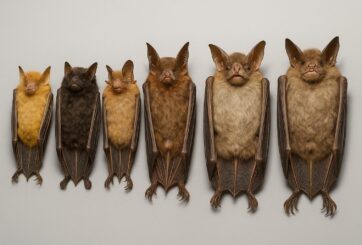
Just in time for Halloween, researchers from the Royal Ontario Museum (ROM), the Field Museum in Chicago, and Lawrence University in Wisconsin have announced the discovery of six new species of bats. These newly identified species, all found in the Philippines, belong to the group known as tube-nosed bats—a fascinating and diverse branch of the mammal family tree. Expanding the Tree of Life Formally recognized as new species through morphological and genetic analysis, this discovery expands the already impressive global…
In a recent study published today in the European Geosciences Union (EGU) journal Biogeosciences, scientists have confirmed that mercury pollution from artisanal and small-scale gold mining (ASGM) is contaminating food crops not through the soil, as previously believed, but directly from the air. Driven by the surging price of gold, which has increased by more than tenfold since 2000, the rapid expansion of unregulated mining in these regions raises urgent questions about food security, human health, and environmental justice The…
A new study from Iceland’s Surtsey island shows that birds carried most of the plants that colonised the island, challenging long-held beliefs that seed or fruit shape determines how plants spread — offering fresh insight into life’s adaptation to c When the volcanic island of Surtsey rose from the North Atlantic Ocean in 1963, it offered scientists a once-in-a-lifetime opportunity to observe how life takes hold on a brand-new and barren land. For decades, ecologists believed that plants’ ability to…
 Feedback
